







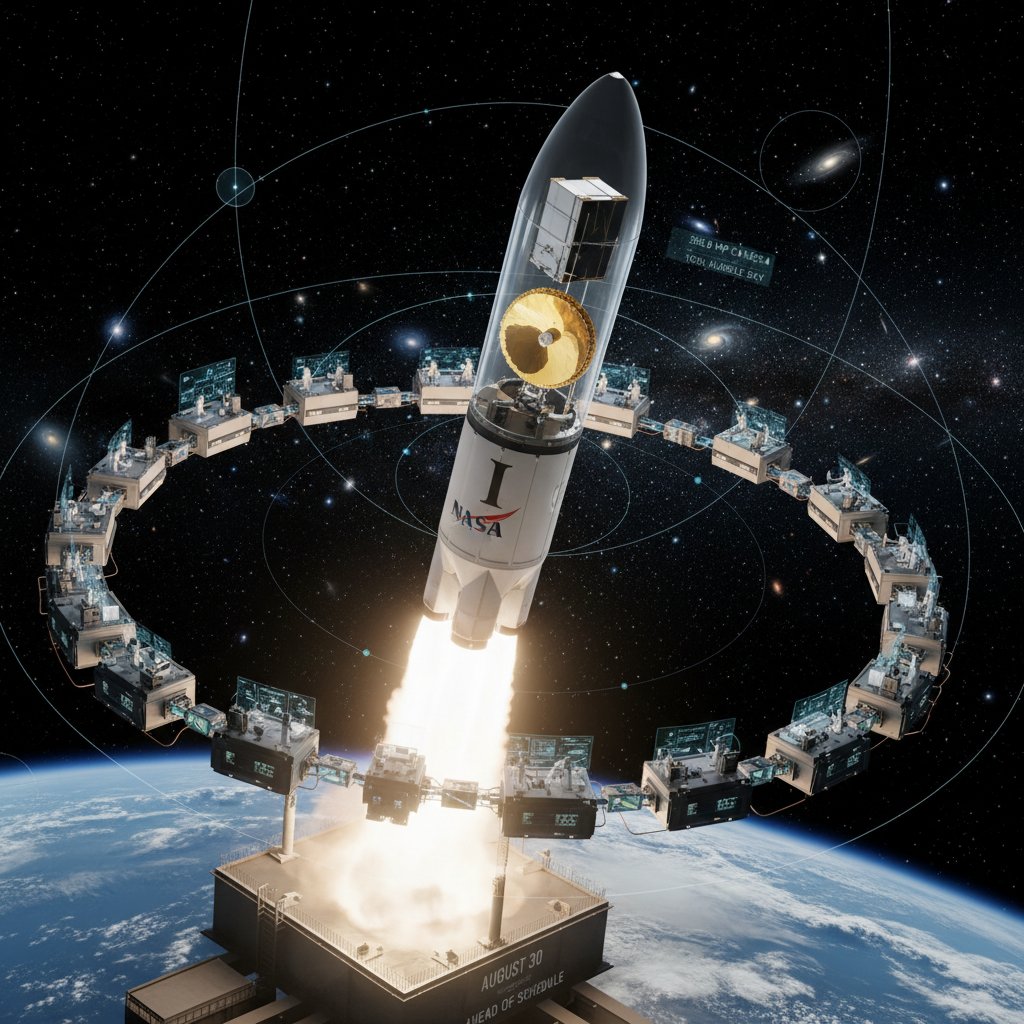
Imagine being able to read an entire library in the time it once took to finish a single book. That’s the scale of the leap NASA’s Nancy Grace Roman Space Telescope is about to deliver. When it launches on August 30 — eight months ahead of its original schedule — it will carry a 300.8-megapixel camera that can capture 100 times more sky in one shot than the Hubble Space Telescope. For anyone who has ever stared up at the night sky and wondered what lies beyond, this means the universe is about to open up like never before.
But why should you care? Because Roman won’t just take pretty pictures. It will map the distribution of dark energy, count the number of rogue planets wandering between stars, and gaze back to the earliest epochs of galaxy formation. Every citizen scientist, every amateur astronomer, and every curious mind will benefit from Roman’s data, which will be publicly released as it’s gathered. This is not a telescope for a select few; it’s a telescope for all of us.
A Cosmic Revolution Begins Early
Originally planned for a 2027 launch, the Roman Space Telescope was already ahead of schedule when NASA announced it would launch on August 30, 2026 — a full eight months faster than the revised timeline. The project, formerly known as WFIRST (Wide Field Infrared Survey Telescope), was renamed in 2020 after NASA’s first chief astronomer, Nancy Grace Roman, the “Mother of Hubble.” Her legacy of pushing the boundaries of space observatories now gets a new chapter.
“Moving the launch date earlier is a testament to the dedication of the team and the robustness of the design,” said Dr. Sarah Kendrew, Roman’s project scientist at NASA’s Goddard Space Flight Center. “We’ve found efficiencies in integration and testing that allowed us to compress the schedule without compromising safety or performance.” The telescope will be launched aboard a SpaceX Falcon Heavy rocket from Kennedy Space Center in Florida, heading for the Sun–Earth L2 Lagrange point, about 1.5 million kilometers from Earth.
That location, shared by the James Webb Space Telescope, gives Roman a stable, cold environment ideal for infrared observations. And unlike Webb, which peers at tiny patches of the earliest universe, Roman is built for speed and breadth.
The Camera That Sees a Hundred Sunsets
The heart of Roman is its Wide Field Instrument, a 300.8-megapixel camera that operates in near-infrared wavelengths. To understand what “100 times more sky” means, consider Hubble’s best wide-field camera: it can image an area of sky about the size of a grain of sand held at arm’s length. Roman’s instrument covers an area the size of the full Moon.
“Every time Hubble takes a deep-field image, it spends days staring at a tiny spot. Roman can do the same science in a single pointing, covering the equivalent area of 100 Hubble fields,” explained Dr. Jason Tumlinson, an astronomer at the Space Telescope Science Institute. “It’s like upgrading from a pinhole camera to a panoramic lens. The statistical power is enormous.”
That power will be deployed in several major surveys. The High Latitude Wide Area Survey will map tens of thousands of square degrees of sky. The Galactic Bulge Time Domain Survey will monitor the dense center of the Milky Way for microlensing events — tiny brightenings caused by planets or stars passing in front of background stars. And the Coronagraph Instrument, a technology demonstrator, will directly image exoplanets by blocking out the light of their host stars, a feat that is currently only possible for the largest, most distant worlds.
What This Means for Dark Energy and Exoplanets
Two of the biggest questions in modern astrophysics are: What is dark energy, and are we alone in the galaxy? Roman is designed to tackle both. By measuring the shapes and redshifts of millions of galaxies, it will map the distribution of matter and the expansion history of the universe over the last 10 billion years. This will give the most precise constraints yet on dark energy — the mysterious force driving cosmic acceleration.
On the exoplanet front, Roman will use microlensing to find thousands of worlds, many of them free-floating planets that wander the galaxy without a sun. Such planets are nearly invisible to other methods, but Roman can detect them by the way their gravity briefly magnifies the light of a background star. Expect a catalog of rogue planets that will change our understanding of planetary system formation.
“Roman will discover more exoplanets than all previous telescopes combined,” said Dr. Emily Gilbert, an exoplanet scientist at NASA’s Jet Propulsion Laboratory. “And because it observes in the infrared, it can see cool, low-mass planets that might be Earth-like in temperature. It’s our best chance before the next generation of observatories to find a true Earth twin.”
Even planets that orbit stars far from Earth will be studied. Roman’s microlensing survey will also measure the mass function of planets down to Mars size, providing a statistical census of worlds across the galaxy.
A New Era of Discovery
Roman’s eight-month head start means that data will begin flowing to Earth even sooner than expected. The first images are anticipated within months of launch, and after a brief commissioning period, the surveys will begin. Anyone with an internet connection will be able to access the raw data and contribute to discoveries. NASA has a strong tradition of citizen science, and Roman’s massive datasets will invite participation from astronomers of all levels.
Looking forward, Roman’s early arrival could also help coordinate observations with other facilities. For example, when Vera C. Rubin Observatory in Chile begins its Legacy Survey of Space and Time later this decade, Roman can follow up on interesting transient sources in real time. The synergy between these two wide-field powerhouses will be unprecedented.
“We are entering a golden age of survey astronomy,” said Tumlinson. “Roman, Rubin, and later the European Euclid mission will together map the universe in three dimensions, in multiple wavelengths, over huge areas. The next five years will transform our view of the cosmos completely.”
For the average reader, this means that the universe is about to become more accessible, more colorful, and more comprehensible than ever before. The August 30 launch is not just a milestone — it’s the starting gun for a decade of discovery that will reshape our place in the cosmos. Whether you’re a professional astronomer or someone who just likes to look up, the Roman Space Telescope is yours.