






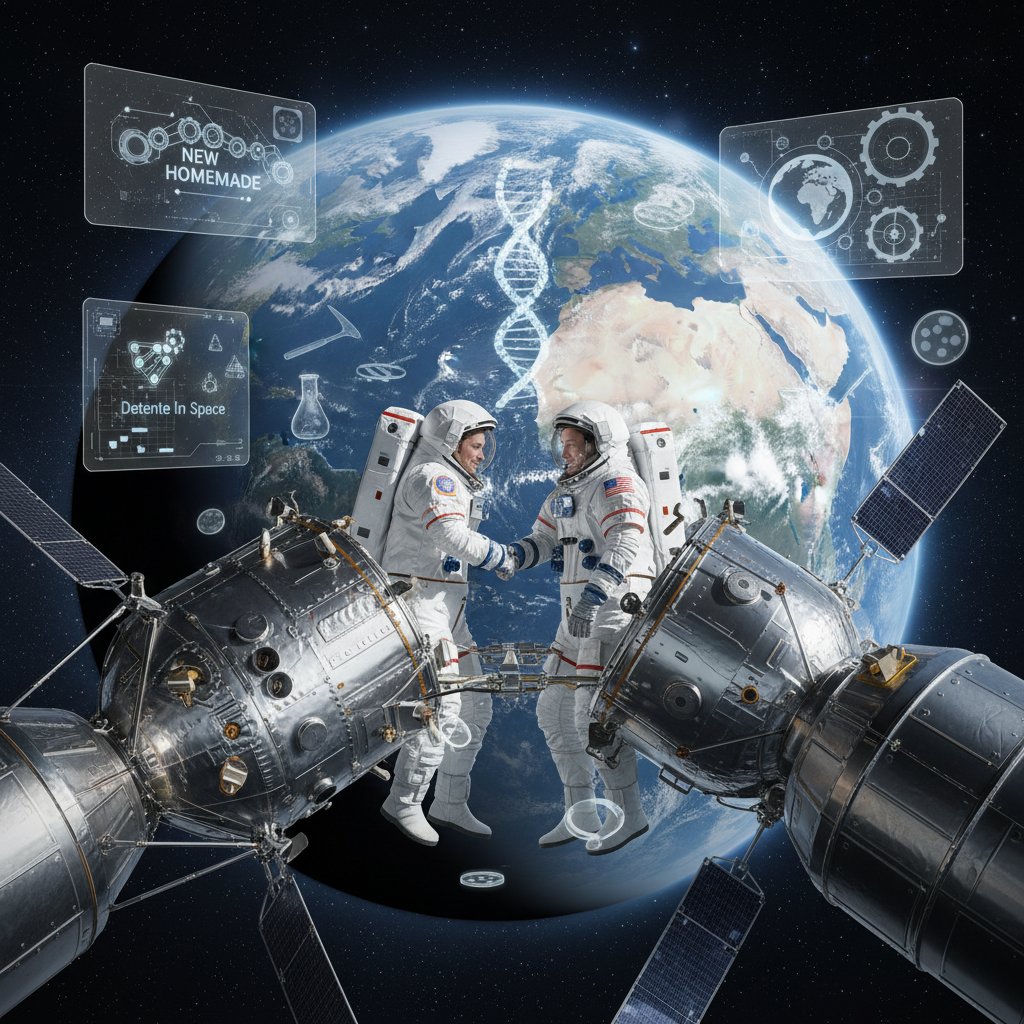
It was July 17, 1975, 164 nautical miles above the Earth. A Soviet Soyuz capsule and an American Apollo spacecraft, after years of separate trajectories, finally came together in a docking port designed to bridge two worlds. The hatch opened, and cosmonaut Alexei Leonov reached out his hand to astronaut Thomas Stafford. That single handshake, broadcast live to millions, was more than a technical achievement—it was a crack in the Iron Curtain, a moment of détente suspended in the vacuum of space.
Now, nearly half a century later, a new homemade documentary is giving that story the intimate, ground-level treatment it deserves. Titled Apollo-Soyuz: Détente in Space, the film was produced independently by filmmaker and space enthusiast James Kowalski over six years, using restored archival footage, declassified Soviet tapes, and fresh interviews with family members of the original crews. While major studios have long neglected this mission in favor of the Apollo moon landings, Kowalski’s grassroots effort is resurrecting a pivotal chapter in Cold War history—and reminding us that international cooperation in space was once a radical act of hope.
A Handshake That Changed History
The Apollo-Soyuz Test Project (ASTP) was born from a 1972 agreement between U.S. President Richard Nixon and Soviet Premier Leonid Brezhnev. The goal was simple: prove that two ideologically opposed superpowers could work together in orbit. The technical challenges were immense. The two spacecraft used different atmospheres (one pure oxygen, one nitrogen-oxygen mix), different docking mechanisms, and different languages. Engineers on both sides spent months designing a universal docking module and training crews in each other’s procedures.
“The political symbolism was enormous, but so were the technical hurdles,” says Dr. Sarah Thompson, a space historian at the Smithsonian National Air and Space Museum. “What Kowalski’s documentary captures so well is the human dimension—the translators struggling with acronyms, the engineers who became friends over shared meals, the awkward but genuine camaraderie.”
The mission itself lasted nine days. After docking, Stafford and Leonov conducted joint experiments, visited each other’s modules, and shared a famous meal of borscht and freeze-dried ice cream. The handshake—captured in a now-iconic photograph—became a symbol of what was possible when politics took a backseat to science.
Behind the Scenes of a Homemade Production
Kowalski, a former NASA contractor turned independent filmmaker, says he was frustrated by how quickly Apollo-Soyuz had been forgotten. “Everyone knows the moon landing. Fewer people know about the first handshake in space,” he told QuasarPost in an interview. “I wanted to tell the story from the inside out—not as a dry history lesson, but as a lived experience.”
Working with a budget of just $120,000, Kowalski pieced together the film from unexpected sources. He secured rare Soviet training footage from a retired engineer in Moscow, unearthed home movies shot by the Apollo crew’s families, and recorded hours of original interviews with surviving family members and ground controllers. The film’s score, composed by a local musician, blends analog synthesizers with Russian folk instruments—a sonic echo of the mission’s hybrid nature.
The documentary premiered this month at a small film festival in Houston, Texas, and has since been picked up by several streaming services. It has already garnered praise from space historians for its nuanced portrayal of the era. “Kowalski doesn’t shy away from the tensions,” notes Dr. Mikhail Petrov, a former Russian space agency advisor and author of Cosmos and Compromise. “He shows that behind the smiling handshake, there were still deep suspicions. But he also shows that personal relationships can transcend political systems. That’s a lesson we desperately need today.”
The Legacy of Détente in Space
Apollo-Soyuz did not immediately end the space race. The U.S. pivoted to the Space Shuttle, while the Soviet Union pursued its Salyut and Mir space stations. But the mission laid the groundwork for every subsequent international partnership in space—from the Shuttle-Mir program in the 1990s to the International Space Station (ISS), which has hosted astronauts from 19 countries continuously since 2000.
“Détente is often dismissed as a temporary thaw in a long winter,” says Dr. Thompson. “But in space, that thaw created a permanent shift. Without Apollo-Soyuz, there would be no ISS. Without the ISS, there would be no blueprint for the Gateway station or the joint Artemis lunar expeditions.”
The documentary highlights how the mission’s legacy is still alive today—but also fragile. Geopolitical tensions between the U.S. and Russia have risen sharply since 2014, threatening cooperative programs like the ISS. In 2022, Russian space chief Dmitry Rogozin made veiled threats about abandoning the station. While the partnership has endured, it has frayed.
Why This Documentary Matters Now
Kowalski’s film arrives at a moment when space cooperation is both more necessary and more precarious than ever. The Artemis Accords, signed by 30 nations, aim to return humans to the Moon and eventually reach Mars—but Russia and China have not signed, and are developing their own lunar infrastructure. Meanwhile, private companies like SpaceX and Blue Origin are reshaping the landscape.
“If we forget how we managed to cooperate during the Cold War—when the stakes were nuclear annihilation—we risk losing the tools for cooperation in a new era of competition,” Kowalski says in the film. “Apollo-Soyuz wasn’t a fairy tale. It was hard work. And it’s work we need to be doing again.”
The documentary ends not with the handshake, but with a quiet moment from 2022: a retired Leonov (who died in 2019) and Stafford, now in their 80s, looking at a photograph of their younger selves. Stafford had visited Leonov in Moscow just a year before the cosmonaut’s death. The two men embraced, exchanged gifts, and spoke of the peace they had helped build—a peace that, like their docking mechanism, was designed to hold.
As the film gains wider release—coming to major streaming platforms in March 2025—Kowalski hopes it sparks a conversation about what détente in space could look like in the 21st century. With the ISS approaching its planned retirement in 2031, and with China’s Tiangong station now operational, the next generation of space diplomats will need to rediscover the lessons of 1975. Apollo-Soyuz: Détente in Space offers a vivid reminder that the first step is always a handshake.