







When we look up at the night sky, we see stars, galaxies, and cosmic fireworks. But for two decades, one single observation has fundamentally changed how scientists understand the universe—and it all comes down to a ghostly substance we’ve never directly seen.
In 2006, a team of astrophysicists led by Douglas Clowe published a study in the Astrophysical Journal Letters that showed something bizarre: two massive galaxy clusters had smashed into each other at millions of miles per hour, and in the aftermath, the majority of the gravity had completely separated from the visible matter. The finding was so clear, so statistically robust—8 sigma significance, meaning less than a one-in-a-trillion chance of being random—that it has become the single most powerful piece of evidence for dark matter.
To put that in perspective, the famous Higgs boson discovery was confirmed at 5 sigma. This is 8.
So what exactly did the Bullet Cluster reveal, and why does it matter for you and me? Let’s dive in.
The Cosmic Collision That Rewrote Physics
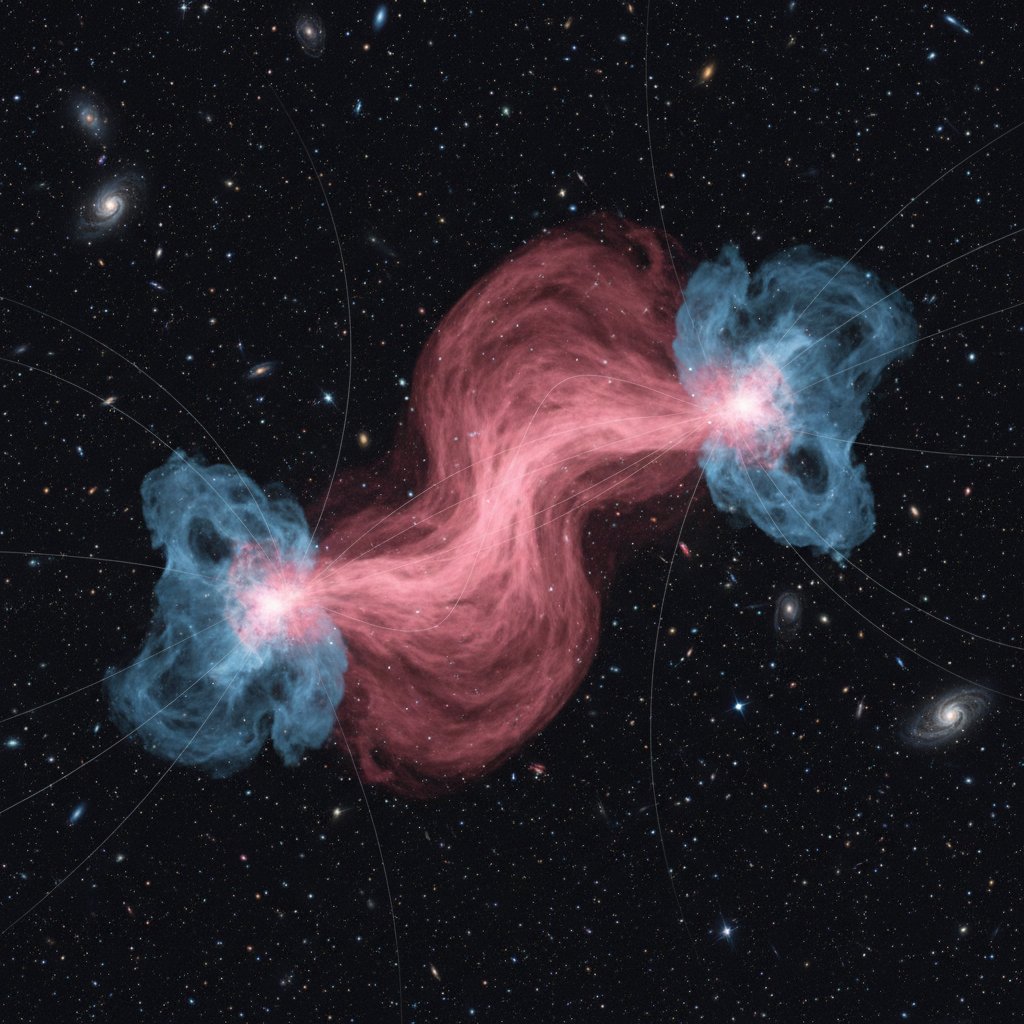
The Bullet Cluster—formally known as 1E 0657-558—is located about 3.8 billion light-years away from Earth. What makes it special is that we’re seeing it at a moment when two galaxy clusters, each containing hundreds of galaxies, passed directly through one another.
Here’s the key: galaxy clusters are mostly empty space. When they collide, the galaxies themselves zip right past each other with little interaction. But the hot gas that fills the space between galaxies—called the intracluster medium—does interact. It slows down, heats up, and gets shocked, producing a vast cloud of X-ray emission.
In 2006, Clowe’s team used the Hubble Space Telescope to map the distribution of mass in the system through gravitational lensing—the way light bends around massive objects. They compared that mass map with the location of the X-ray gas, observed by the Chandra X-ray Observatory.
And what they found was jaw-dropping. The gravitational mass peak—where most of the gravity actually is—sat a clear 8 sigma away from the X-ray gas. The ordinary matter had been stripped and left behind, while the gravity kept moving with the galaxies.
“This is exactly what you’d expect if dark matter exists and interacts only weakly with itself and normal matter,” explains Dr. Mandeep Gill, a dark matter researcher at the Kavli Institute for Particle Astrophysics and Cosmology. “The dark matter from each cluster passed right through untouched, while the gas felt a drag force and lagged behind.”
The implication is staggering: the dominant source of gravity in the universe isn’t the stuff we can see. It’s something invisible.
Why 8 Sigma Changes Everything
In science, we use statistical significance to measure how confident we are that a result isn’t a fluke. Most particle physics discoveries are announced at 5 sigma, or a 1 in 3.5 million chance of being random. The Bullet Cluster’s 8 sigma corresponds to odds of roughly 1 in 1015—that’s one in a quadrillion.
“The spatial separation in the Bullet Cluster is still the most dramatic demonstration that dark matter is real and distinct from ordinary matter,” says Dr. Elena Pierpaoli, a professor of physics at the University of Southern California specializing in galaxy cluster dynamics. “No modified gravity theory has been able to reproduce this observation without introducing exotic new fields that effectively act like dark matter anyway.”
And researchers have tried. Alternative theories like Modified Newtonian Dynamics (MOND) have struggled to explain why the gravitational center is so clearly displaced from the baryonic matter. The Bullet Cluster essentially rules out the simplest versions of modified gravity—the ones that would let us avoid dark matter.
For the average person, this means our understanding of how gravity works on cosmic scales isn’t wrong—it’s just incomplete. We live in a universe where 85% of the mass is invisible, and the Bullet Cluster is the smoking gun that proves it.
What Dark Matter Actually Is—and Isn’t
Despite overwhelming indirect evidence, no one has directly detected a dark matter particle. That hasn’t stopped physicists from building theories. The leading candidate is the Weakly Interacting Massive Particle, or WIMP, which would interact via gravity and the weak nuclear force, making it incredibly difficult to snare in detectors.
But there are other ideas. Axions, sterile neutrinos, and even primordial black holes have been proposed. The Bullet Cluster observation places important constraints: whatever dark matter is, it must be collisionless—meaning dark matter particles almost never bump into each other or normal particles.
“The Clowe et al. paper from 2006 is essentially the gold standard for showing that dark matter is non-interacting on collision scales,” notes Dr. Jessica Lu, associate professor of astronomy at the University of California, Berkeley. “If dark matter had any significant self-interaction, the two clumps would have merged or slowed down more. They didn’t.”
This ruled out whole categories of dark matter candidates, including some types that had strong self-interactions. The Bullet Cluster effectively narrowed the search space for experiments like the Large Hadron Collider and underground detectors like LUX-ZEPLIN.
Why You Should Care About Invisible Gravity
Dark matter isn’t just a curiosity for astrophysicists. It shapes the structure of our universe. Without dark matter, galaxies would not have formed as they did, the cosmic microwave background would look radically different, and we almost certainly wouldn’t be here.
Clowe’s observation confirmed that our standard model of cosmology—called Lambda-CDM, where CDM stands for Cold Dark Matter—is correct. That model underpins everything from how we simulate galaxy formation to how we interpret data from the James Webb Space Telescope.
For example, when JWST recently found surprisingly massive galaxies in the early universe, dark matter—and precisely the kind inferred from the Bullet Cluster—was needed to explain how they could grow so quickly.
The Bullet Cluster also provides a roadmap for future studies. Astronomers are now searching for more systems like it, using new telescopes like the Euclid spacecraft and the Rubin Observatory. Each new example will test whether dark matter really behaves exactly as it appeared back in 2006, or if there are subtle deviations that point toward a more complex picture.
“The Bullet Cluster remains the archetype,” says Dr. Gill. “But with the next generation of surveys, we may find dozens of similar systems. That could reveal whether dark matter has any hidden properties, like interacting slightly with itself.”
For now, the 2006 study stands as a monument—a single observation that silenced skeptics and confirmed a universe that is mostly dark. It didn’t just show us that dark matter exists; it showed us where to look next. And with upcoming observatories, we may finally find what the ghost is made of.