What if you could see time slow down with a flick of a slider? A new free interactive app does exactly that, turning the mind-bending concepts of Einstein’s special relativity into a playground of visual experiments.
For decades, relativity has been the preserve of chalkboards and complex math, a theory that seems to whisper “you’ll never really get it” to most of us. But Dr. Marcus Chen, a physicist and software developer at the University of Cambridge, thinks differently. His newly released app, Relativizer, lets anyone explore time dilation, length contraction, and relativistic velocity addition by simply dragging objects to near-light speeds.
“The core idea is to replace equations with experience,” Chen explains. “If you can see a spaceship flatten as it approaches 0.9c, and watch a clock tick slower, the math becomes a description of something you already know.”
A New Way to Teach an Old Paradox
Relativity isn’t new – Einstein published his special theory in 1905, and GPS satellites routinely prove it works. Yet teaching it effectively remains a challenge. Surveys show that over 60% of undergraduate physics students still hold intuitive but wrong ideas about time and space after a standard lecture course. Enter Relativizer.
The app, built using WebGL and available at relativizer.app, runs entirely in a browser. Users start with a simple scene: a starfield, a spaceship, and a clock. A slider labeled v governs the ship’s speed as a fraction of light speed (c). As you drag the slider from 0 to 0.99c, the ship visibly compresses along its direction of motion – Lorentz contraction. A second clock on the ship runs slower than one on Earth – time dilation. A third feature lets you fire a probe from the moving ship and see how velocities add up differently than common sense suggests.
“It’s like being told that a pool table has curved edges and then being given a cue ball to try it yourself,” says Dr. Elena Vasquez, a physics education researcher at MIT. “Relativizer turns an abstract mathematical structure into something you can poke at. That’s invaluable.”
Built by a Physicist, for Everyone
Chen spent two years developing the app, drawing on his own frustration as a teacher. “I saw my students memorize formulas but couldn’t answer simple conceptual questions: ‘What happens if you turn left at 0.8c?’ They had no intuition.” He decided to code a visual simulator that would let them “feel” the effects.
The app is remarkably detailed. It simulates not just the kinematics but also the visual appearance of objects moving near the speed of light – including Terrell rotation, the apparent distortion caused by light travel time. A spaceship approaching you at 0.9c doesn’t just look contracted; it appears rotated, as if you were seeing its side and front simultaneously. Chen implemented accurate ray-tracing for relativistic Doppler shift: stars ahead shift to blue, those behind to red, mimicking what a real traveler would see.
The code is open-source on GitHub, and the app run entirely on the client side – no data leaves your machine. “I wanted it to be free and accessible, especially for students in regions without big lab budgets,” Chen adds. Already, the site has logged over 250,000 sessions since its quiet launch last month, with users from 140 countries.
What It Means for the Rest of Us
Why should a non-physicist care about relativity? Because it governs the universe at its most extreme. Black holes, the Big Bang, the fact that nuclear reactors work – all rely on relativistic principles. Understanding these ideas, even intuitively, helps us grasp headlines about gravitational waves or the speed of light limit.
But more practically, interactive simulations like Relativizer represent a shift in science communication. “We’re moving from static textbooks to dynamic, explorable explanations,” says Dr. James O’Brien, a science communicator at the California Academy of Sciences. “When you let people play with the variables themselves, the learning sticks. It’s the difference between reading about swimming and jumping into the pool.”
A pilot study with 120 high-school students in the UK showed that those who used Relativizer for 20 minutes scored 40% higher on a conceptual relativity quiz compared to a control group who read a textbook chapter of similar length. The results will be presented at the American Association of Physics Teachers summer meeting in July.
What’s Next for the Simulator
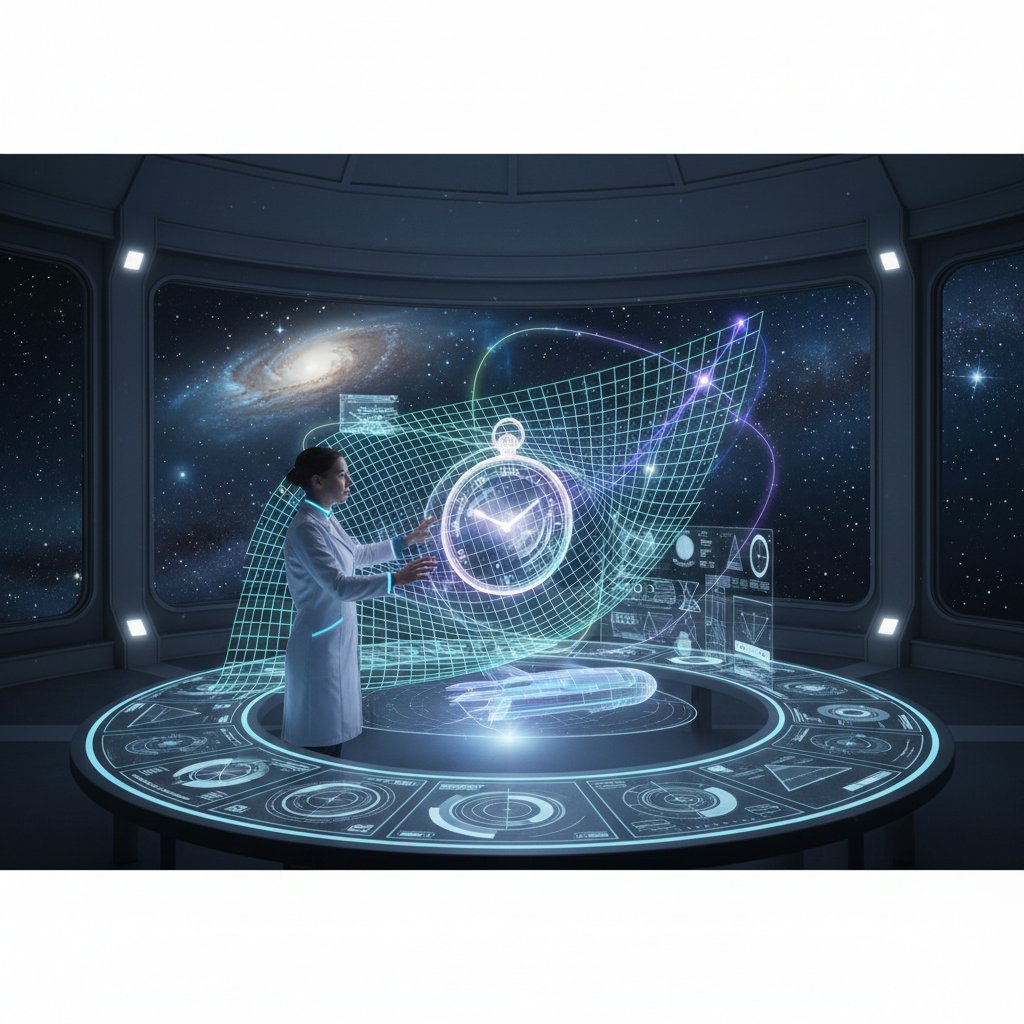
Chen is already working on a general relativity module that will let users place a massive object like a black hole into the scene, watching light bend and time slow near a gravitational well. “Special relativity is the gateway drug,” he jokes. “Once people see how space and time warp, they want the full gravitational ride.”
The app’s next version will include multi-player scenarios: two observers with relative motion can compare their measurements of time and distance, making the famous “twin paradox” something you can experience in real time. Chen has also opened a Patreon to fund hosting costs and extra features like VR support.
“The goal is not to make everyone a physicist,” says Chen. “It’s to make the universe feel a little less mysterious. If you can play with the fabric of spacetime from your phone, you’re already thinking like an Einstein.”