





“I’ve been imaging the Sun for over a decade, but I’ve never seen anything quite like this. It just kept growing, pixel by pixel, until it dwarfed everything else on the solar limb.” – Mark Williams, award-winning astrophotographer based in Arizona.
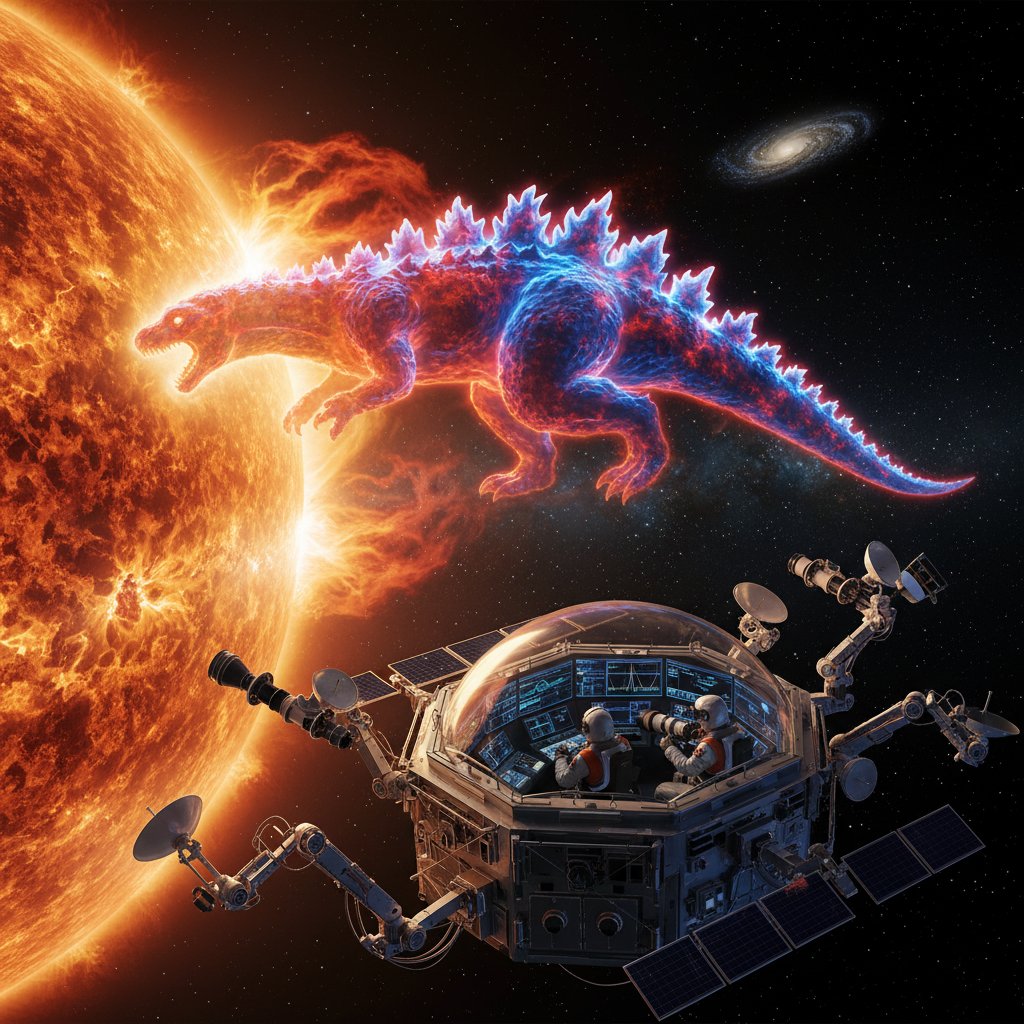
The image is unmistakable: a towering, coiled mass of superheated plasma, its shape vaguely reptilian, clinging to the edge of the Sun like a mythical beast. Astrophotographer Mark Williams captured the phenomenon on the morning of March 14, 2025, using a specialized hydrogen-alpha solar telescope from his backyard observatory in Tucson. He immediately nicknamed it the “Godzilla prominence”, and the name has since spread across astronomy forums and social media.
The structure, a type of solar prominence, measured an estimated 160,000 kilometers (100,000 miles) from base to tip – roughly 12 times the diameter of Earth. Videos released by Williams show the plasma cloud writhing and shifting over a period of four hours before it eventually detached and erupted into space.
Solar prominences are not uncommon, but this one stands out for its sheer size and bizarre morphology. “Prominences come in all shapes – loops, arches, tornadoes – but a form that resembles a bipedal creature, seen from our angle, is exceptionally rare,” says Dr. Rebecca Ingram, a solar physicist at the University of Glasgow who analyzed Williams’ footage.
The Godzilla Prominence: A Spectacle in H-alpha
Williams captured the prominence using a Coronado SolarMax III 90mm hydrogen-alpha telescope, which isolates the specific red light emitted by hydrogen atoms at 656.28 nanometers. This wavelength reveals the chromosphere and the delicate structure of prominences – clouds of cooler plasma that float above the Sun’s visible surface, held aloft by magnetic fields.
“The detail in the footage is remarkable,” Williams explains. “You can see individual strands of plasma twisting like serpents, and at the ‘head’ of the Godzilla shape, there was a bright knot that pulsed with activity.” The video, which he posted on his YouTube channel, has garnered over 2 million views in just two days.
Prominences of this scale are typically visible only during solar maximum, the peak of the Sun’s 11-year activity cycle. We are currently deep in Solar Cycle 25, which has been far more active than initially predicted. According to the National Oceanic and Atmospheric Administration (NOAA) Space Weather Prediction Center, sunspot counts in 2024 and early 2025 have been consistently higher than the official forecast, suggesting that the solar maximum may have arrived early or be particularly intense.
“An eruption of this size is consistent with a very active Sun,” notes Dr. Ingram. “We’re seeing large flares and coronal mass ejections (CMEs) almost weekly now.”
How Such Structures Form on the Sun
Solar prominences are anchored to the Sun’s surface by magnetic fields that loop through the corona. When magnetic flux tubes become twisted and stressed, they can lift vast amounts of ionized gas – plasma – above the limb. The Godzilla prominence likely originated in an active region near the solar equator that has since rotated out of view.
Dr. Sarah Ramirez, a heliophysicist at the University of California, Berkeley, explains the mechanics: “Think of a rubber band that you twist until it kinks. The magnetic field lines become so tangled that they eventually snap, releasing the plasma that was trapped in the kink. In Williams’ video, you can see exactly that process: the prominence becomes more and more twisted over an hour, and then it suddenly erupts.”
The scale of the Godzilla prominence places it in the category of a giant eruptive prominence. By comparison, Earth could fit comfortably inside the main body of the plasma cloud multiple times. The largest ever recorded prominence, observed in 1946, stretched roughly 350,000 kilometers across. While the Godzilla prominence is not a record-holder, its distinctive shape makes it arguably the most visually memorable.
Williams’ video also captured a phenomenon called “coronal rain” – cooler plasma falling back to the Sun’s surface along magnetic field lines after the eruption. “That’s the kind of detail that keeps solar photographers chasing these events,” he says.
What This Means for Solar Activity and Earth
When a prominence erupts, it often sends a coronal mass ejection hurtling through the solar system. In this case, the eruption released a CME that Earth-orbiting satellites monitored for several days. Fortunately, the CME was not directed toward Earth. “We dodged a bullet,” says Dr. Ramirez. “If that plasma cloud had been pointed at us, it could have triggered a severe geomagnetic storm, potentially disrupting power grids and satellite communications.”
The Sun’s current high activity has already caused problems. In November 2024, a powerful X-class flare knocked out high-frequency radio communications over the Pacific Ocean for several hours. Earlier this month, a moderate G2-level geomagnetic storm produced auroras visible as far south as Florida and Texas – unusual for Solar Cycle 25’s latitude range.
For now, the Godzilla prominence is gone, but the region on the Sun that spawned it is likely to produce more activity as it rotates back into view in about 12 days. Space weather forecasters are watching closely. “The solar maximum isn’t over yet,” warns Dr. Ingram. “We could see an encore performance from the same active region.”
The Art and Science of Solar Photography
Williams’ video has also reignited interest in amateur solar observation. Unlike total solar eclipses, which last only minutes, prominences can be observed from your own backyard with proper equipment. “A good hydrogen-alpha telescope costs around $3,000 to $5,000,” Williams notes. “But you can start with a solar filter for a regular telescope and still see sunspots and some prominence activity.”
He stresses safety above all: “Never look at the Sun with a regular telescope or binoculars without a certified solar filter. The results can be permanent eye damage.”
The Godzilla prominence is a reminder of the dynamic, violent nature of our star. As the solar cycle progresses, astrophotographers like Williams will continue to provide both stunning visuals and valuable scientific data. His video has already been shared with the Solar and Heliospheric Observatory (SOHO) team for further analysis.
“Every time I think I’ve seen the Sun’s best show, it proves me wrong,” Williams concludes with a smile in his voice. “I’m already planning my next solar imaging session – because, honestly, with the Sun these days, you never know what’s coming next.”