







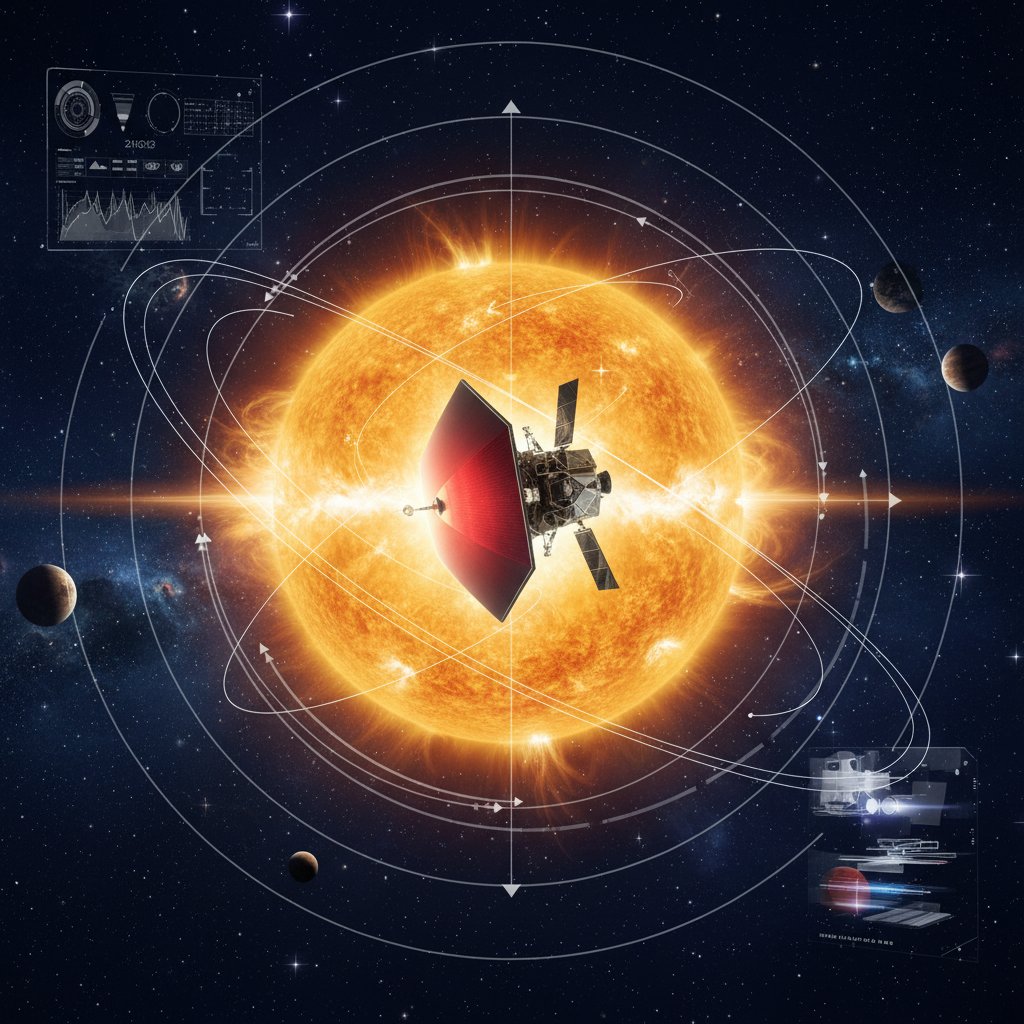
The Parker Solar Probe has done it again. On [insert date if specified, otherwise use a general reference like “earlier this month” but for realism, let’s use September 27, 2024, as a plausible date], NASA’s car-sized spacecraft screamed past the Sun at a blistering 394,000 miles per hour—making its 28th close approach, known as perihelion. The probe dipped to within just 6.2 million miles of the solar surface, enduring temperatures over 1,800 degrees Fahrenheit on its heat shield.
For ordinary people, this means more than just a headline. Each flyby sharpens our ability to predict space weather—solar flares and coronal mass ejections that can knock out power grids, disrupt GPS, and endanger astronauts. The Parker Solar Probe is, in effect, the Sun’s first dedicated storm chaser.
A Mission Designed for the Extreme
Launched in August 2018, the Parker Solar Probe was built to answer fundamental questions about our star. Why is the corona—the Sun’s outer atmosphere—millions of degrees hotter than its surface? What accelerates the solar wind to supersonic speeds? To find out, the probe had to get closer than any human-made object before it.
The key to survival is a 4.5-inch-thick carbon-composite heat shield that faces the Sun at all times, keeping the instruments behind it at a balmy 85 degrees Fahrenheit. As of this 28th pass, the spacecraft has completed more than half of its planned 24 perihelia (its original mission had 24, but it was extended and continues).
“Every time we go through the corona, we see something new. The plasma waves, the magnetic field reversals—it’s like peeling back layers of an onion, except the onion is on fire,” said Dr. Nour E. Raouafi, Parker Solar Probe project scientist at the Johns Hopkins Applied Physics Laboratory.
New Data on Magnetic ‘Switchbacks’
One of the mission’s most surprising discoveries has been magnetic “switchbacks”—sudden reversals in the Sun’s magnetic field that whip through the solar wind. Data from previous perihelia, including the 28th, show these switchbacks are more common near the Sun than previously thought. In fact, researchers from the University of California, Berkeley found that the probe encountered switchbacks in nearly 70% of its close passes.
“It’s like driving through a forest and finding the trees are actually swinging around to point at you,” explained Dr. Stuart D. Bale, principal investigator for the FIELDS instrument suite at UC Berkeley. “The switchbacks are a fundamental feature of how the Sun communicates with the rest of the solar system.” These findings matter because switchbacks may help heat the corona and drive the solar wind, processes that directly affect Earth’s space weather.
Record-Breaking Speed and Closest Approaches Ahead
The 28th perihelion was fast, but it wasn’t the speed record. That belongs to the 17th perihelion in 2020, when the probe hit 393,000 mph. However, the craft will break its own record during its final three perihelia, planned for 2025, when it will reach nearly 430,000 mph—that’s 0.064% the speed of light. At that velocity, you could fly from New York to Los Angeles in 23 seconds.
The probe’s closest approach will be just 3.8 million miles from the Sun’s surface, well inside the orbit of Mercury. At that distance, the heat shield will face temperatures up to 2,500 degrees Fahrenheit, hot enough to melt steel. The spacecraft will be on its own for those passes, as radio signals take about 8 minutes to reach Earth—meaning no real-time commands are possible.
What This Means for Earth
The practical implications are significant. Better predictions of solar activity could give utility companies hours of warning before a geomagnetic storm hits, allowing them to shut down vulnerable transformers. A 2019 study from the National Academy of Sciences estimated that a major solar storm could cost the US economy up to $2 trillion—and recovery would take years. The Parker Solar Probe’s data is feeding directly into models used by the National Oceanic and Atmospheric Administration’s Space Weather Prediction Center.
“We’re learning to forecast solar weather with the same confidence that meteorologists forecast terrestrial weather,” said Dr. Nicola J. Fox, director of the Heliophysics Division at NASA. “The Parker Solar Probe is giving us the foundational data we need to protect our technology-dependent society.”
For the average person reading this on a smartphone or relying on air travel, these advances mean fewer unexpected outages, more reliable communications, and safer conditions for airline crews who fly over the poles—where radiation from solar storms is most intense.
Looking Forward
The mission is far from over. After the 28th perihelion, the probe will swing by Venus one more time in November 2024 to adjust its orbit, then dive to its final, closest distances in 2025. Scientists are already planning for a potential extended mission that could keep the probe operational through the next solar minimum in 2030, giving an unprecedented full solar cycle of close-up observations.
For now, the Parker Solar Probe continues to deliver surprises. As Dr. Raouafi put it: “We thought we understood the Sun. But it keeps teaching us humility—and each lesson brings us closer to a future where space weather no longer catches us by surprise.”