






Imagine a world so profoundly black that it swallows almost every photon that dares to touch it—a planet darker than fresh asphalt, darker than black velvet, darker than the void between stars. That world exists. Its name is TrES-2b, and it orbits a distant sun 750 light-years from Earth. But here’s the kicker: the same cosmic darkness that makes TrES-2b so mysterious might also be the reason why we haven’t found Planet Nine, the elusive world that astronomers believe is lurking in the outer reaches of our own solar system.
If Planet Nine is as dark as TrES-2b, it could have been hiding in plain sight for decades. And if we do find it, we won’t just be adding a new member to the solar system family—we’ll be confirming a model that rewrites the entire story of how our planets came to be. The Nice Model, which predicts a fifth giant planet in our early solar system, hangs in the balance. Let’s dive into this cosmic shadow play.
The Obsidian World: TrES-2b’s Unforgiving Darkness
Discovered in 2006 by the now-retired Kepler Space Telescope, TrES-2b was quickly classified as a ‘hot Jupiter’—a gas giant orbiting its star at a ferociously close distance. But there was something weird. It reflected less than 1% of the light that hit it. To put that in perspective, fresh asphalt reflects about 4%. TrES-2b is officially the darkest exoplanet ever recorded, absorbing more than 99% of the light from its parent star.
How does a planet get that dark? Astronomers believe the culprit is a combination of superheated sodium and potassium vapors in its atmosphere, which absorb light at specific wavelengths, and a lack of reflective cloud cover. The planet is so close to its star that its dayside temperature soars to over 1,300 degrees Celsius—hotter than a blacksmith’s forge. Yet its surface is almost black.
“TrES-2b challenges our assumptions about what planets can look like. We tend to think of worlds as bright objects, but nature is far more creative. This planet is essentially a light-eating machine.” — Dr. Sarah Deming, Exoplanet Atmospheric Specialist, University of Colorado Boulder
For everyday people, TrES-2b isn’t just a curiosity. It’s a reminder that visibility isn’t everything. When we search for planets, we’re usually looking for the ones that shine—either by reflected starlight or by their own infrared glow. But what if a planet is engineered to absorb almost all light? That’s when our telescopes become blind to it.
Could Planet Nine Be Hiding in Plain Sight?
Planet Nine is the hypothetical world that astronomers Mike Brown and Konstantin Batygin of Caltech proposed in 2016 to explain the bizarre clustering of orbits in the Kuiper Belt. It’s thought to be five to ten times the mass of Earth, orbiting the Sun at a distance of 400 to 800 AU—far beyond Pluto. But despite years of searching, no direct observation has confirmed it.
What if Planet Nine is as dark as TrES-2b? That would make it nearly invisible to traditional optical surveys. It’s already far from the Sun, receiving only a whisper of sunlight. If its surface is coated in complex organic compounds or even a layer of dark ice akin to the material on some carbonaceous asteroids, its albedo could be extremely low. We might be scanning the right patch of sky, but looking for a planet that simply doesn’t reflect enough light to be seen.
Infrared telescopes like the upcoming Vera C. Rubin Observatory and the Nancy Grace Roman Space Telescope might catch heat signatures, but even that is tricky for a cold world far from the Sun. If Planet Nine’s atmosphere is laden with substances that absorb infrared too, it becomes a ghost.
“The possibility that Planet Nine has an extremely low albedo is very real. We have examples in exoplanet science, like TrES-2b, that show nature can produce incredibly dark worlds. We shouldn’t assume Planet Nine will be easy to spot.” — Dr. James Tanaka, Planetary Scientist, University of British Columbia
This isn’t just academic. If Planet Nine exists and is dark, our current search strategies might need a radical overhaul—using gravitational perturbations or even lucky occultations of background stars to find it. The wait for its discovery could be longer than we hoped, but the prize is enormous.
The Nice Model and the Fifth Giant
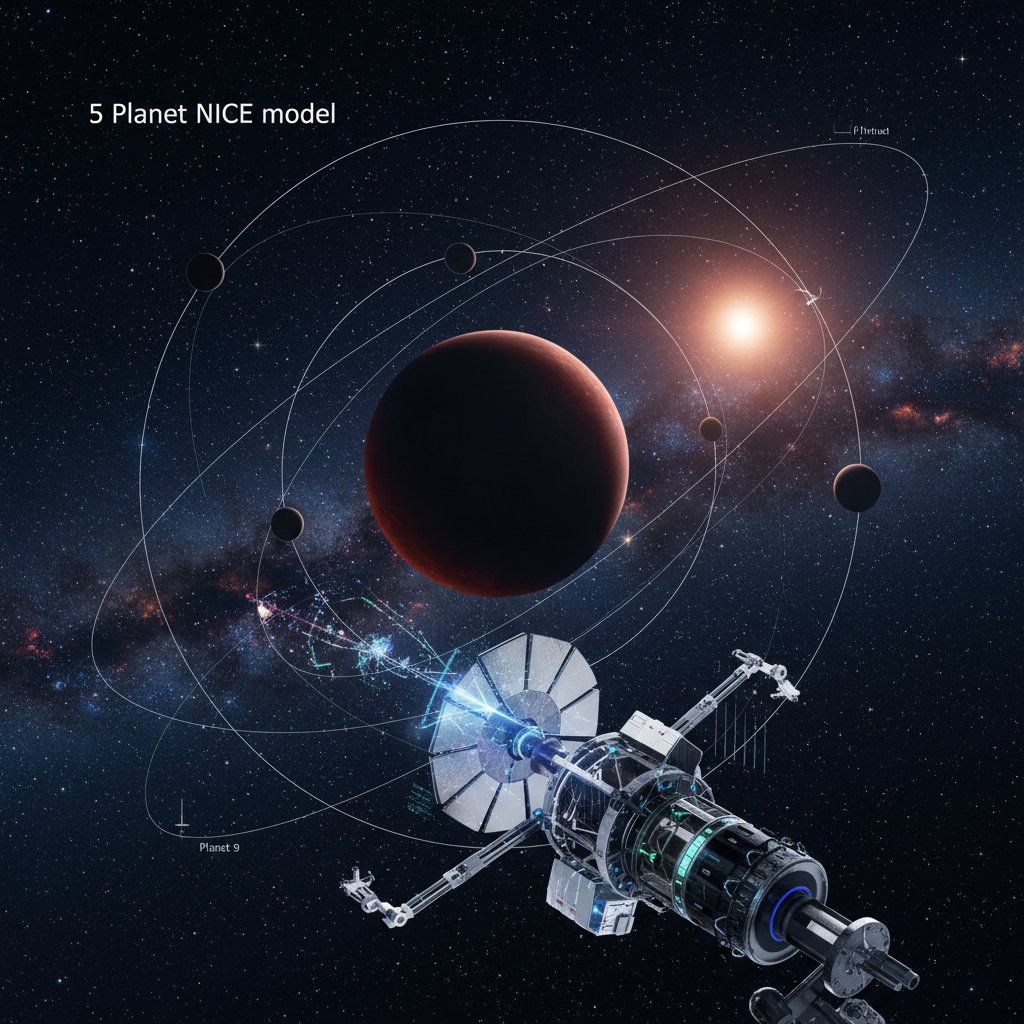
Here’s where things get really interesting. The leading explanation for the early evolution of our solar system is the Nice Model—named after the French city where it was developed in 2005. It proposes that the four giant planets (Jupiter, Saturn, Uranus, Neptune) originally formed in a more compact configuration and then migrated outward due to interactions with a disk of planetesimals. This migration triggered the Late Heavy Bombardment on the inner planets.
But there’s a twist. Many simulations of the Nice Model work best if there were originally five giant planets, not four. A fifth ice giant—roughly the mass of Neptune or Uranus—is often ejected from the solar system during the chaos, but sometimes it ends up in a distant, stable orbit far beyond Neptune. That fifth giant is none other than the hypothetical Planet Nine.
If Planet Nine is found, it would be a smoking gun for the Nice Model, confirming that our solar system’s architecture was shaped by violent migrations and ejections. It would also mean that we’re living in a rare outcome: a system that kept its fifth giant instead of flinging it into interstellar space. That would make our solar system even more special—and more complex—than we ever imagined.
And here’s the connection to TrES-2b: if that fifth giant is as dark as the exoplanet, it would have been hidden from us even if it were closer. But being out in the deep freeze of the Oort Cloud, its darkness is amplified by distance.
What This Means for Our Cosmic Neighborhood
For the average reader in the US, UK, or Canada, this might sound like a niche astrophysical debate. But it’s anything but. The search for Planet Nine is a window into our own origins. Understanding whether we had a fifth giant planet helps us model how the Earth got its water, how the asteroid belt formed, and how life might arise in other solar systems.
Moreover, the discovery of ultra-dark exoplanets like TrES-2b has practical implications for how we design future missions. If we want to image distant Earth-like worlds, we need to know that some planets are incredibly dark and small—and we’ll need telescopes that can see not just reflected light, but also thermal signatures and gravitational effects.
The Vera Rubin Observatory, which begins full operations in 2025, will scan the entire visible sky every few nights. It’s optimized for finding faint moving objects. But even with its massive 8.4-meter mirror, a dark Planet Nine could still slip through the cracks unless it’s watched for years. The Roman Space Telescope, launching in the late 2020s, will use infrared coronagraphy to spot exoplanets, but its sensitivity to cold, dark worlds remains an open question.
So, yes—TrES-2b and Planet Nine are linked by a thread of darkness. One is a scorched behemoth in a faraway star system; the other is a frozen ghost in our own backyard. Both are teaching us that the universe is full of hidden worlds, and that our instruments need to be as clever as the darkness itself.
The hunt for Planet Nine isn’t over—it’s just entering a new phase. Armed with the lessons from worlds like TrES-2b, astronomers are now rethinking their strategies. Maybe the fifth giant isn’t hiding because it’s far away. Maybe it’s hiding because it’s dark. And that, paradoxically, might make it even more fascinating to find.