







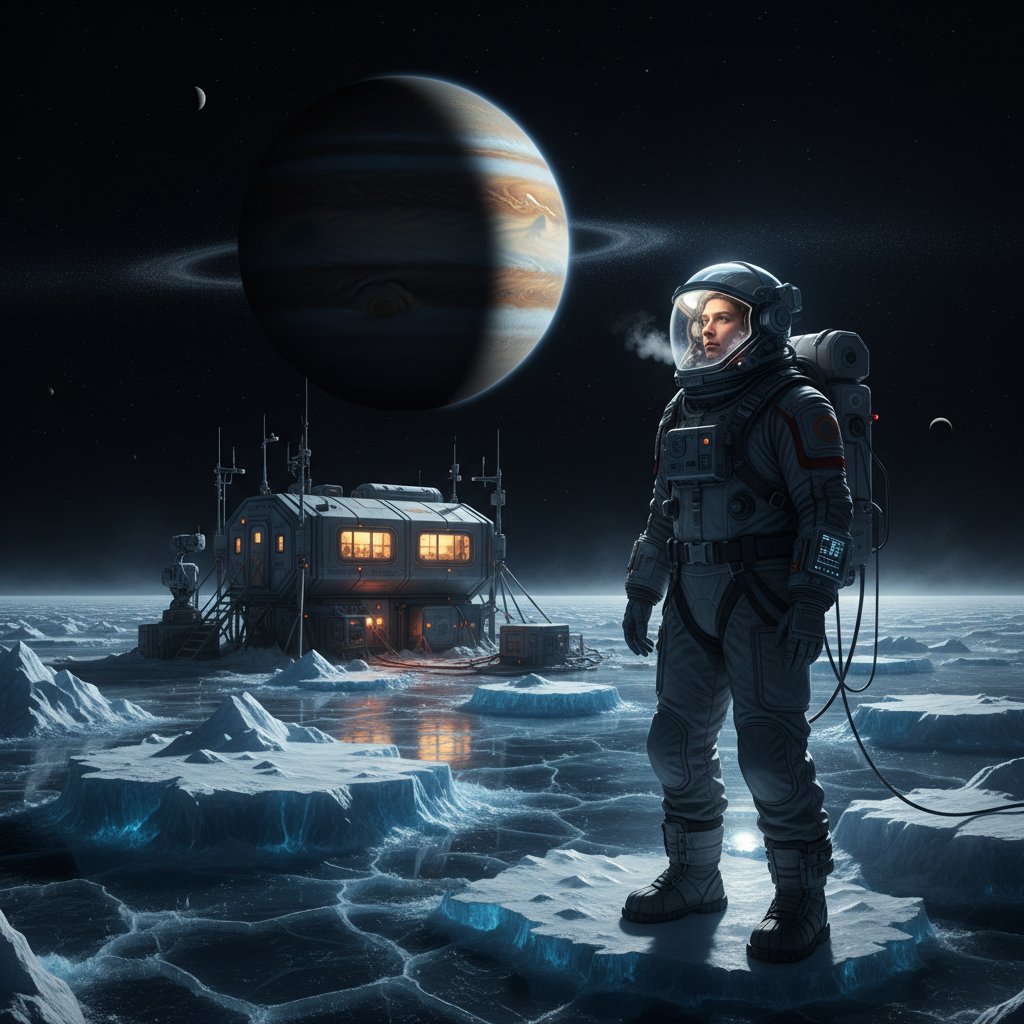
Imagine stepping onto a world where the sky is a perpetual, star-flecked black, even at noon. The ground beneath your feet is not rock, but ice—harder than granite, sculpted by forces beyond earthly experience. The first thing you would notice, before the view, is the cold. Not a winter chill, but a cold so profound it seizes your lungs and turns your breath into a crystalline cloud. This is the reality of standing on the surface of Europa, Jupiter’s enigmatic moon.
For the average person, the most immediate and visceral consequence would be death. Not in minutes, but in seconds. The lack of atmosphere means your blood would boil at body temperature, and the radiation would sear your DNA. Yet, for the sake of understanding, let us explore what the experience would be like, if you were protected by a suit that somehow withstood the moon’s extremes.
An Atmosphere of Nothing
Europa’s atmosphere is a technicality. It exists, but only as a tenuous wisp of oxygen and other molecules, with a surface pressure about one hundred billionth of Earth’s. This is effectively a vacuum. For a visitor, this means no wind, no sound, and no protection. The sky would be a stark, unchanging black, even with Jupiter dominating the heavens, four times the size of our moon in the sky.
Dr. Cynthia Phillips, a planetary geologist at NASA’s Jet Propulsion Laboratory, explains, “Without a substantial atmosphere, there is no weather, no erosion in the way we know it. The surface is a pristine, frozen desert, but with a unique geology driven by tidal forces.” The only sounds would be those transmitted through your suit—the hum of life support, the crunch of your boots on the ice.
And that ice is not a smooth skating rink. It is a chaotic landscape of ridges, cracks, and chaotic terrain, with features like lenticulae—domes and pits formed by warmer ice rising from below. Some areas are stained reddish-brown by salts and sulfur compounds from the subsurface ocean. This is not a place for a casual stroll; it is a frozen, fractured puzzle waiting to be decoded.
The Cold That Cuts to the Bone
The average surface temperature on Europa is a staggering minus 160 degrees Celsius (minus 260 degrees Fahrenheit). At the equator, it can briefly warm to minus 140°C. To put that in perspective, the coldest temperature ever recorded on Earth, in Antarctica, was minus 89.2°C. Europa is colder by nearly 70 degrees. This is beyond the point where carbon dioxide freezes into dry ice.
Any exposed skin would freeze instantly, causing deep tissue damage. But the real danger is the thermal gradient. The heat from your body would conduct away so rapidly that even a well-insulated suit would struggle to maintain a livable temperature. Your breath would freeze in your helmet’s visor, creating a layer of frost. The cold is not just uncomfortable; it is an active, aggressive force, seeking to equalize with your body’s warmth.
This extreme cold also shapes the landscape. The ice behaves like rock, but it is also brittle. Dr. Kevin Hand, a planetary scientist at JPL, notes, “The ice on Europa is subject to constant tidal flexing. This creates stresses that crack the surface, sometimes exposing fresh, darker ice from below.” The result is a network of linear features, some stretching for hundreds of kilometers, that crisscross the moon like a frozen spiderweb.
A Radiation Bath Beyond Imagination
If the cold doesn’t get you, the radiation will. Europa orbits within Jupiter’s powerful magnetic field, which traps and accelerates charged particles to near-light speeds. The surface of Europa receives a radiation dose of about 5.4 Sieverts per day. To put that in context, a lethal dose for a human is about 5 Sieverts over a short period. You would be dead from radiation sickness in a matter of hours without heavy shielding.
This radiation is not just a health hazard; it actively alters the surface chemistry. It breaks apart water ice molecules, creating oxygen and hydrogen. Some of this oxygen may seep down into the subsurface ocean, potentially providing a key energy source for any life that might exist there. The radiation also creates the reddish-brown coloration seen in many images, likely from sulfur compounds reacting with the ice.
For a visitor, the radiation would be invisible but palpable. Your suit’s sensors would be screaming. The sky above would glow faintly in ultraviolet and X-ray wavelengths, a constant aurora invisible to the human eye but a deadly reminder of the hostile environment. This is a world where the very air—or lack thereof—is trying to kill you.
What It Means for the Search for Life
Despite this hellish surface, Europa is one of the most promising places in the solar system to find extraterrestrial life. The key lies beneath the ice. Scientists believe a global ocean of liquid water exists under the icy crust, kept warm by tidal heating from Jupiter’s immense gravity. This ocean may have more water than all of Earth’s oceans combined.
“We’re not looking for a Europa that is a sterile ice ball,” says Dr. Phillips. “We’re looking for an ocean world. The surface is just the window into that ocean.”
The cracks and chaos regions on the surface may allow material from the ocean to reach the surface, and vice versa. This is why missions like NASA’s Europa Clipper, scheduled to launch in 2024, are so critical. The spacecraft will fly by Europa dozens of times, mapping its surface, analyzing its composition, and peering through the ice with radar to understand the ocean below.
For the everyday reader, Europa represents a frontier. It is a world that is both beautiful and brutal, a place where the conditions for life as we know it might exist, but in the most extreme and alien of environments. To stand on its surface would be to witness a world in constant, violent interaction with its parent planet, a world where the ice is not just a crust, but a living, dynamic interface between a frozen sky and a hidden sea.
The experience would be one of profound isolation and awe. You would be standing on a world that is simultaneously a frozen desert and a potential cradle for life, a place where the very fabric of the surface is a testament to the immense forces at play. It is a reminder that in our solar system, the most Earth-like worlds may not be the ones with blue skies and green fields, but the ones locked in a silent, deadly dance with their giant neighbors.
Looking forward, the Europa Clipper will give us our best look yet at this enigmatic surface. It will map the chaos, measure the radiation, and perhaps identify the best places for a future lander to dig down and sample that ocean. If life exists there, it will be a discovery that reshapes our understanding of biology and our place in the cosmos. Until then, we can only imagine what it feels like to stand on the shore of a frozen sea, under the gaze of a giant, striped Jupiter, knowing that a world of water—and perhaps life—lies just beneath your feet.