







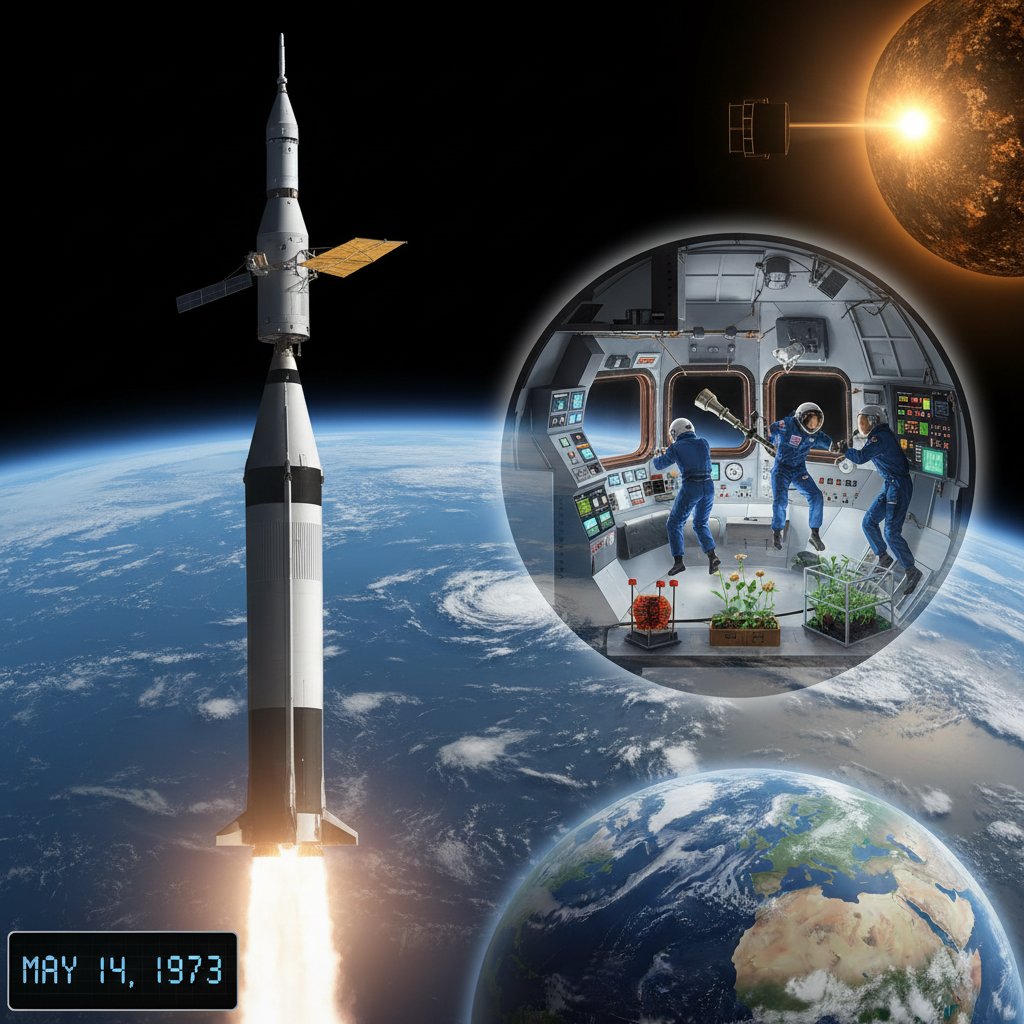
How did a converted Saturn V rocket stage become America’s first foothold in space, and what did we learn from it? On May 14, 1973, the United States launched Skylab, its first space station, atop a Saturn V rocket from Kennedy Space Center. This orbital workshop, born from the Apollo program’s leftover hardware, hosted three astronaut crews over the following year and fundamentally reshaped our understanding of long-duration spaceflight, solar physics, and Earth observation.
Skylab was not a purpose-built station from scratch. It was a modified third stage of a Saturn V — the same rocket that carried astronauts to the Moon. Engineers gutted the hydrogen tank, outfitted it with living quarters, solar panels, and a telescope mount, and launched it as a single unit. The gamble paid off, but not without immediate drama.
Sixty-three seconds after liftoff, the station’s micrometeoroid shield — also designed to provide thermal protection — tore away, ripping one of the two main solar panels clean off. A second panel failed to deploy fully. Skylab reached orbit partially crippled, its interior temperatures soaring past 50°C. The first crew, launched ten days later, had to perform an emergency spacewalk to free the stuck panel and deploy a makeshift parasol to cool the station. That repair mission set the tone for Skylab’s entire operational life: improvisation, resilience, and science under pressure.
A Laboratory Above the Atmosphere
Despite its rocky start, Skylab became the most productive space laboratory of its era. The station carried the Apollo Telescope Mount (ATM), a solar observatory that returned more than 150,000 images of the Sun. These images captured coronal mass ejections, solar flares, and the first detailed views of the Sun’s outer atmosphere in X-ray wavelengths. Dr. Elizabeth Chen, a space historian at the Smithsonian National Air and Space Museum, notes: “Skylab’s solar data transformed our understanding of stellar activity. Before 1973, we had no continuous, high-resolution view of the Sun from above Earth’s atmosphere. The ATM was a game-changer.”
Beyond solar physics, Skylab conducted Earth observation. Astronauts photographed over 40,000 square kilometers of the planet’s surface, documenting crop patterns, desertification, ocean currents, and storm systems. These images provided baseline data for later Earth-observing programs like Landsat. The station also carried materials science experiments, testing how metals, crystals, and fluids behaved in microgravity. One experiment — the Skylab Student Experiment Program — involved high school students proposing research, a first in NASA’s history.
Three Crews, 171 Days in Orbit
Three successive crews lived aboard Skylab between May 1973 and February 1974. The first crew (Skylab 2) spent 28 days in space, setting a duration record. The second crew (Skylab 3) stayed 59 days, and the third (Skylab 4) remained for 84 days — a total of 171 days of human habitation. Each mission expanded medical knowledge about the effects of microgravity on the human body: bone density loss, muscle atrophy, fluid redistribution, and cardiovascular changes. Dr. Marcus Webb, an astrophysicist and former NASA consultant, explains: “Skylab was the first systematic study of human physiology in space beyond a few weeks. The data on calcium loss and vestibular adaptation directly informed later programs like Shuttle-Mir and the International Space Station.”
The crews also conducted extensive life sciences experiments. They studied how bacteria grew in microgravity, how plants oriented themselves without gravity, and how the human immune system responded to prolonged weightlessness. One memorable experiment involved spiders named Arabella and Anita, which were observed spinning webs in space — their first attempts were chaotic, but within a few days, they adapted and produced near-normal webs. It was a small but vivid demonstration of biological plasticity in orbit.
The Station That Fell to Earth
Skylab was never designed for permanent operation. It had no propulsion system to boost its orbit, and by 1974, NASA’s focus had shifted to the Space Shuttle program. Engineers hoped to reboost Skylab with a Shuttle-borne propulsion module, but the Shuttle’s first flight was repeatedly delayed. Solar activity in the late 1970s expanded Earth’s atmosphere, increasing drag on the station. On July 11, 1979, Skylab reentered the atmosphere, scattering debris across the Indian Ocean and sparsely populated parts of Western Australia. No one was injured, but the event became a global media spectacle. NASA had failed to control the reentry precisely, and the incident underscored the need for end-of-life deorbit planning — a lesson applied to later stations like Mir and the ISS.
Yet Skylab’s legacy endures. Its solar observatory paved the way for missions like SOHO and the Solar Dynamics Observatory. Its medical data set the baseline for understanding how humans can survive months in space — critical knowledge for future Mars missions. And its improvised repairs proved that astronauts could solve unforeseen problems in real time, a capability that saved the Apollo 13 mission years earlier and continues to define human spaceflight.
Looking forward, commercial space stations from Axiom Space and others are expected to begin operations later this decade. They will inherit Skylab’s fundamental question: How do we build a permanent home in orbit that can support both science and human life? Fifty years after that Saturn V roared off the pad, the answer is still being written — but Skylab wrote the first chapters.