





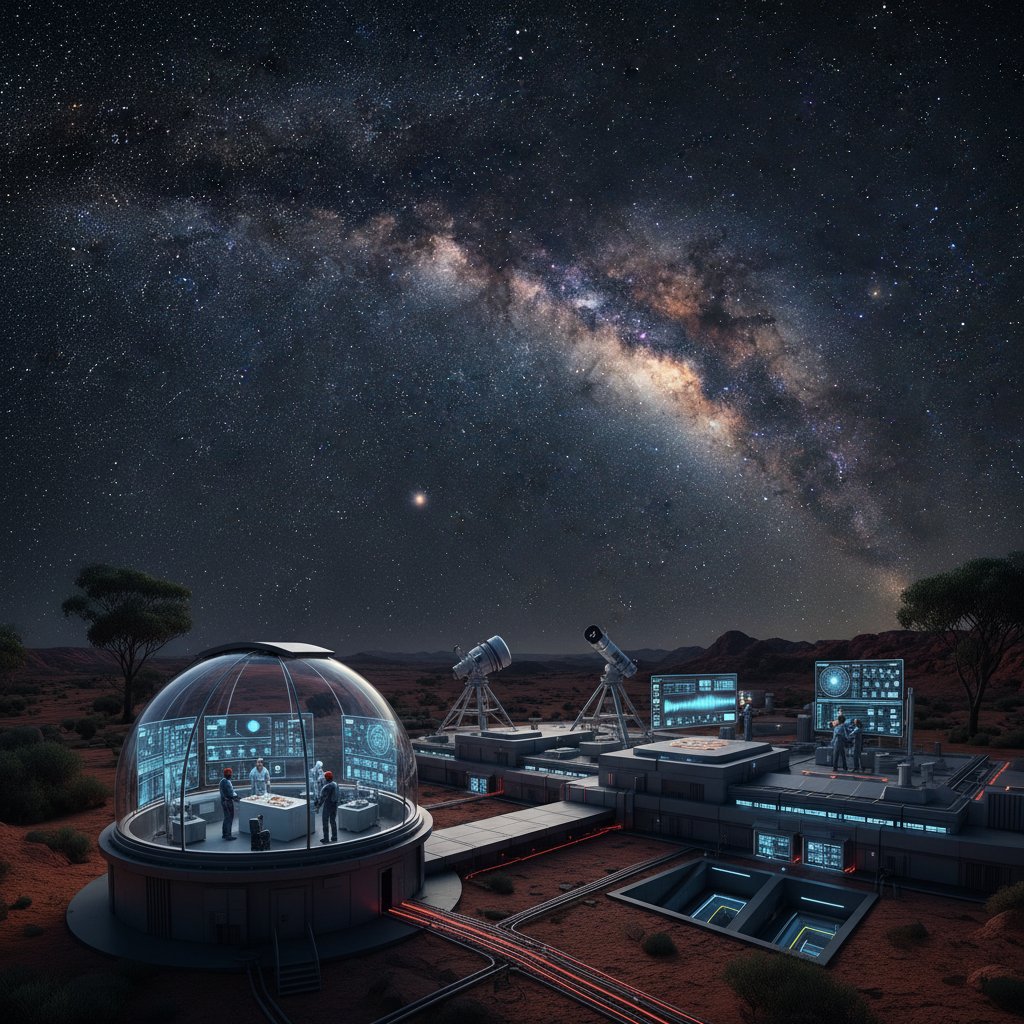
Imagine lying on a swath of red dirt, far from any city lights, staring up at a sky so dense with stars it feels like you’re floating in a sea of diamonds. The Milky Way arcs overhead, a brilliant river of blue, pink, and purple light, with the two fuzzy Magellanic Clouds hovering nearby like celestial guardians. This is the view from Australia’s outback—one of the most breathtaking astronomical experiences on Earth. For stargazers and astrophotographers, the Southern Hemisphere offers an unmatched window into our galaxy’s heart.
Australia is not just a country; it’s a front-row seat to the galaxy. The reason is simple geography: the Milky Way’s brightest region—the galactic center—passes directly overhead during winter nights in the Southern Hemisphere. In the north, the core barely rises above the horizon, often washed out by haze and light pollution. But here, it climbs high and clear, revealing intricate dust lanes, glowing nebulae, and star clusters that leave observers speechless. Combine that with some of the darkest skies on the planet, and you have a paradise for anyone who looks up.
The Southern Hemisphere Advantage
The Milky Way is visible from both hemispheres, but the experience is radically different. From latitudes below the equator, the galactic center—home to a supermassive black hole and billions of stars—culminates at a higher altitude, often exceeding 80 degrees above the horizon. In Australia, during the core season from March to October, the center climbs to near zenith, offering an unobstructed view free from atmospheric interference. This is why astrophotographers flock to places like the Flinders Ranges, the outback of Western Australia, and the dark sky reserves around Coonabarabran and Broken Hill.
Dr. Emma Griffin, an astronomer at the Australian National University, explains:
“From Australia, you get a direct line of sight to the most luminous part of our galaxy. The Milky Way core is about 26,000 light-years away, and here it appears as if you could reach out and touch it. The lack of light pollution amplifies the contrast, making the dust lanes appear three-dimensional.”
Another advantage is the presence of the Large and Small Magellanic Clouds, two dwarf galaxies that orbit the Milky Way. Visible only from the Southern Hemisphere, these clouds are stunning naked-eye objects that add richness to the already crowded sky. Together with the Milky Way, they create a tableau that has inspired human beings for tens of thousands of years.
Where to Experience the Milky Way in Australia
Not all of Australia is equally blessed. The coastal cities like Sydney and Melbourne suffer from light pollution, but venture just a few hours inland, and the darkness returns with a vengeance. Some of the best spots include:
- Uluru (Ayers Rock) – The iconic red monolith stands against a pristine sky. The area is a designated dark-sky sanctuary, with minimal artificial light for hundreds of kilometers.
- Warrumbungle National Park, New South Wales – Home to the Siding Spring Observatory, this region is Australia’s first dark-sky park. It offers public viewing nights and a visitor center dedicated to astronomy.
- The Outback of Western Australia – Remote stations like Mount Magnet or the Nullarbor Plain provide some of the darkest skies on Earth, with no cities for hundreds of miles.
- Tasmania’s Central Highlands – Cool, dry air and low population density create exceptional transparency. The view of the Milky Way reflected in Lake St. Clair is unforgettable.
Astrophotographer Jason Towler, who has spent over a decade capturing the Milky Way from the Australian bush, emphasizes the importance of timing:
“The core season runs roughly from March to October, with the best visibility around the new moon. I always plan my shoots during the winter months when the air is drier and less turbulent. Winter nights are long, giving you hours of prime viewing. My favorite spot is the Pinnacles Desert in Western Australia—the contrast between the golden limestone spires and the deep blue sky is incredible.”
Cultural and Scientific Significance
The Milky Way has profound meaning for Indigenous Australians, who have woven the dark clouds and star clusters into their Dreamtime stories for at least 65,000 years. The dark patches—such as the Emu in the Sky, formed by the Coalsack Nebula—were used to mark seasonal changes and guide hunting practices. Today, astronomers work with Aboriginal elders to preserve this knowledge and combine it with modern astrophysics. The Australian Square Kilometre Array Pathfinder (ASKAP), located in Western Australia’s Murchison region, is a testament to that legacy—its radio dishes peer deep into the galaxy, listening for hydrogen clouds and pulsars.
Professor Alistair Burns, a cultural astronomer at the University of Melbourne, notes:
“Indigenous astronomical knowledge is incredibly sophisticated. They recognized the precession of the equinoxes, the relation between stars and seasons, and the role of the Milky Way as a cosmic pathway. By protecting dark skies in Australia, we honor both scientific discovery and cultural heritage.”
The scientific value extends beyond culture. The clean, dry atmosphere of the Australian outback makes it ideal for optical and radio astronomy. Major observatories like Siding Spring, the Anglo-Australian Telescope, and the new Murchison Widefield Array operate under skies that are among the most transparent on Earth. For amateur observers, the experience is transformative—a single night under the Milky Way in Australia often sparks a lifelong passion for space.
How to Capture the Magic Yourself
If you want to photograph the Milky Way from Australia, you don’t need a professional telescope. A modern DSLR or mirrorless camera with a fast wide-angle lens (f/2.8 or faster) will suffice. Set your ISO to around 3200, exposure time to 20 seconds (using the 500 rule to avoid star trails), and focus manually to infinity. Use a sturdy tripod and a remote shutter to minimize vibration. Apps like Stellarium or PhotoPills can help you predict the Milky Way’s position and the moon’s phase. For the best results, plan for a new moon and clear skies in the months of June, July, or August.
Simple viewing requires only your eyes—and patience. Allow 20 minutes for your eyes to adapt to darkness. Look southeast of the Southern Cross for the bright Carina Nebula, which appears as a pinkish blotch in the Milky Way band. Use binoculars to see the Jewel Box cluster, a glittering array of blue and red stars near the Southern Cross. The view is enough to make anyone feel both small and immensely connected to the cosmos.
The Future of Australia’s Dark Skies
Australia’s dark skies face growing threats from urban expansion, mining operations, and satellite constellations like Starlink. Light pollution is creeping inward, and satellite trails now streak across many long-exposure images. Conservation groups are pushing for stronger dark-sky legislation, and several new dark-sky reserves are being proposed in South Australia and Queensland. Astrotourism is also on the rise—tourists are willing to travel far for an authentic experience of the cosmos, bringing economic incentives to protect the night.
As Dr. Griffin concludes:
“If we lose these skies, we lose a part of our collective imagination. Australia has a responsibility to preserve this window into the universe, not just for scientists, but for everyone who has ever looked up and wondered.”
The next time you find yourself under an Australian sky, lie back on the warm earth and let the Milky Way wash over you. It’s a view that has shaped human history, inspired artistic expression, and propelled scientific discovery. And from this unique vantage point in the Southern Hemisphere, the galaxy feels closer than ever.