








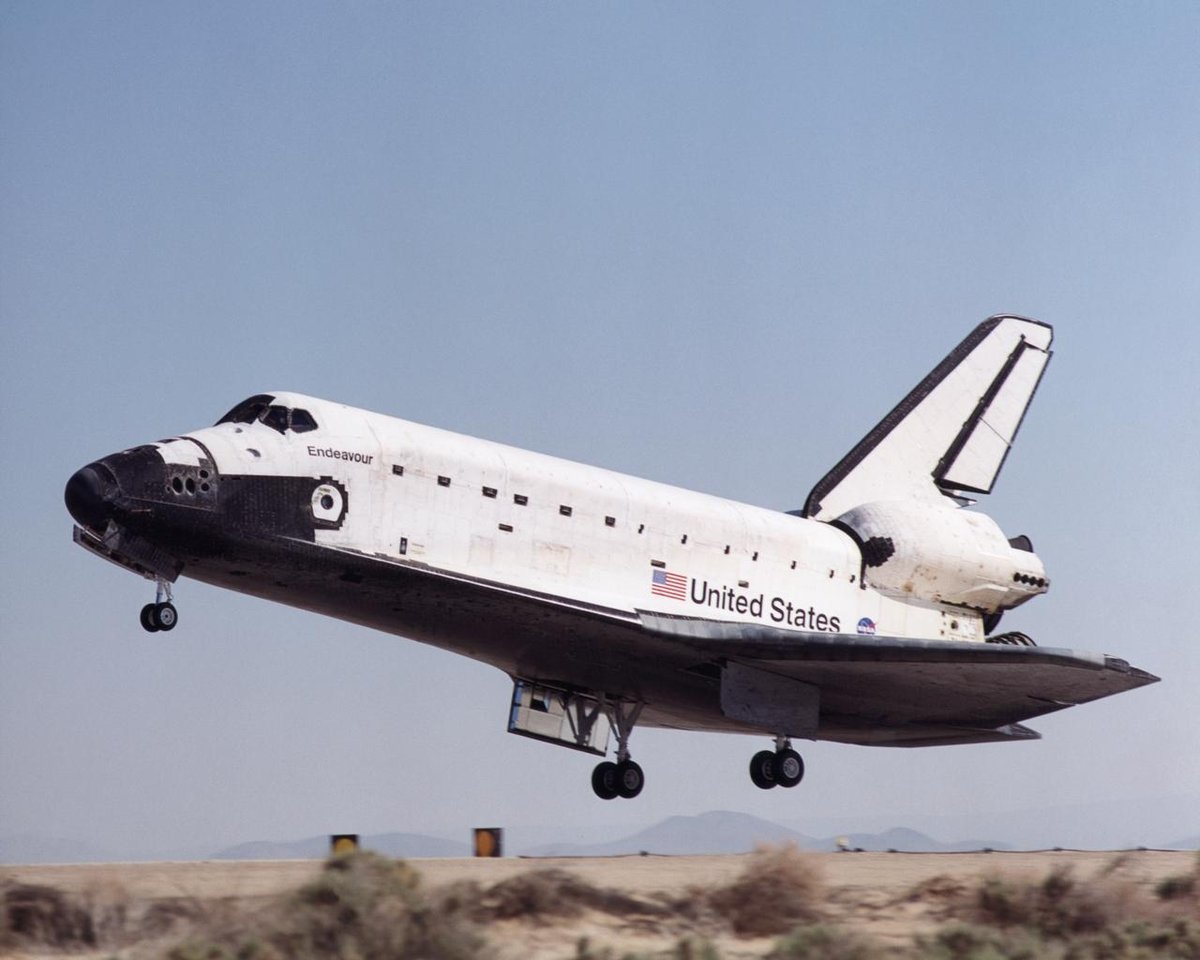
Most people assume a retired space shuttle spends its days gathering dust in a hangar somewhere. That’s not what’s happening in Los Angeles right now. The space shuttle Endeavour — the orbiter that flew 25 missions, helped build the International Space Station, and carried the first African-American woman into space — has just completed what might be its most delicate mission yet: squeezing into a purpose-built museum home.
On Wednesday, the California Science Center in Exposition Park officially opened the Samuel Oschin Air and Space Center, with Endeavour as its centerpiece. The shuttle is mounted in a vertical, launch-ready configuration — engines pointed down, cargo bay doors open, as if it’s about to blast off again. It’s the only display of its kind in the world. And getting it there required 25 years of planning, a 12-mile crawl through the streets of Los Angeles, and a 450-ton crane lift.
“This is the culmination of a decade-long effort,” said Jeffrey Rudolph, president of the California Science Center, during a press event. “We wanted to present Endeavour not as a static object, but as a testament to human ingenuity and the spirit of exploration.”
From Orbit to Exposition Park
Endeavour was built to replace Challenger after the 1986 disaster. It first launched on May 7, 1992. Over the next 19 years, it logged nearly 300 days in space, orbited Earth 4,671 times, and traveled 122 million miles. Its final mission, STS-134 in May 2011, delivered the Alpha Magnetic Spectrometer to the ISS — a particle detector that’s still hunting for dark matter.
After the shuttle program ended in 2011, NASA awarded the orbiters to museums. Discovery went to the Smithsonian, Atlantis to Kennedy Space Center, and Endeavour to California. But the California Science Center didn’t just want to park it on the floor. They wanted to display it as it would have been on the launch pad — vertical, attached to an external tank and twin solid rocket boosters. That meant building a whole new wing around it.
The move itself was a spectacle. In October 2012, Endeavour was strapped to a 160-wheel transporter and crawled through the streets of Inglewood and Los Angeles at 2 mph. Trees were trimmed, utility poles moved, and streets widened. Crowds lined the route. It took three days to cover 12 miles. “It was like watching a whale swim through a city,” said Mary Fichter, a volunteer docent who followed the procession. “People were crying. It was incredible.”
Now, inside the Samuel Oschin Air and Space Center, the shuttle is suspended 20 stories high, flanked by its boosters and tank. The building’s design includes a glass wall so the public can see the shuttle from the sidewalk outside. It’s not just a museum piece — it’s an architectural landmark.
A 25-Mission Legacy
Endeavour‘s flight record is extraordinary. It conducted the first servicing mission of the Hubble Space Telescope in 1993, installing corrective optics that sharpened Hubble’s blurry vision. It carried the first components of the ISS into orbit. It flew the first Japanese astronaut on the shuttle, the first African-American woman (Mae Jemison), and the first Australian-born astronaut.
But the shuttle’s legacy isn’t all glory. The program had devastating failures. Challenger and Columbia both broke apart, killing 14 astronauts. Those tragedies reshaped NASA’s safety culture. Endeavour itself had close calls — in 2008, debris hit its wing during launch, and engineers spent days scanning it for damage similar to what doomed Columbia.
“The shuttle was a marvel, but it was also a fragile machine,” said Dr. John Logsdon, a space historian and professor emeritus at George Washington University. “We pushed a 1970s design well into the 21st century. That it flew as safely as it did is a testament to the thousands of people who worked on it.”
Today, NASA has moved on to commercial crew vehicles like SpaceX’s Dragon and Boeing’s Starliner. But the shuttle’s data is still used. Studies from its robotic arm, its tile inspections, and its orbital experiments inform everything from satellite design to materials science. In fact, some of the thermal protection technologies developed for the shuttle program are now being adapted for advanced imaging systems — a reminder that aerospace research often trickles down into unexpected fields.
What Endeavour’s New Role Means for Science Education
The California Science Center expects 2 million visitors per year. For many of them, Endeavour will be their first up-close encounter with a spacecraft that actually flew to space. That matters.
Studies show that hands-on exposure to real scientific artifacts increases student interest in STEM careers. A 2019 report from the Institute for Learning Innovation found that museum visitors who engaged with authentic exhibits were 40% more likely to pursue further science learning. “When a kid stands under a shuttle that went to orbit, they understand that engineering isn’t abstract — it’s real,” said Dr. Melissa Edwards, a science education researcher at Stanford University. “It’s not a simulation. It’s a machine that people trusted with their lives.”
The center has also integrated climate science into the exhibit. Endeavour‘s payload bay carried instruments that measured atmospheric ozone, tracked sea ice, and monitored volcanic plumes. One of those instruments, the Shuttle Radar Topography Mission, produced 3D models of Earth’s surface that are still used for flood modeling and urban planning. The irony is that while the shuttle program ended, the data it generated is becoming more valuable as climate change accelerates. The UK, for instance, recently recorded its hottest June day ever, and scientists rely on shuttle-era datasets to contextualize such extremes.
The museum also features interactive displays that let visitors simulate docking the shuttle to the ISS or landing it on a runway. There’s a full-scale mockup of the crew cabin where you can see the cramped quarters astronauts endured. And a section dedicated to the thermal protection system — 24,000 tiles, each one handmade — shows why each launch was a gamble.
The Engineering Marvel on Display
Getting Endeavour vertical inside a building was an engineering problem as complex as any faced during its flights. The shuttle, external tank, and boosters together weigh about 1 million pounds. They had to be assembled inside the building because the doors weren’t big enough to bring them in assembled. The tank and boosters were installed first; then a 450-ton crane hoisted the orbiter into place — a maneuver that took five hours and had to be done with centimeter precision.
“We had to account for wind, temperature, and even the settling of the building’s foundation,” said Tom Trowbridge, the center’s director of exhibits. “It was like threading a needle with a freight train.” The result is a 150-foot-tall stacked shuttle — the only one displayed that way outside of Florida’s vertical assembly building. Visitors can walk underneath it, look up its nozzles, see the carbon-carbon leading edges that withstood 1,400°F.
But make no mistake: Endeavour is not coming back to life. Its engines are removed, its fuel lines purged, its crew cabin gutted. It’s a shell, however awe-inspiring. That’s a bittersweet truth. The shuttle program was a Cold War project that outlasted the Soviet Union, survived two disasters, and ended because it was too expensive and risky to continue. Each flight cost about $1.5 billion. Compare that to a SpaceX Falcon 9 launch at $62 million. The shuttle’s time had passed.
Still, Endeavour now serves a new mission: inspiration. In a city where the nearest NASA center is 2,000 miles away, the shuttle brings the frontier of human spaceflight to the people. As climate change, pandemics, and geopolitical shifts dominate the news, a 100-ton machine that once flew over your head at 17,500 mph is a reminder of what we can do when we decide to do it.
“We’re living in a time of big challenges,” said Dr. Logsdon. “Endeavour shows us that big challenges are exactly the kind of thing we’re built to solve. We just have to choose to solve them.”
Frequently Asked Questions
Can I go inside the space shuttle Endeavour at the California Science Center?
No. The shuttle is displayed vertically with its crew cabin gutted and sealed. Visitors cannot enter the orbiter. However, the museum includes a full-scale crew cabin mockup that you can walk through, as well as interactive exhibits showing the interior.
How much does it cost to see Endeavour?
The California Science Center’s general admission is free, but entry to the Samuel Oschin Air and Space Center — which houses Endeavour — requires a timed ticket. As of June 2025, adult tickets are $28, seniors and students $21, and children (3–12) $18. Members get free access.
What other space shuttles are on display in the US?
Three remain: Discovery at the Udvar-Hazy Center in Virginia, Atlantis at the Kennedy Space Center in Florida, and Endeavour in Los Angeles. The test orbiter Enterprise is at the Intrepid Museum in New York. Endeavour is the only one displayed in a vertical, launch-ready configuration.