





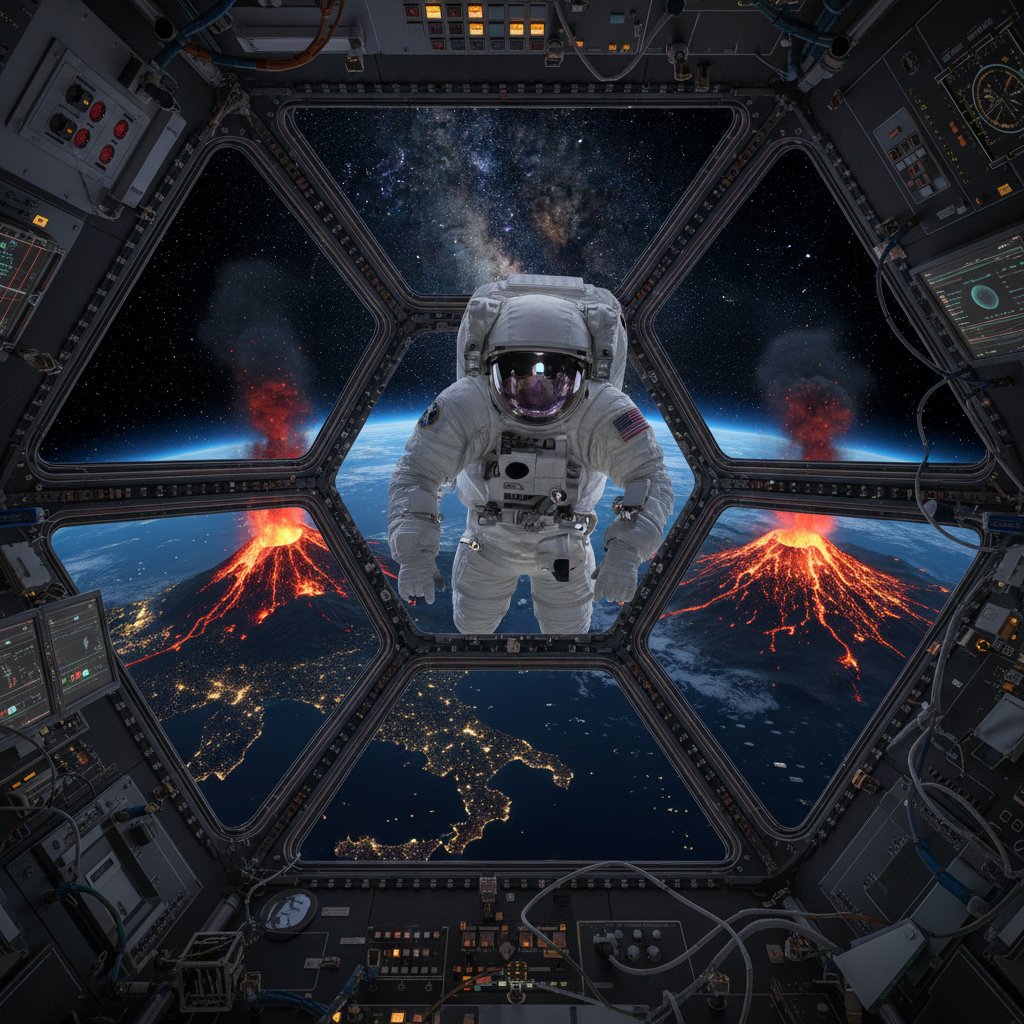
“Seeing these two iconic volcanoes from the Cupola is a powerful reminder of the dynamic forces shaping our planet,” said Dr. Elena Rossi, a volcanologist at the Italian National Institute of Geophysics and Volcanology (INGV), commenting on the newly released images. “The clarity of the photographs allows us to observe subtle surface features and thermal anomalies that are invaluable for monitoring.”
A NASA astronaut aboard the International Space Station (ISS) has captured a remarkable series of photographs showing Mount Etna and Mount Vesuvius in a single panoramic sweep of the Italian peninsula. The images, taken on March 15, 2025, from the station’s seven-window Cupola module, reveal the snow-dusted peaks of both volcanoes rising sharply against the deep blue of the Tyrrhenian Sea.
The photos, released by NASA on March 18, show Etna’s summit crater emitting a faint plume of steam and volcanic gases, while Vesuvius appears calm but imposing, its cone casting a long shadow across the Bay of Naples. The astronaut, who is part of Expedition 72, used a Nikon Z9 camera with a 400mm telephoto lens to capture the details from an altitude of approximately 420 kilometers.
A Rare Double Feature from Orbit
Mount Etna, located on the island of Sicily, is Europe’s most active volcano. Standing 3,357 meters above sea level, it has experienced frequent eruptions over the past year, including a series of Strombolian explosions and lava flows in January 2025. Mount Vesuvius, on the mainland near Naples, rises to 1,281 meters and is best known for its catastrophic eruption in AD 79 that buried Pompeii and Herculaneum. Although dormant since 1944, Vesuvius is closely monitored due to the dense population surrounding it.
“Capturing both volcanoes in one frame is a testament to the ISS’s unique vantage point,” said Dr. Mark Chen, a planetary geologist at the University of Arizona who studies volcanic processes from orbit. “The wide field of view allows us to place these volcanoes in their regional tectonic context—Etna sits on the subduction boundary between the African and Eurasian plates, while Vesuvius is part of the Campanian volcanic arc.”
The ISS orbits Earth at about 28,000 kilometers per hour, completing a full circuit every 90 minutes. Astronauts often use handheld cameras to document geological features, weather patterns, and urban landscapes. These images are not only visually striking but also serve scientific purposes. Researchers at INGV have already requested high-resolution copies of the photos to compare with satellite thermal data from the European Space Agency’s Sentinel-2 mission.
Scientific Value of Astronaut Photography
Astronaut photography has a long history of contributing to Earth science. Since the 1960s, crewed missions have captured millions of images, many of which have been used to track volcanic plumes, glacial retreat, and deforestation. A 2023 study in Remote Sensing found that images taken from the ISS can detect sub-kilometer-scale features that automated satellite sensors might miss, especially in the visible and near-infrared spectrum.
“The human eye combined with a high-quality camera can make real-time decisions about what to photograph,” explained Dr. Chen. “An astronaut can notice a subtle plume or a change in color that a pre-programmed satellite might overlook. That flexibility is invaluable for capturing transient events like volcanic ash emissions.”
Mount Etna has been particularly active in recent months. According to INGV reports, a paroxysmal eruption on February 23, 2025, sent ash clouds 10 kilometers into the atmosphere, disrupting air travel at Catania Airport. The new ISS images were taken about three weeks after that event, showing the volcano in a quieter but still degassing phase. Vesuvius, meanwhile, remains under constant surveillance. The Italian Civil Protection Department maintains a network of seismometers, gas sensors, and GPS stations to detect any signs of reawakening.
“Vesuvius is one of the most dangerous volcanoes on Earth because of the 3 million people living in its immediate vicinity,” said Dr. Rossi. “Every image we get, whether from the ground, drones, or space, helps refine our models of magma movement and eruption forecasting.”
How You Can See the Photos
NASA has published the full set of images on its Gateway to Astronaut Photography of Earth website, where they are freely available for download and use. The photos are cataloged under mission ISS072, with the highest-resolution versions exceeding 20 megapixels. Users can zoom in to see individual lava flows on Etna’s flanks and the urban sprawl of Naples encroaching on Vesuvius’s lower slopes.
For casual observers, the images offer a humbling perspective. The contrast between the ancient, violent geology of the volcanoes and the modern cities clinging to their edges is stark. “It’s a shot that makes you think about time scales,” said Dr. Chen. “The volcano has been building itself for hundreds of thousands of years, while the city around Vesuvius has grown in just a few centuries. The ISS gives us a snapshot of that tension.”
The astronaut who took the photos, whose name has not been officially released pending a routine NASA press cycle, reportedly spent extra time at the Cupola windows waiting for the perfect lighting conditions. Mission controllers adjusted the station’s attitude slightly to allow a better angle, a common courtesy for crew members pursuing high-priority observation targets.
Looking Ahead: Volcano Monitoring from Space
These images come at a time when space-based volcano monitoring is expanding rapidly. NASA’s recently launched NISAR satellite, a joint mission with the Indian Space Research Organisation, will use synthetic aperture radar to measure ground deformation with millimeter precision. The European Space Agency’s upcoming FORUM mission will measure far-infrared emissions from volcanic plumes, helping scientists understand their climate impacts.
Astronaut photography, however, will remain a complementary tool. “No satellite can replicate the intuition of a trained observer,” Dr. Rossi emphasized. “When you see a photograph like this, you feel the scale and the beauty. It reminds us why we study these mountains—not just for science, but for the sheer wonder they inspire.”
As Expedition 72 continues its six-month mission, more Earth observations are expected. The crew has been trained to photograph volcanic hotspots in the Pacific Ring of Fire, including Popocatépetl in Mexico and Mount Merapi in Indonesia. For now, the images of Etna and Vesuvius offer a rare dual portrait of two of Europe’s most famous and formidable geological landmarks.