






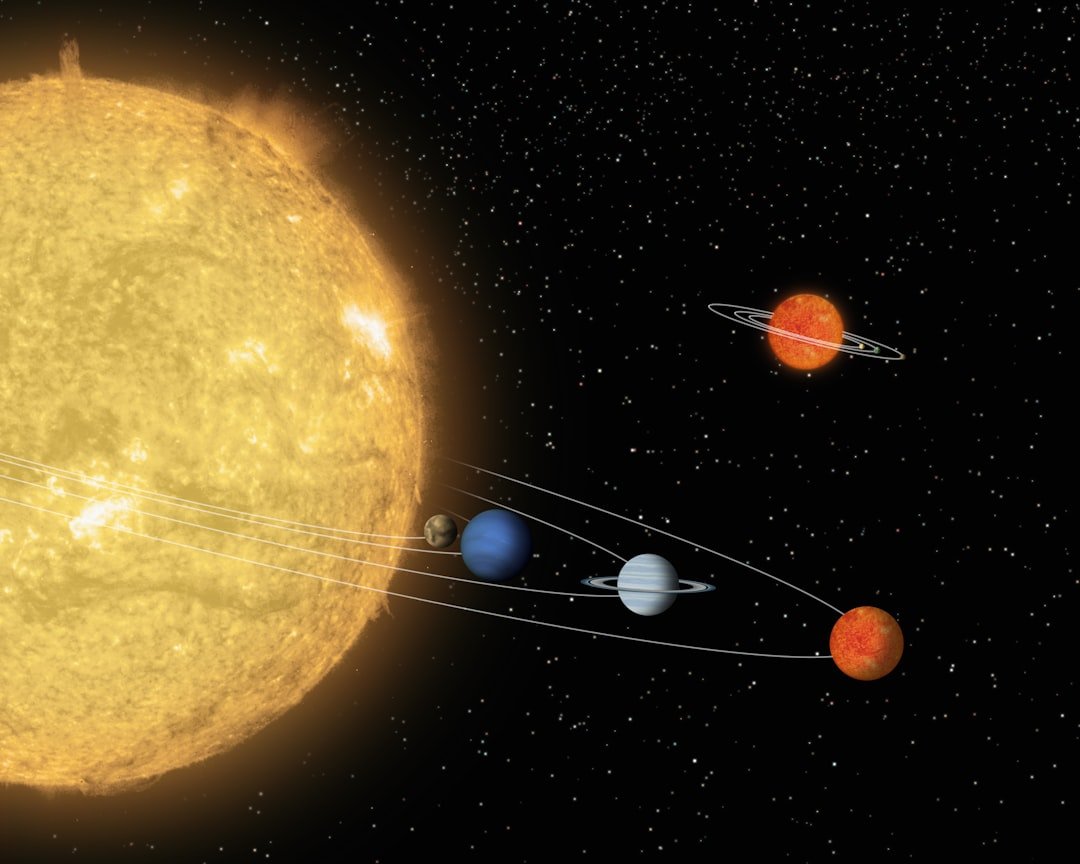
It’s the cosmic equivalent of a phoenix rising from the ashes. A Jupiter-sized world, orbiting a burned-out stellar husk 80 light-years away, is giving astronomers a front-row seat to the drama of solar system apocalypse—and what it means for our own future. Using the James Webb Space Telescope, scientists have peered into the atmosphere of this unlikely survivor, known officially as WD 1856 b, and the results are rewriting the textbooks on planetary survival.
When a Sun-like star runs out of fuel, it doesn’t just fade away quietly. It swells into a red giant, engulfing any planets that wander too close. Mercury, Venus, and possibly Earth will face this fate in about 5 billion years. But here’s the twist: WD 1856 b, a gas giant nearly seven times the mass of Jupiter, somehow managed to not only survive that inferno but also end up in a surprisingly close orbit around the white dwarf corpse of its star. How? That’s the question Webb helped answer.
Surviving the Inferno
“It’s like watching a magician pull a rabbit out of a hat, except the rabbit is the size of Jupiter and the hat is a dying star,” says Dr. Andrew Vanderburg, an astrophysicist at MIT and lead author of the new study. The key, according to the team, is timing—and a bit of gravitational luck.
Billions of years ago, the star that became WD 1856 was a main-sequence star similar to our Sun. As it aged, it bloated into a red giant, shedding its outer layers in a violent wind. Any planet inside the star’s original habitable zone would have been vaporized. But WD 1856 b started much farther out—think Neptune’s orbit or beyond. When the star lost mass, its gravitational grip weakened, and the planet’s orbit spiraled inward. Imagine a child on a merry-go-round slowing down; the planet drifted closer and closer until it reached its current ultra-tight orbit: a dizzying 1.4-day year.
“The planet didn’t just survive—it migrated,” explains Dr. Siyi Xu, an astronomer at NSF’s NOIRLab who helped analyze the Webb data. “We’ve seen similar migration in young systems, but never after a star’s death. This is a completely new window into planetary evolution.”
The Webb observations, taken in near-infrared light, detected water vapor and carbon dioxide in the planet’s atmosphere. No surprise for a gas giant—but the data also showed something unexpected: the atmosphere is remarkably clear, with few clouds or hazes. That’s unusual for a planet this close to a white dwarf, which bombards it with intense ultraviolet radiation.
“We expected to see a thick, hazy atmosphere like Jupiter’s, but instead we got a mostly cloud-free signal. It’s like opening a smoggy room’s window and finding a clear blue sky.” — Dr. Jonathan Fortney, planetary scientist at UC Santa Cruz
A Surprisingly Temperate World
Even more intriguing: the planet’s temperature is about 500 °F (260 °C)—balmy compared to the hellish surface of a typical hot Jupiter. The white dwarf itself is dim, emitting far less energy than the original star. So the planet is bathed in a soft, fading light rather than a blazing inferno. That makes WD 1856 b a template for what may happen to gas giants in many aging solar systems, including our own.
“Jupiter will likely survive the Sun’s red giant phase, but it will end up in a much closer orbit around a white dwarf,” says Vanderburg. “It won’t be a pleasant place for life—but it’s a testament to planetary resilience.”
The team’s findings were published this week in The Astrophysical Journal Letters. The study builds on earlier detections by NASA’s TESS mission, which first spotted the planet’s transit in 2020. Webb’s infrared sensitivity allowed the team to dissect the planet’s atmosphere in exquisite detail—something impossible with any previous telescope. For comparison, TESS had already pushed the boundaries of exoplanet hunting by detecting a planet using ripples in spacetime—a technique known as transit timing variations. You can read about that breakthrough in our earlier story: TESS Finds a Planet Using Ripples in Spacetime—A First.
What This Means for Earth’s Far Future
So, will Earth survive? Almost certainly not. When the Sun expands into a red giant in about 5 billion years, its outer edge may reach Earth’s current orbit. Even if our planet isn’t engulfed, its atmosphere will be stripped, oceans boiled, and surface melted. But the fate of the outer planets—Jupiter, Saturn, and their moons—could be different. They might migrate inward just like WD 1856 b, becoming new worlds orbiting a faint white dwarf.
And that raises a fascinating possibility: could life exist on those moons? Europa and Enceladus, for instance, have subsurface oceans today. If they survived the red giant phase, they could remain warm due to tidal heating, even as the white dwarf cools. “It’s a long shot,” says Xu, “but not impossible. Webb could help us look for atmospheric signs of such moons in the future.”
The next step is to observe more white dwarf planets. Webb has already scheduled follow-up observations of WD 1856 b and at least two other similar systems. The goal: understand how common these survivors are, and whether their atmospheres can evolve into something that might harbor life—or at least reveal the chemical fingerprints of a lost civilization.
For now, WD 1856 b stands as a cosmic testament to the resilience of planets. It’s a reminder that even after a star’s death, the story isn’t over—it just changes chapters. And with Webb’s steady gaze, we’re reading those chapters for the first time.
In the meantime, NASA is pushing forward with other ambitious projects—like its new robotic Moon missions paving the way for a lunar base by 2029, which you can read about here. While the Moon is about human exploration, WD 1856 b is about cosmic extinction and rebirth. Both remind us that the universe is always moving, always changing, and never—ever—boring.
Frequently Asked Questions
How did WD 1856 b survive its star’s red giant phase?
The planet originally orbited much farther from its star, likely beyond the orbit of Neptune. When the star became a red giant and shed its outer layers, it lost about half its mass. Weaker gravity allowed the planet’s orbit to gradually spiral inward to its current close orbit around the white dwarf. It never entered the star’s envelope, so it survived.
Could Earth survive the Sun’s death?
Almost certainly not. Earth’s orbit is too close. When the Sun becomes a red giant in about 5 billion years, its outer edge will likely engulf Earth, vaporizing the planet. Even if Earth survives engulfment, its atmosphere and oceans will be stripped away. The outer planets like Jupiter and Saturn have a better chance of surviving and migrating inward.
What makes Webb’s observations special for this planet?
Webb’s infrared sensitivity and high-resolution spectroscopy allow astronomers to detect molecules like water and carbon dioxide in the planet’s atmosphere. For WD 1856 b, Webb also revealed an unusually clear atmosphere with few clouds, which is surprising given the intense ultraviolet radiation from the white dwarf. No other telescope could have obtained this level of detail.