







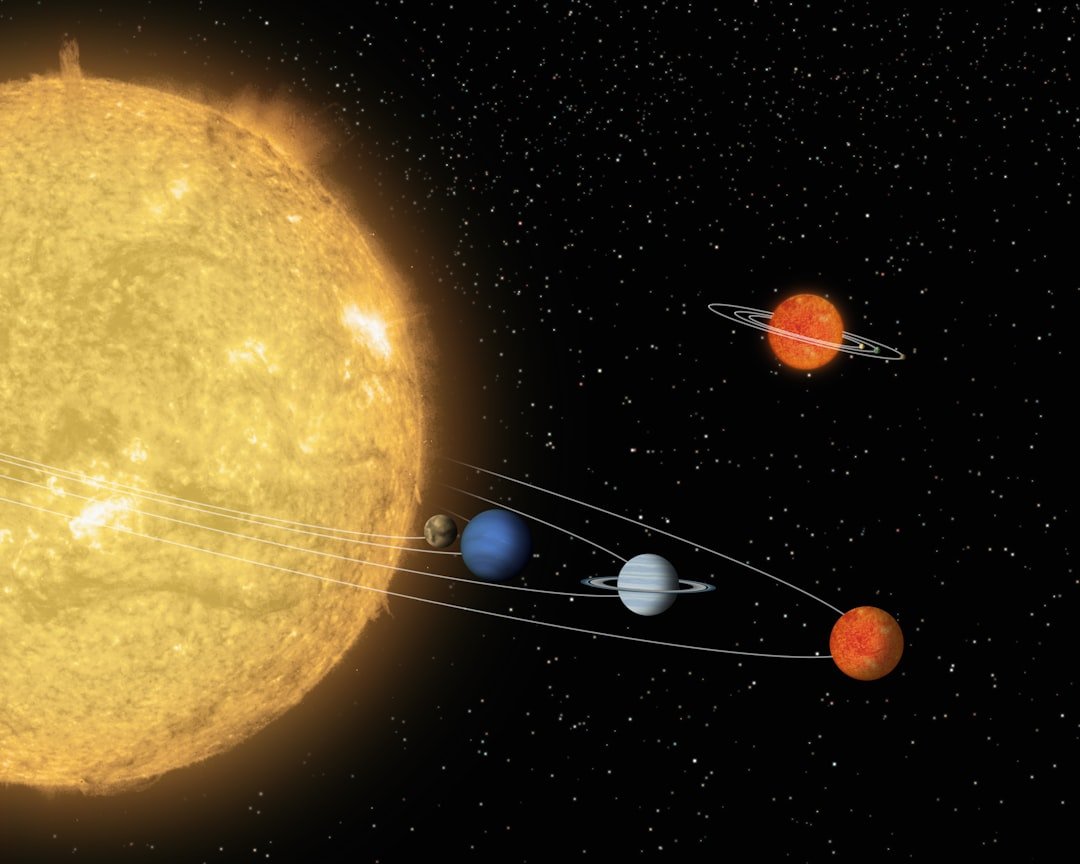
For the first time, NASA’s Transiting Exoplanet Survey Satellite (TESS) has done something no planet-hunting mission has done before: it found a world not by catching it crossing in front of its star, but by detecting the subtle space-time ripples the star itself sends out. The newly confirmed planet—a super-Jupiter, about 10 times the mass of Jupiter—orbits a star called TOI-4600, some 730 light-years away. And it’s not tucked in close like a typical TESS discovery. It orbits at a distance roughly 14 times the Earth-Sun separation. That’s in the neighborhood of where Saturn sits in our own solar system.
How’d they pull this off? TESS monitors stars for tiny dips in brightness caused by transits—when a planet passes between us and its host star. But this super-Jupiter doesn’t transit. So the team used an indirect technique: measuring the star’s “wobble” caused by the gravitational tug of the unseen planet. That wobble shifts the star’s light spectrum ever so slightly, and TESS’s high-precision photometry captured it through a phenomenon called beaming—a kind of Doppler boosting. “This is the first time TESS has detected a planet via relativistic beaming,” says Dr. Avi Shporer, an astrophysicist at MIT and co-author of the study. “It opens a new window for the mission.”
The Ripple Effect: How Gravity Reveals Hidden Worlds
Think of it like this: a star and its planet are both orbiting a common center of mass—like a couple ballroom dancing but with the star doing most of the heavy lifting. As the invisible planet pulls the star this way and that, the star’s light gets blueshifted (compressed) when it moves toward us and redshifted (stretched) when it moves away. That periodic shift is the ripple. And TESS’s camera, built for extreme stability, caught it.
The technique, formally called the phase curve method, picks up not just the Doppler shift but also the star’s own light variations as it rotates. “It’s like listening to a bass drum in a symphony—you know something heavy is there even if you can’t see it,” explains Dr. Emily Rauscher, a physicist at the University of Michigan who wasn’t involved in the study. “What excites me is that this proves TESS can find planets that are otherwise invisible to it. That’s a game-changer for future surveys.”
NASA’s new robotic moon missions are another testament to how the agency is pushing boundaries—but TESS’s new trick is arguably more profound for exoplanet science. Until now, TESS has been a transit factory, spitting out thousands of candidate planets, most of which orbit within 50 days. This new method lets it find planets on longer orbits, ones that take years to circle their star.
Why This Super-Jupiter Matters
Most exoplanets we’ve found are either scorching hot Jupiters hugging their stars or small rocky worlds in tight orbits. That’s observational bias, not a cosmic rule. Super-Jupiters like this one—orbiting at moderate distances—are crucial for understanding how planetary systems form and evolve. They’re the missing middle: not too close, not too far. “We’re essentially catching a glimpse of what Jupiter might have looked like in a different solar system,” says Dr. Shporer. “It tells us about the archeology of planet formation.”
The star, TOI-4600, is an M-dwarf, a red dwarf smaller and cooler than the Sun. M-dwarfs are the most common type of star in the galaxy, but they’re notoriously tricky for planetary searches because they’re dim and prone to flares. Finding a super-Jupiter around one suggests that these stars can host massive planets at large separations—a finding with implications for the search for life, since M-dwarfs are prime targets for habitable-zone rocky planets.
But let’s be real—this super-Jupiter isn’t habitable. It’s a gas giant with no solid surface and likely extreme winds. But the method is what matters. If TESS can spot massive planets at wide orbits using beaming, it could also find Neptune-mass worlds or even smaller ones with next-generation instruments.
What This Means for You and the Future of Space Science
Look, most of us won’t book a ticket to TOI-4600 anytime soon. But the implications hit closer to home. Every new detection method expands our ability to map the neighborhood of the galaxy. Think about it: ten years ago, we didn’t know if planets around M-dwarfs were rare. Now we know they’re abundant. And with missions like the Nancy Grace Roman Space Telescope coming in 2027, we’ll have even sharper tools to detect worlds via the same gravitational wobble technique.
This discovery also underscores something about human curiosity. We’re wired to find patterns, even those as faint as a star’s twitch in spacetime. “It’s a beautiful demonstration of physics being used as a telescope,” says Dr. Rauscher. “We turned general relativity into an instrument.”
And yet, there’s a practical side: understanding the demographics of exoplanets helps us prioritize which stars to study for potential life. If M-dwarfs can host massive outer planets, that might affect the stability of inner rocky worlds. Stability matters for life. As we build AI systems to simulate alien climates on Earth, every data point sharpens the models.
So next time you hear about TESS, don’t just think of it as a transit hunter. It’s now a gravity detective. And it just solved a case that’s been waiting 730 years in the dark—waiting for us to pay attention.
The search for worlds like ours just got a little more interesting.
Frequently Asked Questions
How does TESS detect planets without transits?
TESS normally looks for tiny dips in starlight when a planet passes in front of its star. But in this case, it used relativistic beaming—measuring subtle shifts in the star’s brightness caused by the gravitational tug of the planet. As the star moves toward us, its light gets slightly brighter (blueshifted); as it moves away, it gets dimmer (redshifted). This periodic change reveals the planet’s presence.
Could this method find Earth-like planets?
Potentially, yes—but not yet. The beaming signal is strongest for massive planets (like Jupiter-size) on wide orbits. For an Earth-sized planet, the signal would be incredibly faint. However, future telescopes like the Nancy Grace Roman Space Telescope will have the sensitivity to detect smaller worlds using similar techniques, opening the door to finding Earth-like planets at larger orbital distances.
Why is finding a super-Jupiter around an M-dwarf significant?
Red dwarf stars (M-dwarfs) are the most common stars in the galaxy, but we know less about their planetary systems. Finding a massive planet like this one suggests that M-dwarfs can host Jupiter-class worlds at distances comparable to our own solar system’s gas giants. This has implications for planetary formation theories and for the stability of any smaller rocky planets that might orbit closer in.