








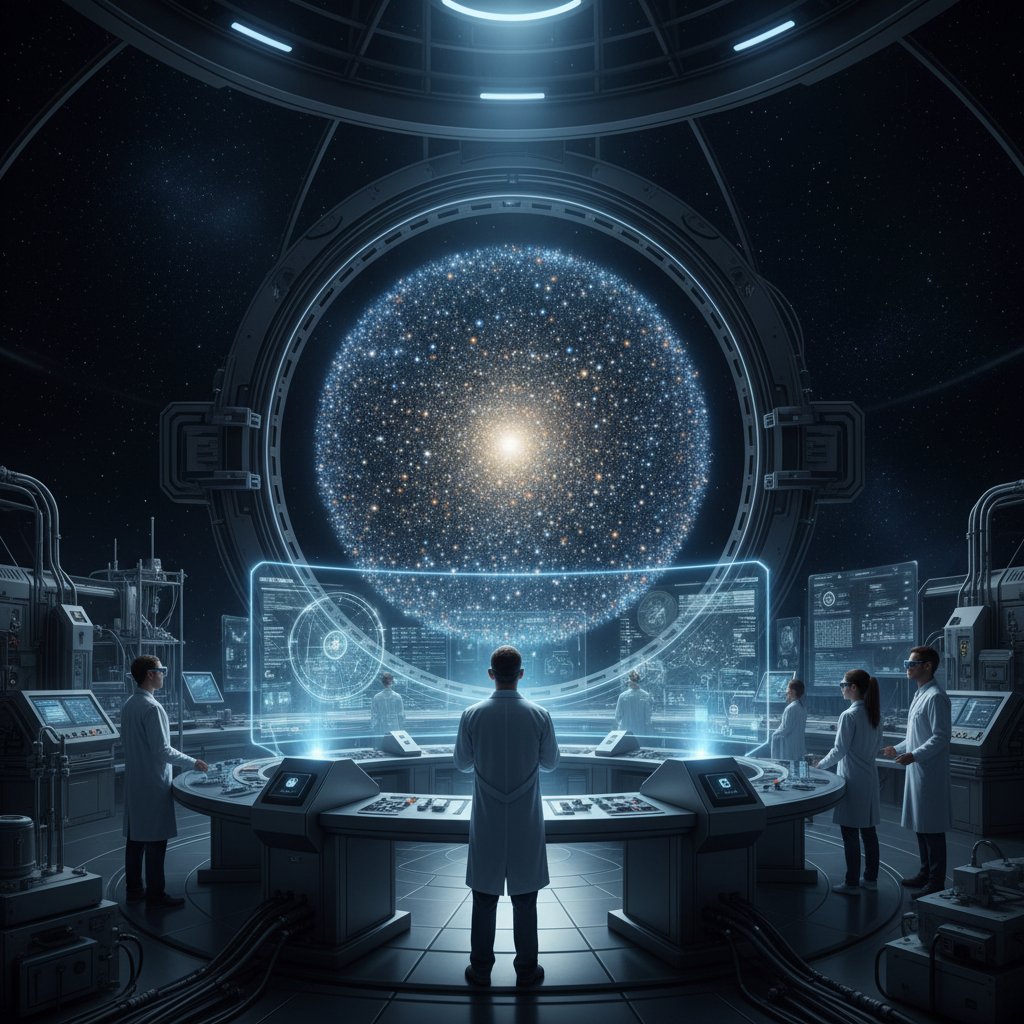
What if the most massive cluster in our galaxy is not a cluster at all — but the stripped core of a long-lost dwarf galaxy? That is the question astronomers have been asking about Omega Centauri, the brightest and largest globular cluster visible from Earth. New evidence from the Hubble Space Telescope and ground-based observatories is rewriting the origin story of this ancient stellar metropolis.
Omega Centauri is not just big. It is astonishingly big. Located about 15,800 light-years from Earth in the constellation Centaurus, this cluster contains an estimated 10 million stars packed into a sphere roughly 150 light-years across. To put that in perspective, typical globular clusters in the Milky Way host only a few hundred thousand stars. Omega Centauri is a class of its own.
The Numbers Behind the Beast
First cataloged by Edmond Halley in 1677 as a ‘nebulous star,’ Omega Centauri was later recognized as a globular cluster — a dense, spherical collection of ancient stars orbiting the galactic halo. But its sheer scale sets it apart. With a mass of roughly 4 million solar masses, it is the most massive globular cluster in the Milky Way, outweighing others by a factor of ten or more.
Recent observations from the Hubble Space Telescope have refined our understanding. In 2023, a team led by Dr. Nadine Neumayer at the Max Planck Institute for Astronomy measured the motions of stars within the cluster using 20 years of Hubble data. They found evidence of an intermediate-mass black hole at its center — a rarity in globular clusters. “This is the best evidence yet for an intermediate-mass black hole in a globular cluster,” Neumayer told QuasarPost. “Omega Centauri is unique. It has the mass and structure of a small galaxy.”
The black hole, weighing about 8,200 solar masses, sits at the cluster’s heart, pulling stars into tight orbits. This discovery adds weight to the theory that Omega Centauri is not a true globular cluster but the remnant of a dwarf galaxy that was torn apart by the Milky Way’s gravity billions of years ago.
A Dwarf Galaxy in Disguise?
For decades, scientists have debated whether Omega Centauri is a globular cluster or the stripped nucleus of a dwarf galaxy. The case for a galaxy origin has grown stronger. In 2020, a study by Dr. Alison Sills of McMaster University examined the chemical composition of Omega Centauri’s stars. “We found multiple populations of stars with different metallicities,” Sills explained. “That is not typical for a globular cluster, which usually has a uniform chemical signature. It suggests that this cluster formed from its own gas cloud, not from the same material as the Milky Way.”
Further evidence comes from the cluster’s rotation. Unlike most globular clusters, which are essentially static spheres, Omega Centauri rotates — a hallmark of a galaxy core. “Think of it like a fossil,” said Dr. Holger Baumgardt, an astrophysicist at the University of Queensland. “It is the leftover heart of a smaller galaxy that merged with the Milky Way about 10 billion years ago. The outer stars were stripped away, but the dense inner region survived.”
“Omega Centauri is unique. It has the mass and structure of a small galaxy.” — Dr. Nadine Neumayer, Max Planck Institute for Astronomy
If confirmed, this would mean Omega Centauri is a window into galactic cannibalism — a process where large galaxies absorb smaller ones, a key mechanism in cosmic evolution. It would also make it the nearest example of a stripped galactic nucleus, offering clues about how supermassive black holes grow.
What This Means for Stellar Archaeology
For amateur astronomers, Omega Centauri is a treat. Visible to the naked eye under dark skies in the Southern Hemisphere, it appears as a faint, fuzzy star. Through binoculars or a small telescope, it resolves into a spectacular ball of hundreds of thousands of stars. But for scientists, it is a laboratory for understanding the early universe.
The cluster’s stars are among the oldest in the galaxy, with ages exceeding 12 billion years — nearly as old as the universe itself. Studying them reveals the conditions of star formation in the early cosmos. “Omega Centauri is like a time capsule,” said Dr. Sills. “The stars here formed when the universe was only a few billion years old. Their chemistry tells us what elements were available at that time.”
In 2024, a team using the James Webb Space Telescope detected signatures of carbon and oxygen in the cluster’s outer regions, suggesting that multiple generations of stars exploded as supernovae, enriching the cluster’s gas. This is another point in favor of a dwarf galaxy origin, as globular clusters typically lack the gas to sustain multiple star-forming episodes.
The Future of Omega Centauri Research
What comes next? Astronomers are planning to use the upcoming Nancy Grace Roman Space Telescope, set to launch in 2027, to map the motions of millions of stars in Omega Centauri. This will help pinpoint the black hole’s exact mass and test theories of galaxy merging. “We are only scratching the surface,” Dr. Baumgardt said. “With Roman, we will be able to see the cluster’s internal dynamics in unprecedented detail. That could finally settle the debate.”
For now, Omega Centauri remains an enigma — a giant that defies easy classification. Whether it is a globular cluster or a galactic fossil, it stands as a reminder that the cosmos is full of objects that break the rules. As we peer deeper into its starry heart, we are not just looking at the past; we are watching the story of galaxy formation unfold.