







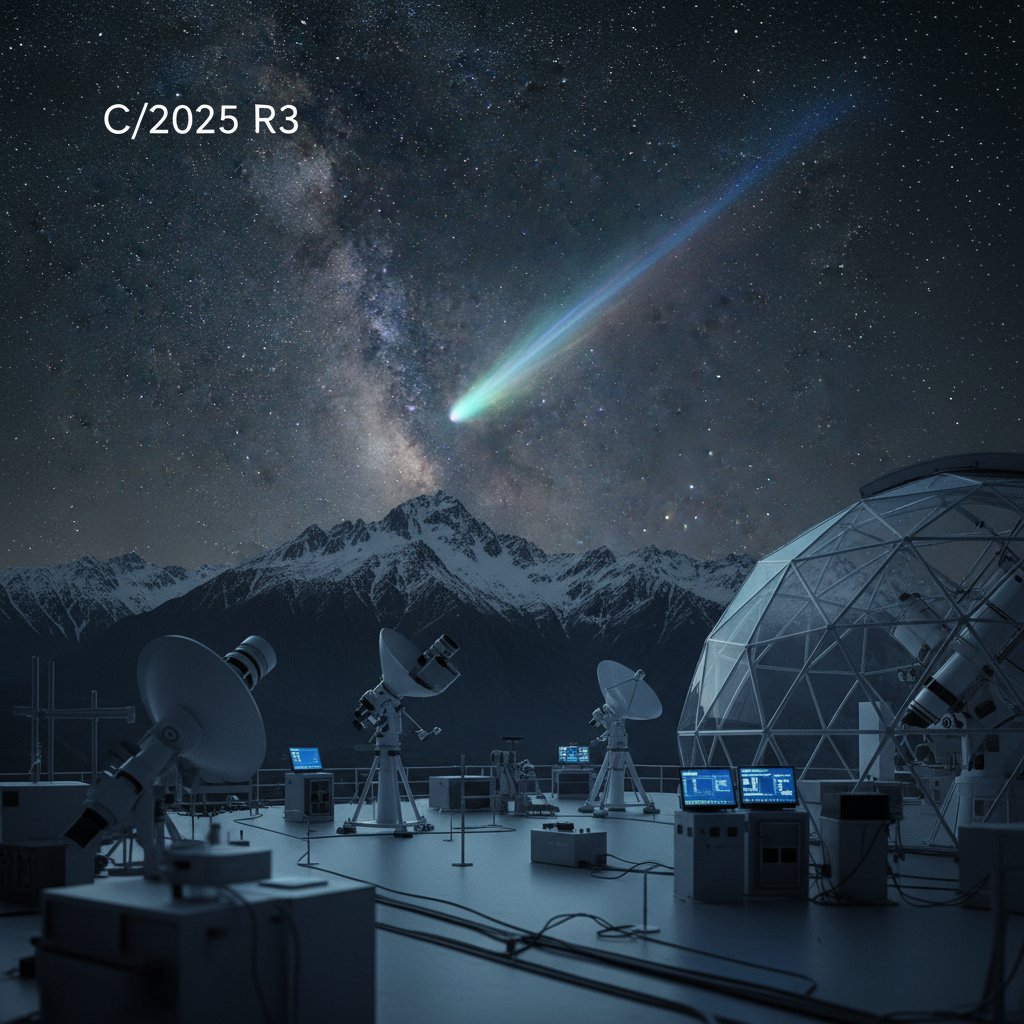
On a crisp, clear night in late March 2025, a celestial visitor painted the sky above New Zealand’s Southern Alps with an ethereal glow. The comet C/2025 R3, discovered just months earlier, streaked over the jagged peaks of the Remarkables mountain range, leaving a trail of gas and dust that stretched for millions of kilometers. For the handful of astronomers and astrophotographers who braved the alpine chill, it was a moment of pure wonder—a reminder that the universe still has surprises in store.
The comet, officially designated C/2025 R3 (Pan-STARRS), was first spotted in September 2024 by the Panoramic Survey Telescope and Rapid Response System in Hawaii. At the time, it was a faint speck beyond Jupiter’s orbit, barely visible to the most sensitive instruments. But as it swung toward the inner solar system, it brightened dramatically, becoming one of the most anticipated comets of the decade. By late March 2025, it had reached its closest approach to Earth—a mere 0.8 astronomical units, or about 120 million kilometers—and was putting on a show for observers in the Southern Hemisphere.
New Zealand, with its dark skies and pristine landscapes, proved to be an ideal vantage point. The Remarkables, a mountain range near Queenstown known for its dramatic silhouettes, provided a breathtaking foreground. Photographers captured the comet’s greenish coma and bifurcated tail as it dipped below the horizon, a sight that many described as otherworldly. “It was like watching a cosmic brushstroke across the canvas of the night,” said Dr. Emily Hart, an astrophysicist at the University of Canterbury who traveled to the site to observe the event. “The combination of the comet’s vivid colors and the rugged peaks was absolutely unforgettable.”
A Rare Visitor from the Oort Cloud
C/2025 R3 is a long-period comet, meaning it originates from the Oort Cloud—a vast, spherical shell of icy bodies that surrounds the solar system at a distance of up to 100,000 astronomical units. These comets are rare visitors; their orbits can take thousands or even millions of years to complete. For C/2025 R3, its last pass through the inner solar system likely occurred during the last ice age, around 30,000 years ago. Its next return? Not for another 50,000 years, if at all.
Comets like C/2025 R3 are time capsules from the early solar system. They contain pristine ice, dust, and organic compounds that date back 4.6 billion years. As they approach the Sun, their surfaces heat up, releasing gas and dust that form the characteristic coma and tail. In the case of C/2025 R3, its tail was particularly striking—a dual structure that included a blue ion tail, shaped by the solar wind, and a broader, yellowish dust tail. “The bifurcation is a sign that the comet’s nucleus is rotating and shedding material unevenly,” explained Dr. Marcus Chen, a planetary scientist at the University of Auckland. “It’s a dynamic process that tells us a lot about the comet’s composition and history.”
For New Zealanders, the event was a rare treat. The country’s latitude—roughly 35 to 47 degrees south—placed it directly in the comet’s path, offering optimal viewing conditions. Unlike the Northern Hemisphere, where comets often appear low on the horizon, C/2025 R3 climbed high into the southern sky, visible to the naked eye for several hours after sunset. Amateur astronomers set up telescopes in parks and backyards, while social media buzzed with images of the comet streaking over landmarks like Mount Cook and the Southern Alps.
What This Means for Science
Beyond its visual spectacle, C/2025 R3 is a scientific goldmine. Researchers around the world have been training telescopes on the comet to study its chemical makeup. Early observations from the James Webb Space Telescope, which turned its infrared gaze on the comet in early March, revealed a rich mix of molecules, including water, carbon dioxide, carbon monoxide, and even complex organic compounds like methanol and formaldehyde. These findings could shed light on how the building blocks of life were delivered to Earth billions of years ago.
“Comets are like messengers from the past,” said Dr. Sarah Jenkins, a comet specialist at NASA’s Goddard Space Flight Center. “By analyzing the gases they release, we can piece together the conditions that existed in the early solar system. C/2025 R3 is particularly exciting because it appears to be relatively pristine—it hasn’t been baked by repeated close passes to the Sun. That means its material is as close to the original as we can get.”
The comet’s trajectory also offers clues about the structure of the Oort Cloud. By tracking its orbit with high precision, astronomers can infer the gravitational influences that nudged it toward the Sun—perhaps a passing star or a giant molecular cloud. “Long-period comets are our best probes of the outer solar system’s dynamics,” added Dr. Chen. “Each one tells a story about the forces that shape our cosmic neighborhood.”
For the public, the comet’s appearance is a reminder of the ongoing dance between Earth and the cosmos. Comets have fascinated humanity for millennia, from the Bayeux Tapestry’s depiction of Halley’s Comet in 1066 to the modern era of space probes like Rosetta, which landed on Comet 67P in 2014. C/2025 R3, while not as bright as some historic comets, still managed to captivate millions. In New Zealand, tourism operators reported a surge in stargazing tours, with hotels in Queenstown and Wanaka fully booked for the week of the comet’s peak visibility.
How to Catch a Glimpse
For those who missed the show over the Remarkables, there’s still time. C/2025 R3 will remain visible in the southern sky through mid-April, though it will fade rapidly as it moves away from Earth. Observers in the Southern Hemisphere—including Australia, South Africa, and parts of South America—can spot it with binoculars or a small telescope. Look for it in the constellation Phoenix, just after sunset, low in the southwestern sky. The comet’s greenish glow and faint tail should be distinguishable from background stars.
In the Northern Hemisphere, the view is less favorable. The comet will dip below the horizon for most observers, though those near the equator might catch a glimpse in early April. “It’s a southern sky special,” said Dr. Hart. “But that’s part of what makes it so magical. It’s a reminder that the sky is not the same everywhere—and that there’s always something new to discover.”
For astrophotographers, the challenge is worth the effort. Long-exposure images can reveal details invisible to the naked eye, such as the comet’s intricate tail structure and the faint glow of its surrounding hydrogen cloud. “I spent three nights setting up my gear in the freezing cold,” said Auckland-based photographer Liam O’Connor, whose image of C/2025 R3 over the Remarkables went viral. “But when I saw the final shot, I knew it was worth it. It’s not every day you get to capture a piece of the ancient solar system.”
Looking Ahead
As C/2025 R3 fades into the darkness, astronomers are already looking to the next big comet. Several candidates are on the horizon, including C/2026 A1, which is expected to brighten in late 2026. But for now, the legacy of C/2025 R3 is secure. It has reminded us of the beauty and mystery of the universe—and of the importance of looking up.
“Comets are unpredictable,” reflected Dr. Jenkins. “They can fizzle out or explode into brilliance. That’s what makes them so thrilling. C/2025 R3 delivered a spectacular show, and it’s given us a wealth of data to analyze for years to come. Who knows what secrets it still holds?”
For the people of New Zealand, the comet will be remembered as a moment of shared wonder—a cosmic visitor that graced their skies and left an indelible mark on their memories. As the Remarkables stand silent under the stars, the universe continues its eternal journey, and we, for a brief moment, are part of it.