







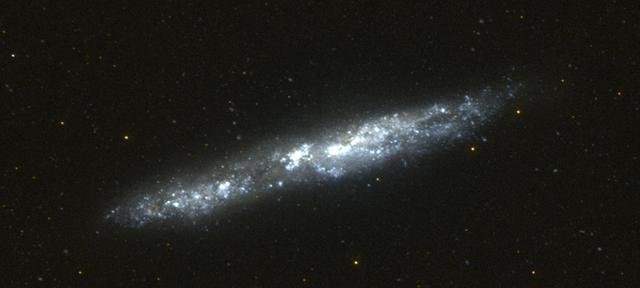
At the heart of the Cigar Galaxy—M82, 12 million light-years away in Ursa Major—something remarkable is happening: stars are being born at a rate that makes our Milky Way look like a sleepy village. NASA‘s James Webb Space Telescope has just given us the sharpest infrared view yet of this starburst galaxy, peeling back layers of dust to reveal the chaotic, crowded nursery where millions of young stars are blazing to life. And the numbers are staggering—M82’s star formation rate is roughly 10 times higher than that of our own galaxy, with some regions cranking out the equivalent of 10 new Suns every year.
That’s not all. The combination of Webb’s infrared eyes and archival data from the Hubble Space Telescope is painting a picture of galactic evolution that challenges some long-held assumptions. The two telescopes together are like a pair of detectives—one sees the visible mess, the other sees what’s hiding behind the smoke.
Why M82 Matters—and Why It’s Called the Cigar Galaxy
M82 got its nickname because, from our vantage point, we see it edge-on—a slender, elongated streak across the sky, like a cigar. But don’t let the name fool you. This is a violent place. The galaxy is undergoing a massive starburst, triggered by a close encounter with its larger neighbor, M81, some 200 million years ago. That gravitational tug-of-war compressed gas clouds, spawning a frenzy of star formation that’s still going strong.
For astronomers, M82 is a laboratory. It’s close enough to study in detail, but extreme enough to show us what happens when galaxies go into overdrive. And because it’s edge-on, we get a perfect cross-section of the disk, letting us see how stars and gas move perpendicular to the plane. That geometry is crucial for understanding how star formation feedback—winds, radiation, supernova explosions—shapes a galaxy’s structure.
As Dr. Rebecca Levy, lead author of the new study from the University of Arizona, put it: “M82 is like a cosmic construction site where we can watch stars being built in real time, but the dust has always been the problem. Webb’s infrared capability changes everything—we’re finally seeing the scaffolding.”
It’s a bit like looking at a construction site at midnight versus at noon. Hubble could see the finished buildings (bright star clusters) and the wrecking balls (supernova remnants), but the raw materials—the cold gas and newly forming protostars—were invisible. Not anymore.
What Webb Saw That Hubble Couldn’t
Hubble’s visible-light images of M82 show brilliant knots of young stars and dark dust lanes, but the dust absorbs most of the light from the youngest, most embedded stars. Webb’s Near-Infrared Camera (NIRCam) picks up wavelengths that slip right through the dust, like a flashlight through fog. The result? A detailed map of the galaxy’s star-forming clumps, including some structures never seen before.
One of the most striking findings is the discovery of a dense chain of star clusters along the galaxy’s central plane, each containing hundreds of thousands of newly formed stars. And the wind—the outflow of gas driven by supernovae and stellar winds—turns out to be more complex than models predicted. Instead of a smooth, uniform flow, Webb reveals filaments, bubbles, and cavities. It’s messy. (And honestly, messy is usually more interesting.)
The team used NIRCam to study the distribution of polycyclic aromatic hydrocarbons (PAHs)—organic molecules that glow in infrared when hit by starlight. Those PAH emissions trace the edges of the star-forming regions, showing exactly where the youngest stars are cooking. Combined with Hubble’s data on older stars and ionized gas, the astronomers now have a multiwavelength jigsaw puzzle that’s finally clicking together.
Dr. Alberto Bolatto, a co-author from the University of Maryland, explained: “What we’re seeing is that the feedback from star formation is not as efficient at blowing out gas as we thought. The clumps are dense and persistent. That has huge implications for how galaxies evolve over cosmic time.”
And here’s a fun twist: the same dust that hides the stars also holds clues to how galaxies build up heavy elements. Webb measured the distribution of carbon-rich dust particles, which are created by dying stars. Those particles get blown into the intergalactic medium, seeding future generations of stars and planets. M82 is basically a cosmic recycling factory—and Webb just read the blueprints.
Implications for Galactic Evolution—and the Search for Life
Why should anyone care about a cigar-shaped galaxy 12 million light-years away? Because starbursts were common in the early universe. Galaxies like M82 are analogs for what our own Milky Way may have looked like during its most active phases, billions of years ago. Understanding how starbursts start, sustain, and eventually fizzle out is key to understanding the life cycle of galaxies.
There’s also a link to the search for life. Starburst galaxies produce enormous amounts of heavy elements—the stuff of rocky planets and organic molecules. If we want to know how common life-supporting planets are, we need to know how quickly galaxies can churn out the ingredients. M82, with its furious star formation, is a laboratory for that cosmic chemistry.
Interestingly, Webb’s new data also helps refine our understanding of galaxy outflows—the winds that can either enrich or strip a galaxy of its gas. And here’s where a recent article about alien signals and solar wind becomes relevant: just as solar wind can drown out faint extraterrestrial signals, powerful galactic winds can obscure our view of star formation. Webb’s infrared capability is like that suggested fix—it cuts through the noise and lets us see the signal.
The new M82 observations also sync with earlier work by NASA’s Webb mission team, who have been systematically targeting starburst galaxies to build a database of how star formation feedback works across different environments. Every new galaxy adds a piece to the puzzle.
What Comes Next—and What It Means for You
The Webb team isn’t done with M82. They’re planning follow-up spectroscopy with the Mid-Infrared Instrument (MIRI) to measure the velocities and temperatures of the outflows. That data will let them calculate exactly how much gas is being expelled versus retained—a number that will feed into models of galaxy evolution for years.
For the rest of us? It’s a reminder that the universe is not static. Stars are being born and dying all around us, even in galaxies we thought we understood. And with each new instrument—from Hubble to Webb to the upcoming Nancy Grace Roman Space Telescope—we’re getting closer to answering one of the biggest questions: how did we get from a cloud of hydrogen to a planet that can support life?
Dr. Levy summed it up: “The Cigar Galaxy is telling us that star formation is a chaotic, inefficient, but persistent process. And that’s exactly what we need to know if we want to understand our own origins.”
As Webb continues to peel back the dust, expect more revelations—not just from M82, but from thousands of other galaxies that will become as familiar as old friends. The universe, it turns out, is not so dark after all. We just needed the right eyes.
Frequently Asked Questions
What is the Cigar Galaxy and why is it called that?
The Cigar Galaxy, officially known as Messier 82 (M82), is a starburst galaxy about 12 million light-years away in the constellation Ursa Major. It appears as a narrow, elongated shape from Earth because we see it edge-on, resembling a cigar. Its intense star formation is triggered by a gravitational interaction with its neighbor, M81.
How does the James Webb Space Telescope see through dust that Hubble cannot?
Webb observes primarily in infrared wavelengths, which are longer than visible light. Dust particles in space absorb and scatter visible light, making them opaque to telescopes like Hubble. But infrared light can pass through those same dust clouds, allowing Webb to reveal stars and gas structures hidden from view. This is why combining Hubble and Webb data gives a much more complete picture of galaxies like M82.
What does M82’s starburst tell us about the early universe?
Starburst galaxies like M82 were common in the early universe, when galaxies were colliding and merging more frequently. By studying M82 in detail, astronomers can understand how rapid star formation affects a galaxy’s gas content, its ability to form new stars, and how heavy elements are distributed. This helps refine models of galactic evolution and the conditions that led to planets and life.