







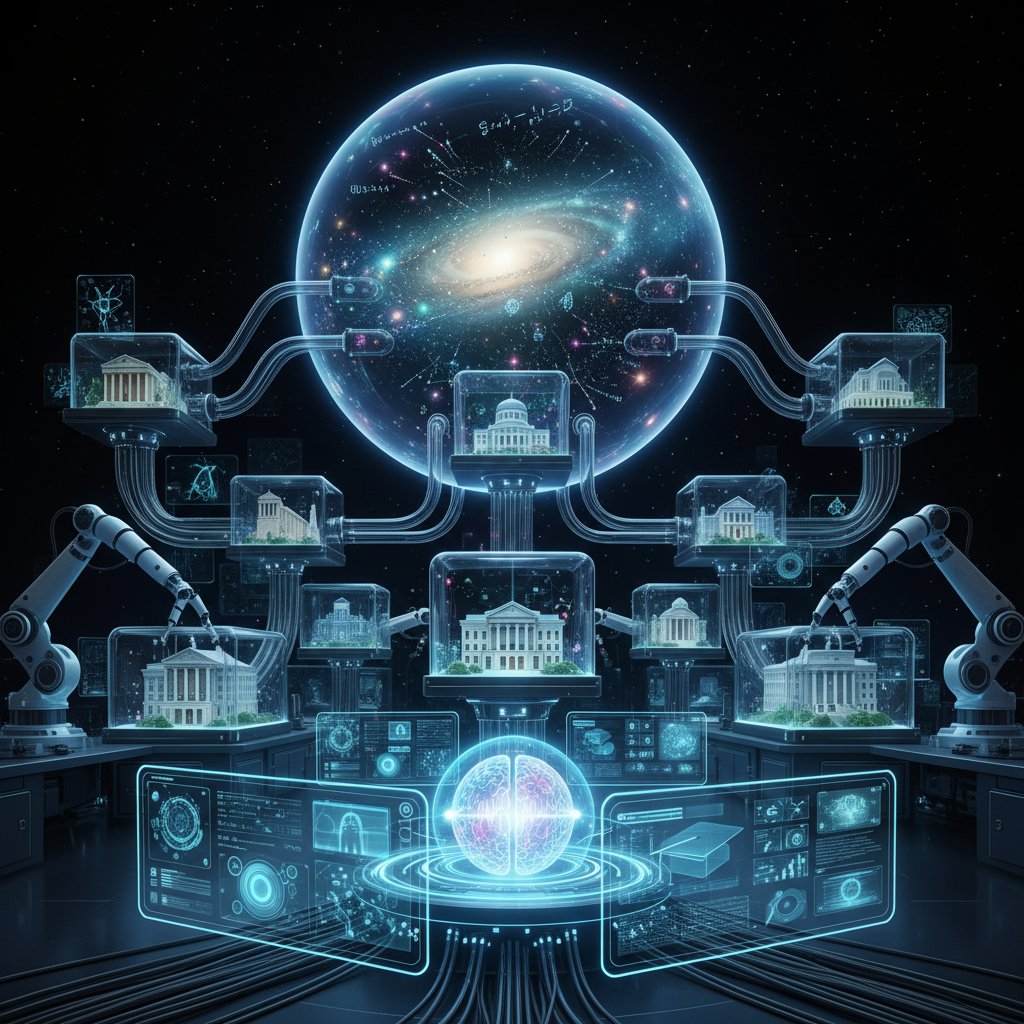
Forget memorizing the periodic table or dissecting frogs. The most profound impact of space science on everyday life might just be happening in your child’s classroom. From interactive holograms of distant galaxies to real-time data analysis from Mars rovers, space research is quietly dismantling the traditional school curriculum and rebuilding it with something far more compelling: a sense of wonder.
A child today can access the same raw data that professional astronomers use to discover exoplanets. That’s not a futuristic fantasy. That’s happening right now in hundreds of districts across the US and UK. And it’s changing how we think about learning.
From Textbooks to Telescopes: The Data Revolution
The shift began, in earnest, about a decade ago. NASA’s open-data policy, combined with the explosion of affordable satellite technology, meant that the universe was no longer locked away in elite observatories. Suddenly, a high school in Ohio could analyze light curves from the Kepler Space Telescope to identify a planet 1,200 light-years away.
“We’ve moved from teaching science as a static body of facts to teaching it as a dynamic process of discovery,” explains Dr. Anya Sharma, a former ESA education officer now leading curriculum design at the University of Cambridge. “Space gives us the perfect sandbox. The data is messy, the questions are huge, and the answers are often surprising.”
The impact is measurable. A 2023 study from the UK’s Department for Education found that schools integrating real space data into STEM lessons saw a 17% increase in student engagement among 14-16 year olds. More importantly, the effect was strongest among groups traditionally underrepresented in science, including girls and students from low-income backgrounds.
Beyond STEM: The Hidden Curriculum of Space
But the revolution isn’t just about science, technology, engineering, and math (STEM). Space is a uniquely interdisciplinary subject. Consider the art class designing a habitat for a lunar colony. Or the history lesson analyzing the geopolitical tension of the Apollo-Soyuz mission. Or the ethics debate on planetary protection: Should we contaminate Mars with Earth bacteria?
“Space forces you to think in systems,” says Mark Chen, a former astronaut instructor and current director of the Space Education Institute in Houston. “You can’t separate the engineering from the biology, or the politics from the physics. It naturally breaks down the silos we’ve built in our schools. And that’s exactly the kind of thinking kids need to tackle climate change, pandemics, or any other 21st-century problem.”
Practical Steps for Parents and Teachers
So what does this look like in practice? Here are a few programs already making a difference:
- AstroPi (European Space Agency): Students code their own experiments, run on the International Space Station. Over 80,000 students have participated since 2015.
- Eyes on the Solar System (NASA/JPL): An interactive 3D visualization tool used in over 5,000 US classrooms to track real missions in real time.
- Mission X (NASA/ESA): A fitness program training like an astronaut, which has expanded to over 30 countries and reached more than 100,000 students.
What This Means for Your Child
If you’re a parent, this shift is both promising and challenging. Promising, because it offers a richer, more relevant education. Challenging, because it demands new skills from teachers who were trained in the old system. Most teachers report feeling unprepared to handle the open-ended nature of real scientific inquiry.
“We’re asking teachers to be facilitators of discovery, not just dispensers of knowledge,” notes Dr. Sharma. “That requires a massive investment in professional development. But the payoff is huge. When a student finds a real anomaly in the data—something no one else has seen—that’s a moment that changes their life.”
And it’s not just about future astronauts. The skills taught in space-based curricula—critical thinking, data literacy, collaborative problem-solving—are exactly those listed by the World Economic Forum as essential for the jobs of 2030. Whether your child ends up designing rockets or running a restaurant, they will benefit from learning how to navigate complexity and uncertainty.
The Road Ahead: From Earth to the Stars
The next frontier in education is the Moon. With NASA’s Artemis program aiming to land the first woman and next man on the lunar surface by 2025, schools are already preparing. Programs like Moon Camp (ESA and Autodesk) let students design 3D-printed habitats using real lunar regolith data. By 2027, educational payloads from student experiments are scheduled to fly on commercial lunar landers.
This isn’t science fiction. It’s the classroom of tomorrow, arriving today. The universe, it turns out, may be the best teacher we have.
As Mark Chen puts it: “Every child looks up at the stars and wonders. Our job is to give them the tools to answer their own questions. That’s not just education. That’s empowerment.”