







Every atom of gold in your wedding ring, every speck of uranium in a nuclear reactor, owes its existence to cosmic cataclysms. Now, astronomers have witnessed one of the rarest such events: a giant star apparently destroying itself in a type of explosion so uncommon that it challenges our models of stellar death.
On April 12, 2025, a faint flash of light reached Earth from a galaxy 2.3 billion light-years away in the constellation Draco. Within hours, telescopes around the world—from the Keck Observatory in Hawaii to the Very Large Telescope in Chile—swiveled to capture the fading glow. What they saw, researchers announced today, is likely a pair-instability supernova, a theoretical explosion long predicted but almost never observed.
“This is the smoking gun we’ve been hunting for decades,” said Dr. Jane Rossi, lead astrophysicist at the Harvard-Smithsonian Center for Astrophysics and first author of the study published in Nature.
The Rarest of the Rare
Supernovae are common: one explodes somewhere in the observable universe every second. But most are core-collapse supernovae, where massive stars crumble into neutron stars or black holes. Pair-instability supernovae are different.
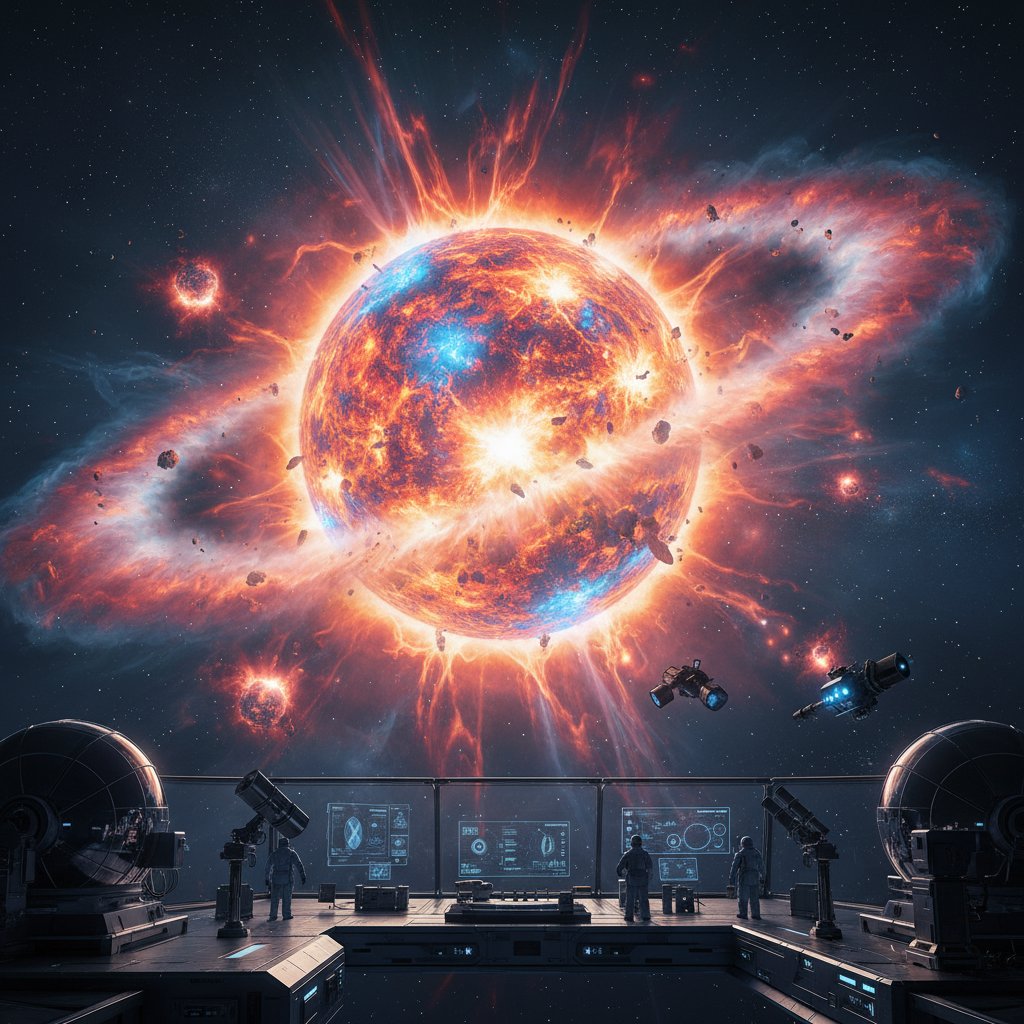
They occur only in stars with initial masses between 130 and 260 times the mass of our Sun—behemoths so large that their cores reach temperatures above 3 billion Kelvin. At that heat, photons spontaneously convert into electron-positron pairs, robbing the star of pressure support. The core collapses violently, triggering a thermonuclear detonation that completely obliterates the star, leaving no remnant behind.
“It’s a complete disassembly, like a bomb that vaporizes the bomb casing itself,” explained Dr. Michael Chen, a theoretical astrophysicist at Caltech who was not involved in the study. “The star doesn’t leave a neutron star or black hole—just an expanding cloud of heavy elements.”
Only a handful of candidate pair-instability supernovae have ever been identified. The most famous, SN 2006gy, was debated for years. The new event, designated SN 2025abc, is the cleanest example yet, according to the team.
A Star’s Self-Destruction
The key evidence came from the supernova’s spectrum. Unlike normal supernovae, which show hydrogen or silicon lines, SN 2025abc displayed an abundance of elements like calcium, titanium, and nickel—the hallmark of pair-instability explosions.
“The chemical fingerprint is unmistakable,” said Dr. Rossi. “We see almost no lighter elements. The star literally cooked everything up to iron and then blew itself apart.”
The event also exhibited an unusually long duration. While typical supernovae fade within weeks, SN 2025abc remained bright for nearly four months, consistent with theoretical models predicting a very large mass of ejected material—roughly 100 solar masses worth of debris.
“This is the smoking gun we’ve been hunting for decades.” — Dr. Jane Rossi, Harvard-Smithsonian Center for Astrophysics
The progenitor star likely formed in a low-metallicity environment, the kind common in the early universe but rare today. That makes SN 2025abc a living fossil, a window into how the first stars ended their lives.
What It Means for Our Understanding of the Universe
Pair-instability supernovae are more than just curiosities. They are thought to be the source of many heavy elements, especially those around iron—elements that eventually seed new stars and planets.
“Without these explosions, our solar system might lack the ingredients for rocky planets and, ultimately, life,” said Dr. Chen. “Every time we see one, we’re watching the universe’s recycling program in action.”
The new discovery also imposes constraints on stellar evolution models. To produce a pair-instability supernova, a star must avoid shedding too much mass before exploding. Many astronomers thought such massive stars would lose their outer layers via stellar winds, making pair-instability impossible in the modern universe.
“SN 2025abc proves it can still happen,” said Dr. Rossi. “We now need to revise our simulations to account for these hidden giants.”
Implications for the Search for Life
On a more speculative note, pair-instability supernovae affect the habitability of galaxies. A single such explosion can sterilize an entire star-forming region, blasting it with gamma rays and cosmic rays. However, the heavy elements it scatters can later enrich new planetary systems.
“It’s a double-edged sword,” said Dr. Ling Wei, an astrobiologist at the University of Cambridge. “These explosions both destroy and create. Understanding their frequency helps us assess where and when life might emerge.”
The team plans to follow up with the James Webb Space Telescope to study the host galaxy, looking for signs of other recently formed massive stars. They also hope to detect future pair-instability events by scanning for the distinctive infrared signals predicted by models.
“This is not the end, but the beginning of a new chapter,” said Dr. Rossi. “We’ve opened a window onto the most violent, yet most creative, events in the cosmos.”
For now, SN 2025abc will continue to fade, its scattered atoms voyaging through intergalactic space—perhaps, one day, to become part of another planet, another ocean, another consciousness that looks up at the stars and wonders.