






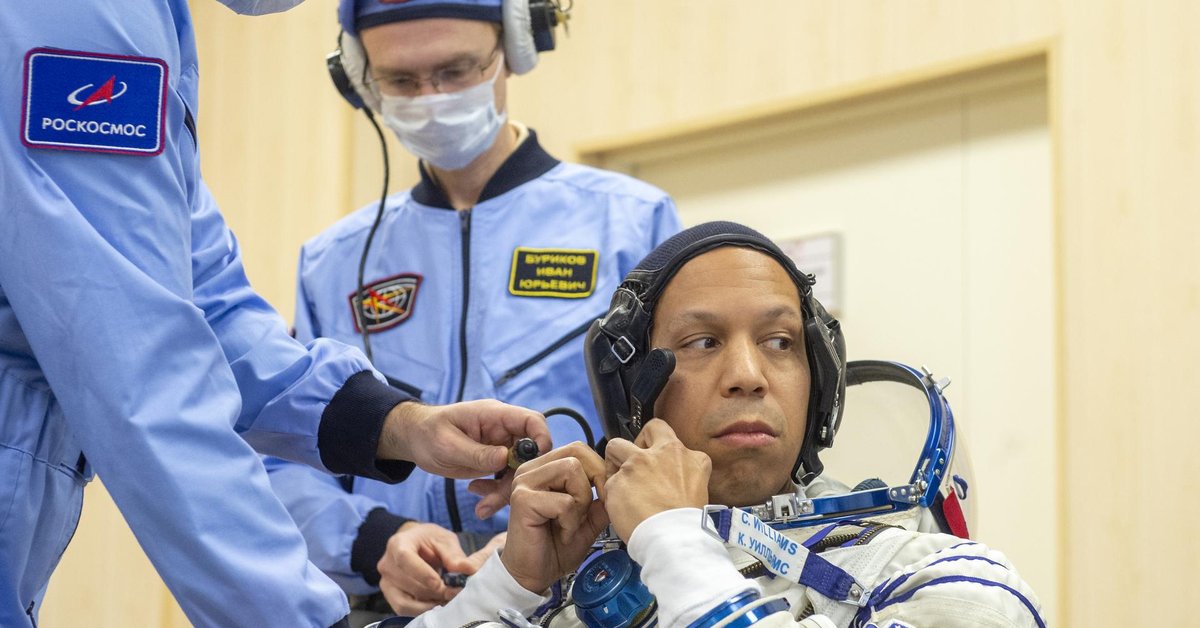
When NASA astronaut Chris Williams touched down in the Kazakh steppe on Sunday at 5:27 a.m. CDT, he didn’t just end an eight-month stay aboard the International Space Station. He brought back a payload of data that, if past missions are any guide, will quietly reshape everything from drug design to materials science back on Earth. The splashdown — or rather, the parachute-assisted thud into the desert — marks the close of Expedition 71/72, a rotation that saw the crew conduct over 200 experiments in microgravity. But the real story isn’t the return itself. It’s what we’re only beginning to understand about doing science in a place where fire doesn’t burn the same way.
Williams, alongside Roscosmos cosmonauts Sergey Kud-Sverchkov and Sergei Mikaev, undocked from the ISS in their Soyuz MS-26 spacecraft and executed a flawless descent to the remote landing zone near Zhezkazgan, Kazakhstan. The trio looked visibly relaxed as ground crews extracted them from the capsule — a routine that’s become almost mundane after two decades of continuous habitation. Almost. Because the mundane, in this context, is a quiet miracle of engineering and biology.
The Eight-Month Toll on the Human Body
Let’s get one thing straight: eight months in space is not a vacation. It’s a controlled assault on the human skeleton. Without gravity pulling down, bones lose calcium at a rate of about 1% per month. Muscles atrophy. Fluids shift upward, squishing the eyeballs and causing vision changes — a condition called Spaceflight-Associated Neuro-Ocular Syndrome, or SANS. Williams and his crewmates have been poked, prodded, and scanned every step of the way.
“The data from this mission will help us understand why some astronauts bounce back quickly while others struggle for months,” according to a NASA briefing released before the landing. The agency is particularly focused on countermeasures: exercise regimens, nutritional tweaks, and even pharmaceutical interventions that could keep future Mars-bound crews healthy on a three-year round trip.
But here’s the kicker: the research isn’t just for astronauts. The same bone loss mechanisms that plague space travelers are identical to what happens in osteoporosis patients on Earth. So the drugs tested up there — the ones that might keep a hip from fracturing after a fall — could end up in your grandmother’s pharmacy. And that’s the part that doesn’t make the nightly news.
Fire, Crystals, and the Weird Physics of Microgravity
One of the more visually striking experiments Williams oversaw involved combustion in microgravity. Fire behaves differently when there’s no buoyancy-driven convection. Flames form spheres. Soot particles drift in patterns that look like tiny galaxies. The goal? Build better fire suppression systems for spacecraft — but also design cleaner-burning engines on Earth. The physics doesn’t care whether you’re in orbit or on the freeway.
Another set of experiments focused on protein crystal growth. In microgravity, crystals can grow larger and more perfectly ordered than in Earth’s gravity. That lets researchers map the 3D structure of disease-related proteins with higher resolution. Think of it as a molecular GPS for drug targets. If you’ve ever taken a medication for cancer or autoimmune disease, there’s a non-zero chance its design was informed by a crystal grown on the ISS.
And then there’s the psychology. Eight months of confinement, recycled air, and the same faces — it’s a social experiment as much as a scientific one. NASA has been collecting data on crew cohesion, conflict resolution, and sleep patterns. The findings are feeding directly into plans for the Lunar Gateway and, eventually, Mars. In a way, Williams’ mission was a dress rehearsal for the long haul.
Interestingly, the timing of this return coincides with growing public debate about the future of human spaceflight. While Williams was up there, a story broke about Antarctic guides quitting over climate-related disillusionment — a reminder that extreme environments, whether polar or orbital, test human limits in ways that policy can’t fully prepare for. The parallels are striking: isolation, resource scarcity, and the constant hum of existential risk.
What Comes Next for the ISS and Its Crews
Williams’ return is part of a carefully choreographed rotation. With his departure, the ISS now hosts Expedition 72, led by NASA astronaut Anne McClain. The next Soyuz launch is scheduled for late April, carrying a fresh crew to continue the work. But the bigger picture is shifting. NASA has committed to operating the ISS through 2030, after which the station will be deorbited into the Pacific Ocean. Private stations from companies like Axiom Space and Blue Origin are expected to take over low-Earth orbit science.
This transition raises a question: will commercial operators prioritize the same kind of fundamental research that NASA and Roscosmos have conducted for decades? Or will they chase shorter-term profits — tourism, manufacturing, media stunts? The answer matters for scientists who rely on microgravity to answer basic questions about the universe.
For now, Williams and his crewmates are undergoing a 45-day rehabilitation program to regain strength and balance. They’ll be re-acclimating to gravity, one step at a time. Meanwhile, the data they collected is already being downloaded and analyzed by hundreds of researchers around the world. The real work has just begun.
As for the broader implications: this mission underscores that space isn’t just a destination. It’s a laboratory. And every time a capsule lands in the Kazakh desert, we get a little smarter about living — both up there and down here.
Frequently Asked Questions
How long did Chris Williams spend on the ISS?
NASA astronaut Chris Williams spent approximately eight months aboard the International Space Station, from his launch in early 2024 to his return on Sunday, April 6, 2025.
What kinds of experiments did the crew conduct?
The crew performed over 200 experiments, including studies on bone loss countermeasures, protein crystal growth for drug design, combustion in microgravity, and crew psychology — all of which have applications both in space and on Earth.
What happens to the ISS now after Williams’ return?
The ISS continues operations with Expedition 72 under NASA astronaut Anne McClain. The station is expected to remain crewed through 2030, after which it will be deorbited and replaced by commercial space stations.