
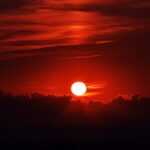



Nobody is talking about this: the blood-red sun hanging over North America this summer isn’t a cosmic event or an atmospheric anomaly—it’s a direct, measurable consequence of wildfire smoke at high altitude. And the science behind why the sun turns red says something unsettling about what’s already in the air we breathe.
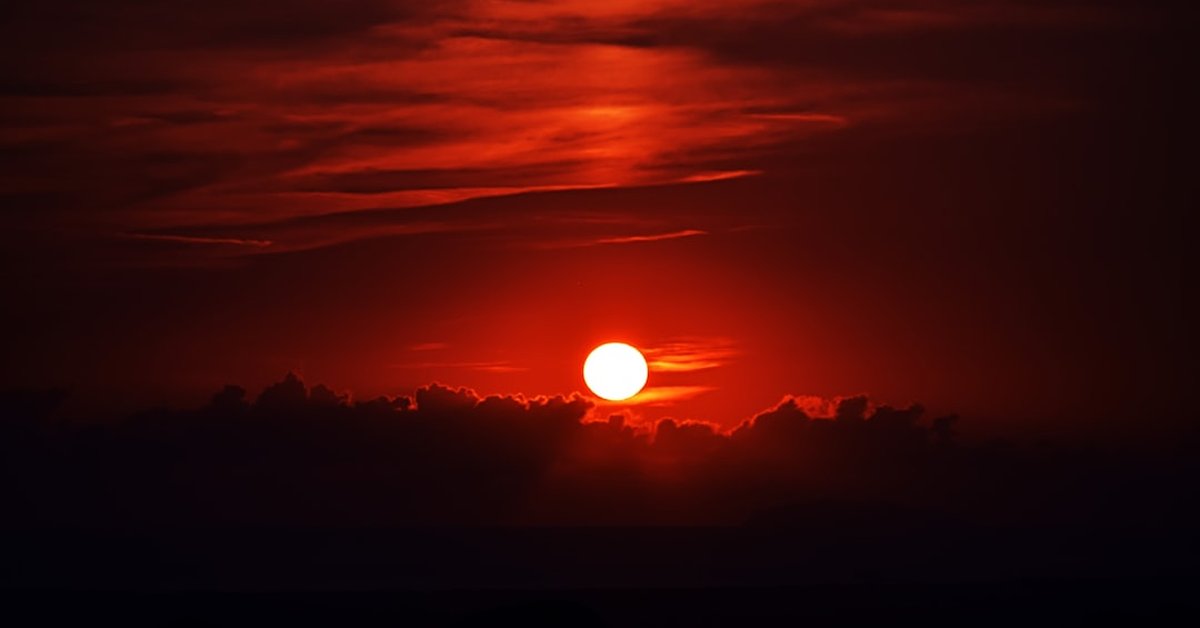
On July 30, NASA’s Astronomy Picture of the Day (APOD) featured a striking image of a deep red sun filtered through wildfire smoke. The caption was brief—a technical note about Rayleigh scattering and particulate matter. But what it didn’t say is that this phenomenon, once rare outside of major fire zones, is now appearing routinely across the United States, Canada, and even parts of Europe. That’s the part worth unpacking.
The Physics of a Red Sun—and Why It Matters
Sunlight contains all visible wavelengths. Normally, blue light scatters more than red as it passes through the atmosphere—that’s why the sky is blue. But when smoke particles (typically <2.5 micrometers in diameter, known as PM2.5) saturate the upper troposphere, they preferentially scatter the shorter blue and green wavelengths, leaving only the longer red and orange to reach your eyes. The result is a sunset-colored sun at noon.
This isn’t just a pretty picture. According to the National Oceanic and Atmospheric Administration (NOAA), the same particulate matter that reddens sunlight is small enough to penetrate deep into lung tissue and enter the bloodstream. In other words, the visual signal you see in the sky is also a health signal. When the sun looks red at midday, the air quality index (AQI) in that region is almost certainly elevated into the ‘unhealthy’ or ‘hazardous’ range.
What’s changed in recent years is the altitude of the smoke. Wildfire plumes now routinely inject smoke into the stratosphere, where it can travel thousands of miles and persist for weeks. That’s a shift from even a decade ago, when most fire smoke stayed closer to the ground and cleared out faster.
What a Red Sun Tells Us About Fire Season 2024
The APOD image from July 30 captures a moment, but the trend is what matters. Canada’s 2024 fire season started early and aggressively. By mid-July, the Canadian Interagency Forest Fire Centre (CIFFC) had recorded over 3,000 fires and nearly 4 million hectares burned—more than double the 10-year average for that date. Smoke from Quebec, Ontario, and British Columbia drifted south into the US, triggering air quality alerts from Minnesota to New York.
This is not an isolated event. The pattern matches what climate models have predicted for two decades: warmer temperatures and earlier snowmelt create drier fuels, which burn hotter and longer. Hotter fires produce more pyrocumulonimbus clouds—essentially fire-generated thunderstorms—that punch smoke into the upper atmosphere. And that’s where the red sun comes from: high-altitude smoke that hangs around.
For context, the 2023 Canadian fire season was the worst on record, with over 18 million hectares burned. The 2024 season is tracking close behind. What the APOD image doesn’t show is the invisible part: the carbon monoxide, volatile organic compounds, and heavy metals riding along with that smoke.
What This Means for You—Beyond the Photo Op
For people in the US, UK, and Canada, the practical takeaway is straightforward. If the sun looks red or orange during the middle of the day, check your local AQI before going outside. The Environmental Protection Agency’s AirNow website provides real-time data. A reading above 150 means even healthy adults should limit outdoor exertion. For children, the elderly, and anyone with respiratory conditions, the threshold is lower.
There’s also an economic angle. Wildfire smoke disrupts agriculture by reducing solar radiation available for photosynthesis—a phenomenon known as ‘global dimming.’ Studies from the University of California, Davis estimate that heavy smoke periods can reduce crop yields by 10–30% in affected regions. That hits food prices and supply chains weeks later. So that red sun? It’s a leading indicator for higher grocery bills.
And here’s the longer view: the increasing frequency of red-sun events is a visible proxy for a larger shift in fire regimes. In the western US, fire seasons are now 78 days longer than in 1970, according to a 2022 study in Scientific Reports. The same study projects that by 2050, wildfire smoke could affect 125 million Americans annually. That’s roughly one in three people.
Interestingly, the same atmospheric conditions that redden the sun also reduce visibility for satellite imaging and ground-based astronomy. As we push into an era of more frequent launches—NASA’s 2026 NIAC awards, for instance, include proposals for solar system shortcuts—smoke interference could become a practical constraint for observation windows. Not a catastrophic one, but an added variable that mission planners will have to budget for.
Meanwhile, in the UK and parts of Europe, red-sun events are still relatively rare but becoming less so. In 2023, smoke from Canadian wildfires crossed the Atlantic and turned skies hazy over London and Paris. For communities not accustomed to wildfire smoke, the red sun can be disorienting. But the science is the same: if you see it, the air is probably worse than it looks.
Look, I’m not saying every red sunset is a crisis. But a red sun at noon is a different animal entirely. It means the smoke is thick enough and high enough to shift the color balance of the entire sky. That’s not normal. And normalizing it—treating it as just another summer phenomenon—misses the point.
For readers who want to track this in real time, NASA’s Worldview tool shows satellite imagery of smoke plumes updated every few hours. Pair it with your local AQI reading, and you’ve got a pretty good picture of what’s actually in the air. The red sun is a symptom. The smoke is the story.
Frequently Asked Questions
Why does wildfire smoke make the sun look red?
Smoke particles in the atmosphere scatter shorter wavelengths of light (blue and green) more effectively than longer wavelengths (red and orange). When smoke concentrations are high, especially at altitude, the blue light is removed from the direct path to your eye, leaving only red light. This is the same physics that makes sunsets red, but with smoke it can happen at any time of day.
Is a red sun a reliable indicator of unhealthy air quality?
Generally, yes. A distinctly red or orange sun at midday usually indicates high levels of PM2.5 particulate matter in the air. However, it’s not a precise measurement. For accurate data, check the Air Quality Index (AQI) from a local monitoring station. A red sun is a strong visual cue to look up the numbers, not a replacement for them.
How long can wildfire smoke stay in the atmosphere?
It varies. Low-altitude smoke from nearby fires may clear in hours or days. But smoke injected high into the stratosphere by intense firestorms can remain for weeks and travel intercontinental distances. The 2023 Canadian wildfire smoke that reached Europe took about 10 days to cross the Atlantic and lingered for several more days over the UK.