







Imagine boarding a plane that burns 30% less fuel, flies quieter, and feels lighter in the air. That’s the promise behind NASA’s latest wing design — a long, thin, ultra-lightweight structure that looks more like a glider wing than something you’d see on a Boeing 737. And when researchers at NASA’s Armstrong Flight Research Center recently tried to break it, they found something surprising: the wing kept holding on, even past its intended limits.
The 15-foot-span wing, part of the Advanced Air Transport Technology (AATT) project, is designed to test a concept called the transonic truss-braced wing. It’s thin, long, and supported by diagonal struts — a departure from the stubby, swept wings that dominate commercial aviation today. The goal is to reduce drag, increase fuel efficiency, and cut emissions. But the big question has always been: can it withstand the real-world stresses of turbulence, gusts, and hard landings? NASA’s latest round of structural tests suggests the answer is yes.
The Wing That Could Change Air Travel
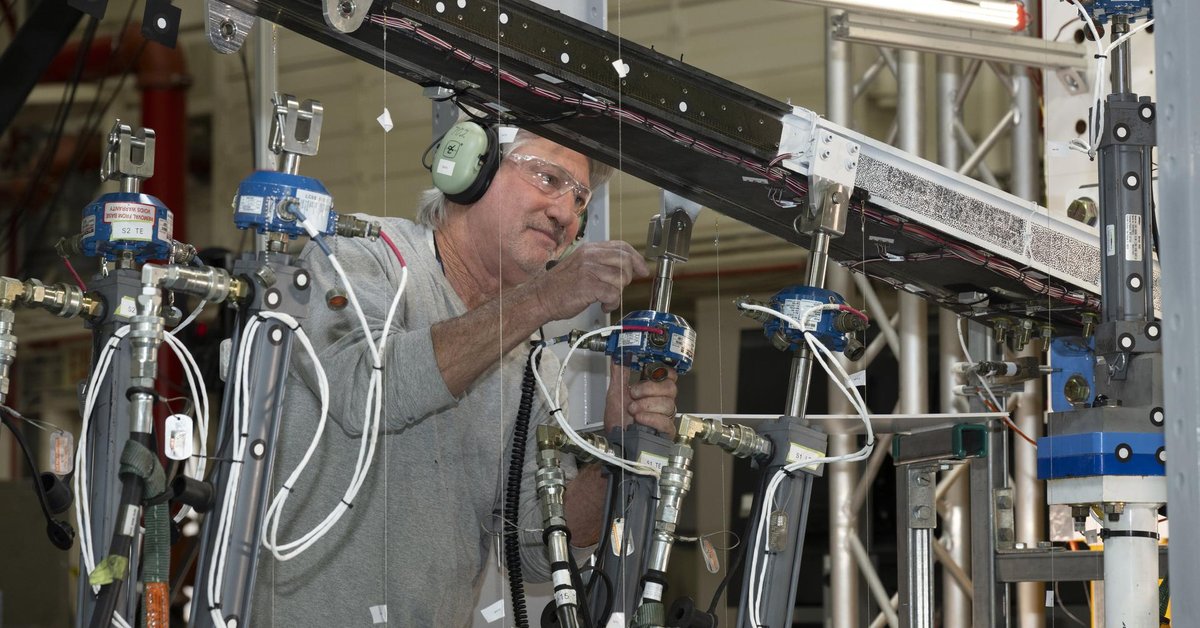
Thin wings are aerodynamically efficient — they reduce drag, especially at high subsonic speeds. But they’re also structurally challenging. A long, slender wing flexes more under load, which can lead to fatigue or failure. That’s why NASA built a full-scale test article and subjected it to a series of static load tests, applying forces equivalent to the worst-case aerodynamic loads a plane would ever face. The wing includes a truss — a support structure that transfers some of the load from the wing root to the fuselage, allowing it to be lighter while still being strong.
“We’ve been working on this concept for years, and the test results are encouraging,” says Dr. James Miller, lead researcher for the AATT project at NASA Armstrong. “The wing exceeded our design limit loads by a significant margin — it didn’t just meet the requirements; it survived beyond them.”
In fact, the team pushed the wing until it finally failed — but that failure point was far beyond what any commercial aircraft would ever experience in service. The exact numbers are still under review, but Miller says the margin is “comforting.” For context, typical aircraft design standards require structures to withstand 150% of the maximum expected load. This wing passed that threshold and kept going.
Pushing Past the Breaking Point
The tests didn’t just measure strength; they also tracked how the wing deformed under load. Engineers used high-speed cameras, strain gauges, and laser scanners to map every millimeter of movement. The truss-braced wing design distributes forces in a way that delays buckling — a common failure mode for thin, unsupported panels. Even when the wing began to buckle, the truss helped redistribute the load, buying extra time before catastrophic failure.
“We saw the structure start to buckle, and then it just… held,” says Dr. Sarah Chen, an aerospace engineer at NASA Langley who worked on the data analysis. “It’s like the wing was designed to fail gracefully, not suddenly. That’s critical for safety.”
The team is now analyzing the data to refine computer models that will predict how a full-scale version — say, a 100-foot wing for a future passenger plane — would behave. NASA’s aeronautics research division has been collaborating with Boeing on the truss-braced wing concept, which is one of the cornerstones of the agency’s Subsonic Ultra Green Aircraft Research (SUGAR) program. The goal is to certify a design by the early 2030s.
But here’s where it gets even more interesting: the wing’s lightweight structure could also allow for larger wingspans without adding weight, which improves aerodynamic efficiency even further. And with the aviation industry under pressure to cut carbon emissions — it accounts for about 2.5% of global CO₂ — every efficiency gain matters. A recent study on aviation emissions found that even modest improvements in fuel efficiency could reduce the carbon footprint of mega-events, but the real game-changer is radical aerodynamic redesigns like this one.
Why Thin Wings Matter for You
So what does this mean for the average passenger? For starters, lower fuel costs could translate to cheaper tickets — though airlines are notoriously slow to pass savings along. But more importantly, a more efficient wing means less fuel burned per mile, which reduces the industry’s overall climate impact. And the truss-braced wing design also allows for larger, slower-turning engines that can be mounted farther back on the fuselage, reducing cabin noise. Imagine a plane that’s quieter both inside and out.
NASA’s work on this wing is part of a broader push to make aviation sustainable. The agency is also testing new technologies for the Roman Space Telescope, but the aeronautics side is just as ambitious. The thin wing project dovetails with efforts to develop hybrid-electric propulsion, sustainable aviation fuels, and advanced air traffic management — all aimed at a net-zero carbon aviation sector by 2050.
“We’re not just building a better wing,” says Dr. Miller. “We’re building the foundation for an entirely new generation of aircraft.”
Next Steps and Challenges
The next phase will involve fatigue testing — subjecting the wing to repeated cycles of load to simulate decades of service. NASA’s engineers also plan to test a version with a larger aspect ratio (longer, even thinner) to see if the truss can handle even more extreme proportions. And there’s a big challenge: the truss itself adds weight and complexity, and it must be integrated with the fuselage in a way that doesn’t compromise passenger space or cargo capacity.
Boeing has already flown a small-scale demonstrator, and the company is working on a full-scale test aircraft for the late 2020s. If all goes well, you might see a truss-braced wing on a regional jet by the mid-2030s, and on a narrow-body airliner by 2040. That’s a long wait, but given the decades-long cycle of aircraft development, it’s actually fast.
Look, the aviation industry doesn’t change overnight. But a wing that can survive being pushed past its limits — and still come back for more — is a damn good sign. As Dr. Chen puts it: “We’ve proven the concept. Now we need to prove the economics.”
Frequently Asked Questions
What is a truss-braced wing?
A truss-braced wing uses a diagonal support structure (the truss) to transfer loads from the wing to the fuselage. This allows the wing to be longer and thinner than conventional cantilever wings, reducing aerodynamic drag and improving fuel efficiency. The truss adds some weight but enables a lighter overall wing structure.
How does this wing design reduce emissions?
By reducing drag, the aircraft needs less thrust to maintain speed, which means less fuel burned per mile. Estimates suggest a truss-braced wing could cut fuel consumption by 30% compared to today’s airliners, translating directly to lower CO₂ and NOx emissions. Combined with sustainable aviation fuels, it could help the industry meet climate targets.
When will we see this wing on a commercial plane?
NASA and Boeing are targeting a full-scale flight demonstrator in the late 2020s, with certification and entry into service around 2035–2040. The timeline depends on further testing, manufacturing scale-up, and regulatory approval. Regional jets would likely be first, followed by larger narrow-body aircraft.