






It sounds like science fiction, but it’s real. NASA‘s TESS mission has just revealed two exoplanets so bizarre they defy logic — worlds the size of Jupiter, but with densities comparable to cotton candy. These are the puffiest planets ever discovered, and they’re rewriting what we thought we knew about how planets form.
This isn’t just another exoplanet discovery. These so-called “super-puff” planets challenge the very definition of a planet. Imagine a gas giant so light it would float on water — if you could find a body of water big enough. These two newly confirmed worlds orbit a star called Kepler 51, about 2,600 light-years from Earth. And they’re part of a system that already held the record for the puffiest planets — now, TESS has found two more, pushing the boundary even further.
What Are Super-Puff Planets?
Super-puffs are a rare class of exoplanets with remarkably low densities. Their masses are somewhere between Earth and Neptune, but their radii are inflated to Jupiter-like proportions. The result? Densities less than 0.1 grams per cubic centimeter. For reference, water’s density is 1 gram per cubic centimeter. Cotton candy? Roughly 0.01 g/cm³. These planets are even fluffier than that.
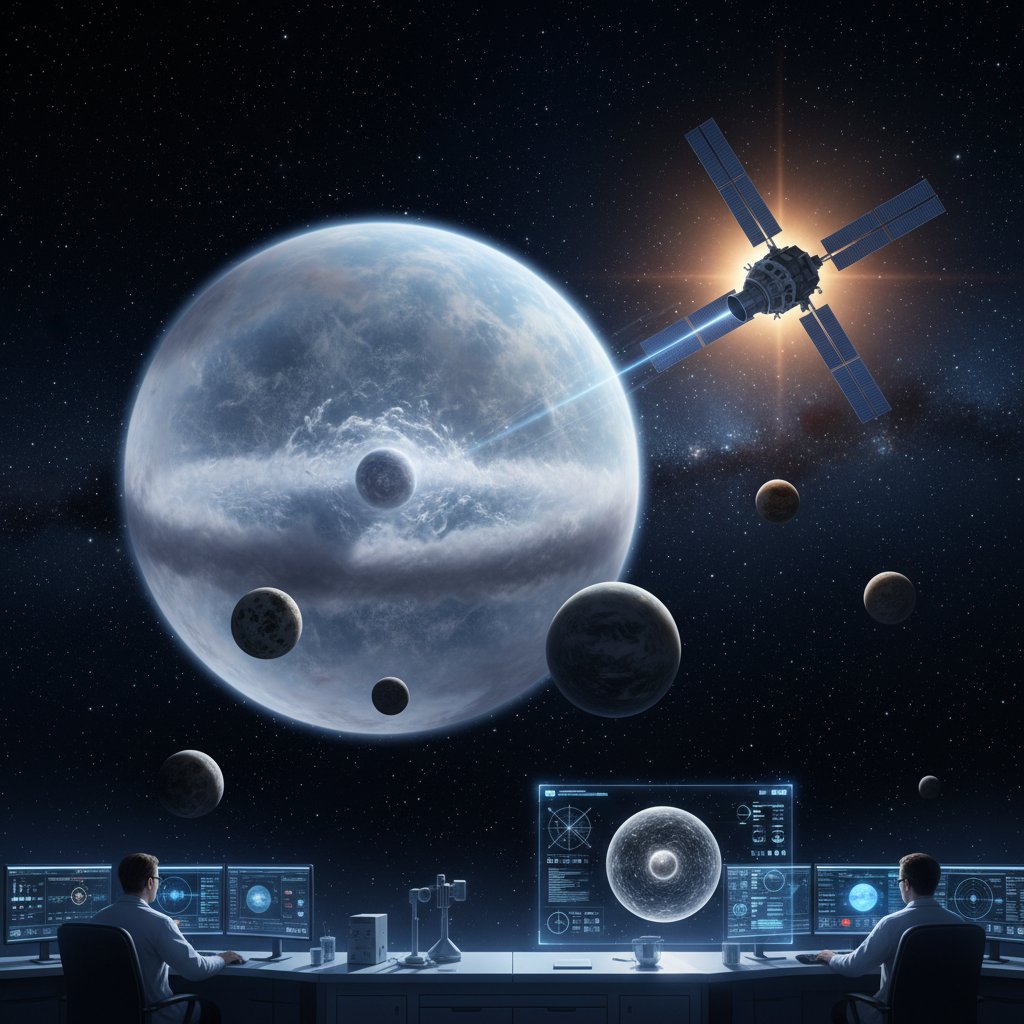
Dr. Jessica Libby-Roberts, a researcher at the University of Colorado Boulder who led the study, told reporters: “These planets are incredibly weird. They have the density of cotton candy, and yet they’re enormous. Our atmospheric models can barely explain them.” TESS — the Transiting Exoplanet Survey Satellite — observed the Kepler 51 system repeatedly, capturing the faint dips in starlight as the planets passed in front of their host star. Those dips revealed their sizes, and follow-up observations with ground telescopes allowed scientists to calculate their masses.
So here’s the thing: the Kepler 51 system is already famous for three other super-puffs discovered in 2019. But TESS data showed that these two new planets — Kepler-51e and Kepler-51f — are even puffier. They’re so low-density that some astronomers joke they’re not planets at all, but “floating space clouds.” And they’ve genuinely got people scratching their heads.
The Puffiest Ever Found
Let’s talk numbers. The two new planets have radii similar to Jupiter’s — roughly 70,000 to 80,000 km across — but their masses are only a fraction of Earth’s. One of them has a density of about 0.01 g/cm³. That’s roughly the same as a bag of cotton candy from a carnival. “It’s almost like these planets are made of air,” said Dr. Mark Fox, an exoplanet modeler at Caltech who was not involved in the study. “We’ve never seen anything quite like it.”
Look, these worlds aren’t just fluffy — they’re dramatically under-dense. Most gas giants like Jupiter are composed mostly of hydrogen and helium, compressed to immense densities by their own gravity. But super-puffs have a different internal structure. They likely have extended, puffy atmospheres filled with light gases that are heated by the star, causing them to balloon outward. “Think of a ball of foam rather than a solid rock,” Dr. Libby-Roberts added.
“These planets are so unusual that they might be a new class of exoplanets altogether. They’re teaching us that planetary formation can produce outcomes we never expected.” — Dr. Jessica Libby-Roberts
The discovery was announced at the recent American Astronomical Society meeting, and the data was collected over multiple TESS observation sectors. The paper has been submitted to The Astronomical Journal. And while the public might not be paying attention yet — this is the nobody is talking about this angle — planetary scientists are buzzing.
How Do You Get a Planet Like This?
Good question. And so far, we don’t have a perfect answer. One leading theory: these planets might have formed farther from their star, where ices and gases are abundant, then migrated inward. The heat from the star inflates their atmospheres, giving them that super-puff quality. Another idea: these worlds might have substantial rings that throw off our calculations of their true size. But Libby-Roberts’ team ruled that out using infrared observations — no rings.
Another possibility — and this is the exciting one — is that super-puffs represent a planet caught in a transitional stage. Think of a planet that’s losing its atmosphere: it could puff up before collapsing down to a more compact world. “We might be seeing a snapshot of planetary evolution,” said Dr. Fox. “If that’s the case, these objects are like cosmic fossils.”
The implications ripple outward. Understanding super-puffs may help us classify other strange exoplanets, like the so-called “hot Jupiters” and “mini-Neptunes.” And it could even inform our search for habitable worlds — after all, if planets can vary this wildly in density, then what else is out there?
It’s a good reminder: space is weird. And NASA’s TESS mission, which is largely known for discovering terrestrial planets in the habitable zone, keeps delivering surprises. For context, TESS has now found over 5,000 candidate planets since its launch in 2018, and this weird system might be its most unusual yet. Meanwhile, just last month, Inside Artemis II: Orion’s Lessons That Could Take Us to Mars showed how we’re still pushing the boundaries of human spaceflight — and TESS pushes them at the cosmic level.
What This Means for Exoplanet Science
Let’s put this in perspective: we’ve now confirmed two new super-puffs in the same system, which means this star is a puffy planet factory. Why? What’s special about Kepler 51? The star itself is young and active, which may explain the inflated atmospheres. But scientists admit they’re still in the dark.
The next step is to study these planets’ atmospheres with the James Webb Space Telescope. JWST’s infrared capabilities can detect the chemical signatures of gases in their puffy envelopes. If we find elements like water vapor, carbon dioxide, or methane, we can begin to piece together their origins. “JWST observations will be transformative,” said Dr. Libby-Roberts. “We can finally see what these worlds are made of.”
For the average reader, this discovery might feel abstract. But consider this: the more we learn about these bizarre planets, the better we understand our own solar system. Why is Jupiter so dense, while these planets are not? Why does Earth have a solid surface? The range of possibilities out there is staggering.
And as we continue to explore — whether through missions like TESS or telescopes like the upcoming Nancy Grace Roman Space Telescope — we might find that super-puffs are not rare at all. They could be everywhere, hiding in plain sight.
For now, these two cotton candy worlds hold the record. But you can bet astronomers are looking for more. And they’re probably not going to find anything normal anytime soon.
Frequently Asked Questions
What makes a planet a “super-puff”?
A super-puff is an exoplanet with an extremely low density — less than about 0.3 g/cm³. They have the size of a gas giant like Jupiter but the mass of a much smaller world, often only a few times Earth’s mass. Their atmospheres balloon outward, making them appear inflated and fluffy.
How did TESS discover these planets?
TESS detects planets via the transit method — it monitors the brightness of stars and looks for tiny, periodic dips caused by a planet passing in front. For the Kepler 51 system, TESS observed multiple transits over several months, which allowed scientists to measure the planets’ sizes and, combined with ground-based radial velocity data, their masses.
Could these planets ever be habitable?
Unlikely. These super-puff planets are gas giants with no solid surface, and their upper atmospheres are extremely hot — possibly hundreds of degrees Celsius. They lack the conditions necessary for liquid water or life as we know it. However, studying them helps us understand the diversity of planetary systems, which indirectly informs the search for habitable worlds.
For more on the latest exoplanet discoveries, check out NASA’s TESS mission page at exoplanets.nasa.gov/tess and the full research paper on arXiv.