







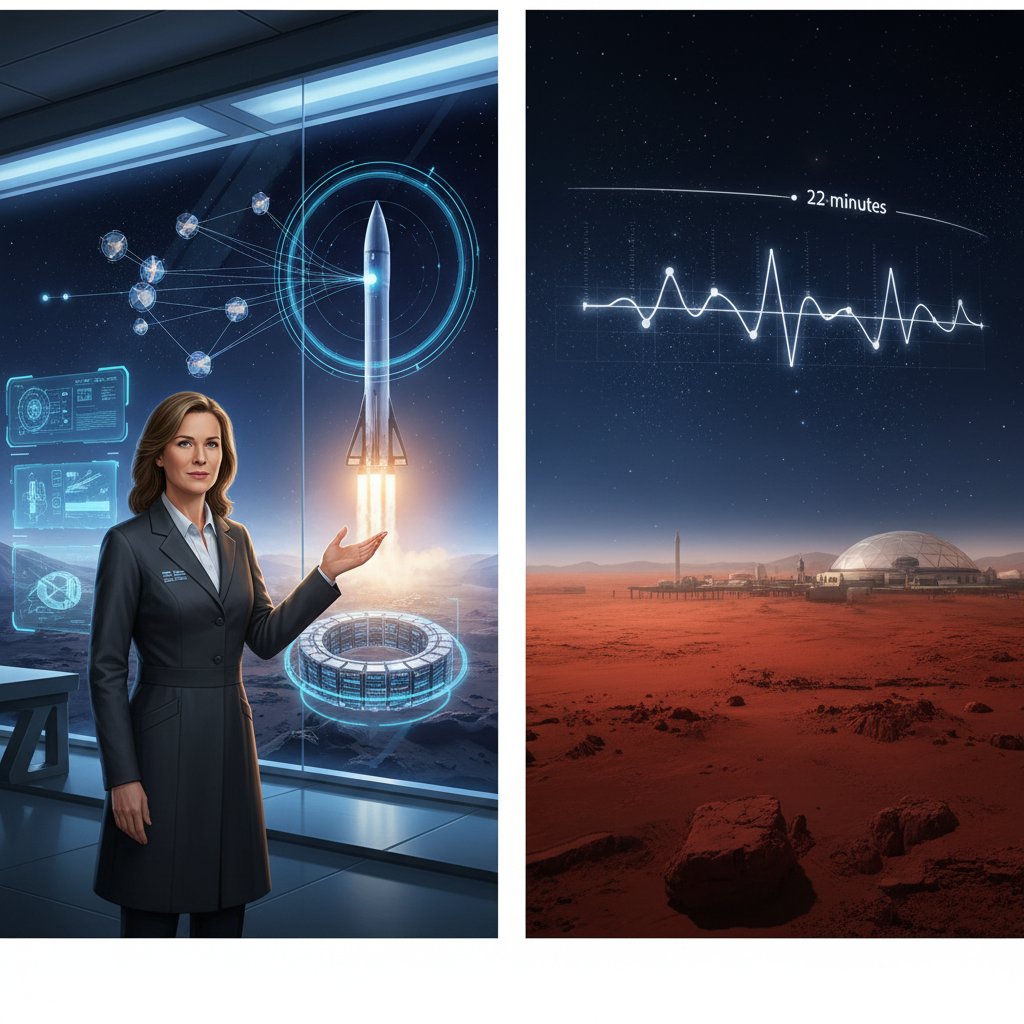
By the end of this decade, the way you stream video, run cloud applications, or even book a flight could depend on data processed not in a warehouse in Virginia, but in a server rack orbiting 550 kilometers above your head. That is the vision Gwynne Shotwell, president and chief operating officer of SpaceX, laid out in a wide-ranging interview this week. The conversation, which spanned nearly 22 minutes, covered the company’s immediate commercial priorities, the rapid iteration of the Starship launch system, and the long arc of becoming a multiplanetary species.
Shotwell’s remarks come at a pivotal moment. SpaceX’s Starlink constellation now numbers over 5,000 operational satellites and serves more than 2.3 million subscribers across 70 countries. But the company sees connectivity as only the first layer of a much larger space-based infrastructure. “We’re starting to have serious conversations with cloud providers about putting compute nodes in orbit,” Shotwell said. “Latency-sensitive applications — high-frequency trading, autonomous vehicle coordination, real-time disaster response — could benefit enormously from not having to send data thousands of miles on the ground.”
The Next Leap in Low Earth Orbit
Orbital data centers have been a theoretical concept in aerospace engineering circles for at least two decades. The fundamental challenge is cost: lifting a single kilogram of cargo to low Earth orbit (LEO) still runs between $1,500 and $3,000 on most commercial launchers. At those prices, a fully equipped data center module would cost hundreds of millions of dollars just in launch fees. But Starship, SpaceX’s fully reusable super-heavy-lift vehicle, changes that calculation. With a target cost of roughly $10 million per launch and a payload capacity of 100 to 150 metric tons to LEO, the cost per kilogram could drop below $100.
“If Starship flies at even a tenth of its projected launch cadence — say 50 to 100 flights per year — the economics of putting infrastructure in space completely invert,” said Dr. Karina Patel, a space systems engineer at the University of Southern California who studies orbital logistics. “You go from ‘can we afford to launch a server rack?’ to ‘how many racks do we want to fly?’”
Shotwell confirmed that SpaceX is already working with at least one major cloud computing firm on a prototype orbital node, though she declined to name the partner. The module would initially be attached to a Starship that remains in orbit as a free-flying platform, drawing power from its own solar arrays and communicating with ground stations via laser links in the Starlink network. “We’re aiming for a demonstration mission within the next 18 to 24 months,” Shotwell said. “It won’t be a full data center — more of a breadboard test. But it’s the first step toward a true space-based cloud.”
Starship: The Workhorse for a New Space Economy
The Starship program itself has had a turbulent year. After the third integrated test flight in March 2024 achieved a controlled reentry and splashdown in the Indian Ocean, the fourth flight in June lost the Super Heavy booster during a landing burn and the upper stage broke apart during reentry. Nonetheless, SpaceX has maintained an aggressive iteration schedule. “We learn as much from a failure as we do from a success,” Shotwell said. “Every flight gives us data that reshapes the vehicle. We’re aiming for weekly flights by 2026.”
That timeline aligns with a broader strategy. The U.S. Space Force has awarded SpaceX a $150 million contract to demonstrate on-orbit refueling using Starship tanker variants by 2027 – a capability essential for sending large payloads to Mars. NASA’s Human Landing System contract also depends on Starship for the Artemis III and IV lunar missions. “Starship isn’t just a rocket; it’s the chassis for an entire ecosystem,” said retired Air Force Colonel Eric Voss, now a space policy fellow at the Hudson Institute. “Once you have cheap, high-cadence access to orbit and the ability to refuel, you unlock everything from lunar bases to asteroid mining.”
Shotwell acknowledged that the company has had to restructure certain production lines to accelerate manufacturing. The Boca Chica facility in Texas is being expanded to accommodate a second high-bay for stacking, while the Cape Canaveral launch site is being upgraded for Starship operations. “We’re building the equivalent of an airline factory, not a rocket factory,” she said. “That shift in mindset is harder than any engineering problem we’ve solved.”
From Orbital Data Centers to Martian Cities
When the conversation turned to Mars, Shotwell’s tone shifted from operational pragmatism to something approaching reverence. Elon Musk has long articulated a goal of building a self-sustaining city on Mars with a population of one million. Shotwell, while still focused on near-term milestones, made it clear that the Martian ambition remains central to the company’s identity. “We have to be realistic about the timeline,” she said. “We need Starship flying reliably, we need orbital refueling, we need at least two or three unmanned cargo runs to establish life-support infrastructure before anyone sets foot there. That probably means the first crewed mission is in the early 2030s, not 2029.”
She highlighted a frequently overlooked point: in-situ resource utilization (ISRU). Mars has a thin atmosphere rich in carbon dioxide and water ice in the subsurface. Electrolysis of that water yields oxygen for breathing and hydrogen for rocket fuel. “The most important cargo we’ll send to Mars isn’t food or water — it’s the equipment to make those things there,” Shotwell noted. “Every kilogram you can produce on site is a kilogram you don’t have to launch from Earth.” That principle also applies to orbital data centers: rather than bringing all the hardware from Earth, SpaceX envisions using Starships to deliver fabrication units that can assemble server racks from aluminum and silicon harvested from asteroid or lunar regolith.
Dr. Patel pointed out that the two projects — orbital data centers and Martian settlement — are more connected than they seem. “If you can operate a server in the vacuum of space for years without maintenance, and if you can build a closed-loop life-support system for that server’s cooling, you’re essentially solving the same problems you’d need for a Mars habitat,” she said. “The technology maturation pathway runs through LEO before it heads to the Red Planet.”
What This Means for Earth
For everyday users, the most visible impact in the next five years will be on connectivity and cloud computing. Starlink has already brought broadband to rural Alaska, Ukrainian war zones, and Pacific island nations. Orbital data centers could reduce end-to-end latency for global financial networks by as much as 30%, according to a 2023 study by the European Space Agency. But there are regulatory hurdles. The International Telecommunication Union and national spectrum authorities have not yet allocated frequency bands for space-based data processing centers, and concerns about orbital debris — each data center module would be roughly the size of a shipping container — require new collision-avoidance protocols.
“The environmental impact is also a legitimate concern,” said Dr. Patel. “Launching a hundred Starships a year means a lot of CO₂ and water vapor in the upper atmosphere. You have to weigh that against the carbon saved by reducing terrestrial data-center energy use, which is often powered by fossil fuels.” Shotwell responded that SpaceX is investing heavily in methane capture for its Raptor engines and is exploring carbon-neutral synthetic propellant derived from atmospheric CO₂. “We don’t want to solve one problem by creating another,” she said. “The entire point of going to space is to make Earth better, not just to escape it.”
Looking forward, the interview left little doubt that Shotwell sees the next decade as a series of interlocking technological dominoes. Starship reliability begets orbital refueling, which begets lunar cargo, which begets Mars cargo. Along the way, the same reusable vehicle architecture enables a new industry in space-based cloud computing. “We’re not a launch company anymore,” she concluded. “We’re a transportation and infrastructure company. And infrastructure, once it’s built, changes everything.”