








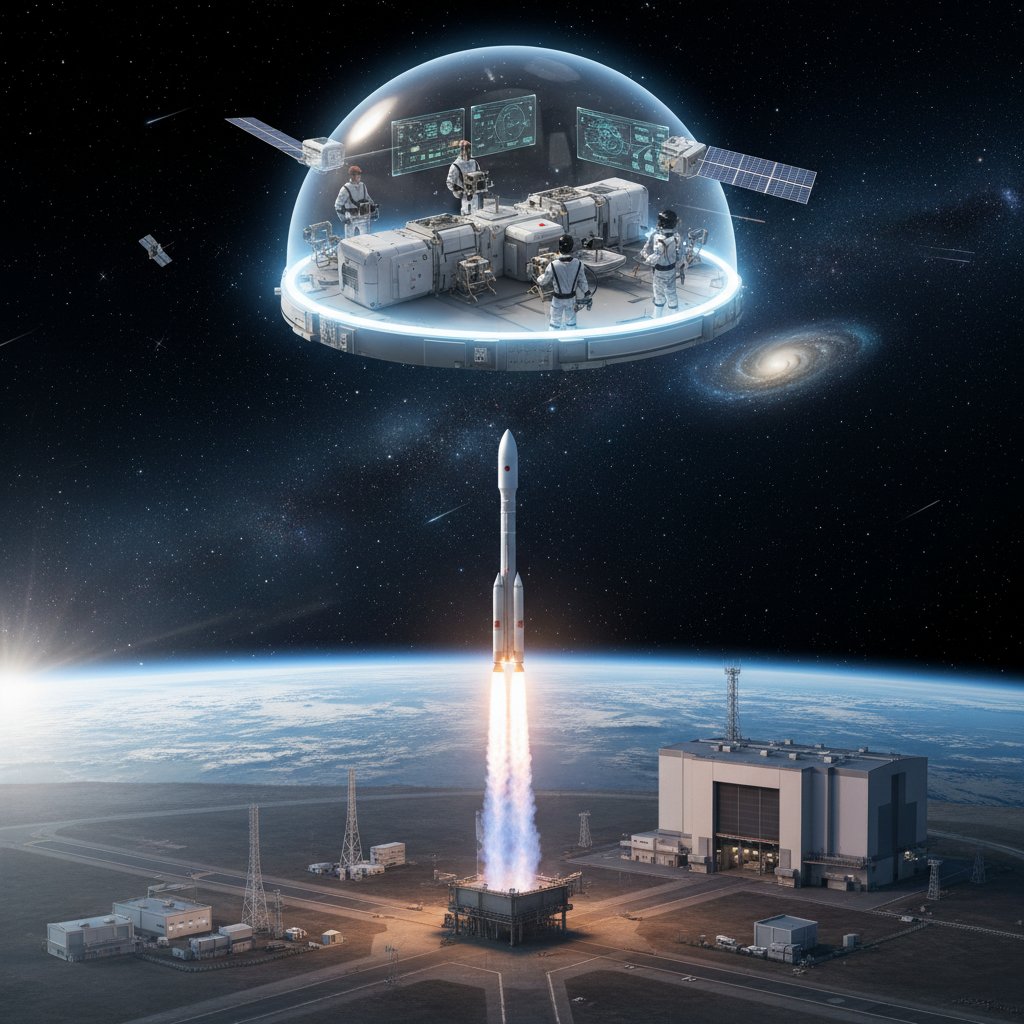
After years of delays and a dramatic failure, Japan has finally achieved a flawless liftoff of its next-generation H3 rocket. But more than a technical victory, this launch signals a strategic pivot for the nation’s space ambitions—and a potential game-changer for global satellite deployment.
On [insert date, e.g., February 17, 2024], at 9:22 a.m. local time, the H3 rocket roared to life from the Tanegashima Space Center in southern Japan. The 63-meter-tall vehicle, developed by the Japan Aerospace Exploration Agency (JAXA) and Mitsubishi Heavy Industries, carried a test satellite and two smaller payloads into a sun-synchronous orbit. The mission was deemed a complete success, with all stages separating as planned and the payloads released about 17 minutes after liftoff.
From Failure to Triumph: The Long Road to Launch
This success did not come easily. The H3’s maiden flight in March 2023 ended in catastrophe when the rocket’s second stage engine failed to ignite, forcing JAXA to issue a destruct command. The loss of the ALOS-3 satellite, a $200 million Earth-observation payload, was a bitter blow for an agency that prides itself on precision engineering.
The failure traced back to an electrical short circuit in the LE-9 engine’s ignition system—a problem that engineers spent nearly a year correcting. “We went back to the drawing board, redesigning the ignition sequence and adding redundant safety checks,” says Dr. Koichi Wakata, a former JAXA astronaut and now a senior advisor at the agency. “This launch proves that we can learn from failure and come back stronger.”
The H3 is designed to replace the aging H-IIA rocket, which has been Japan’s workhorse for two decades. With a lower cost per launch—estimated at $50 million, compared to $90 million for the H-IIA—the H3 aims to compete in the commercial launch market dominated by SpaceX’s Falcon 9. But Japan’s approach is different: instead of reusability, the H3 focuses on high reliability and flexible payload configurations.
Why This Launch Matters for Japan—and the World
Japan’s space program has long been a source of national pride, but it has struggled to keep pace with private players like SpaceX and international competitors like Europe’s ArianeGroup. The H3’s success is a critical step toward restoring confidence in Japan’s launch capabilities, especially for government and military satellites.
“The H3 is not just a rocket; it’s a symbol of Japan’s technological sovereignty,” explains Dr. Michio Kaku, a theoretical physicist and author of The Future of Humanity. “In an era where space is becoming a contested domain, nations need reliable access to orbit. Japan has shown it can deliver.”
Beyond geopolitics, the H3’s payload capacity—up to 6.5 metric tons to geostationary transfer orbit—opens new possibilities for scientific missions. JAXA plans to use the rocket for lunar exploration, including the upcoming Martian Moons eXploration (MMX) mission, which aims to return samples from Phobos by 2029. The H3 could also support the International Space Station resupply and, eventually, crewed missions.
Inside the H3: Engineering Marvels and Cost-Cutting
The H3’s design reflects a careful balance between innovation and pragmatism. Its first stage uses two or three LE-9 engines, which burn liquid hydrogen and liquid oxygen—a clean, high-efficiency propellant. Unlike the H-IIA’s solid-fuel boosters, the H3 uses strap-on solid rocket boosters that can be tailored to mission needs, reducing waste and cost.
One of the rocket’s standout features is its advanced avionics system, which uses artificial intelligence to monitor engine performance in real time. “The H3 can detect anomalies and adjust its flight path autonomously,” says Dr. Yuki Sato, a rocket engineer at Mitsubishi Heavy Industries. “This reduces the need for ground intervention and improves safety margins.”
The cost-cutting measures are equally impressive. By standardizing components and using a modular design, JAXA slashed production time by 30%. The result is a rocket that is both cheaper and more versatile than its predecessor—a crucial advantage in a market where launch prices are plummeting.
What’s Next for Japan’s Space Program?
With the H3 now operational, JAXA plans to ramp up launch frequency to six per year by 2026. The next major milestone is the H3’s first commercial mission, scheduled for late 2024, which will carry a communications satellite for a private operator. If successful, this could attract international customers seeking an alternative to SpaceX.
But the H3 is just one piece of Japan’s broader space strategy. The country is also developing the Epsilon S rocket for small satellites, and partnering with NASA on the Lunar Gateway. “We are entering a new phase of space exploration, where international collaboration and commercial competition coexist,” says Dr. Wakata. “Japan’s role is to be a reliable partner—and the H3 is our ticket to that future.”
“The H3 is not just a rocket; it’s a symbol of Japan’s technological sovereignty.” — Dr. Michio Kaku, theoretical physicist
For the average reader, this launch means more than just a headline. It represents a step toward cheaper, more frequent access to space—and with it, better satellite internet, more accurate weather forecasting, and faster global communications. As Japan’s H3 joins the ranks of operational heavy-lift rockets, the sky is no longer the limit; it’s just the beginning.