







“This black hole is essentially a sleeping giant,” said Dr. Ignas Juodžbalis, a postdoctoral researcher at the University of Cambridge and lead author of the study published in Nature. “It’s not actively feeding, yet its mass is staggering — six billion times that of our Sun.”
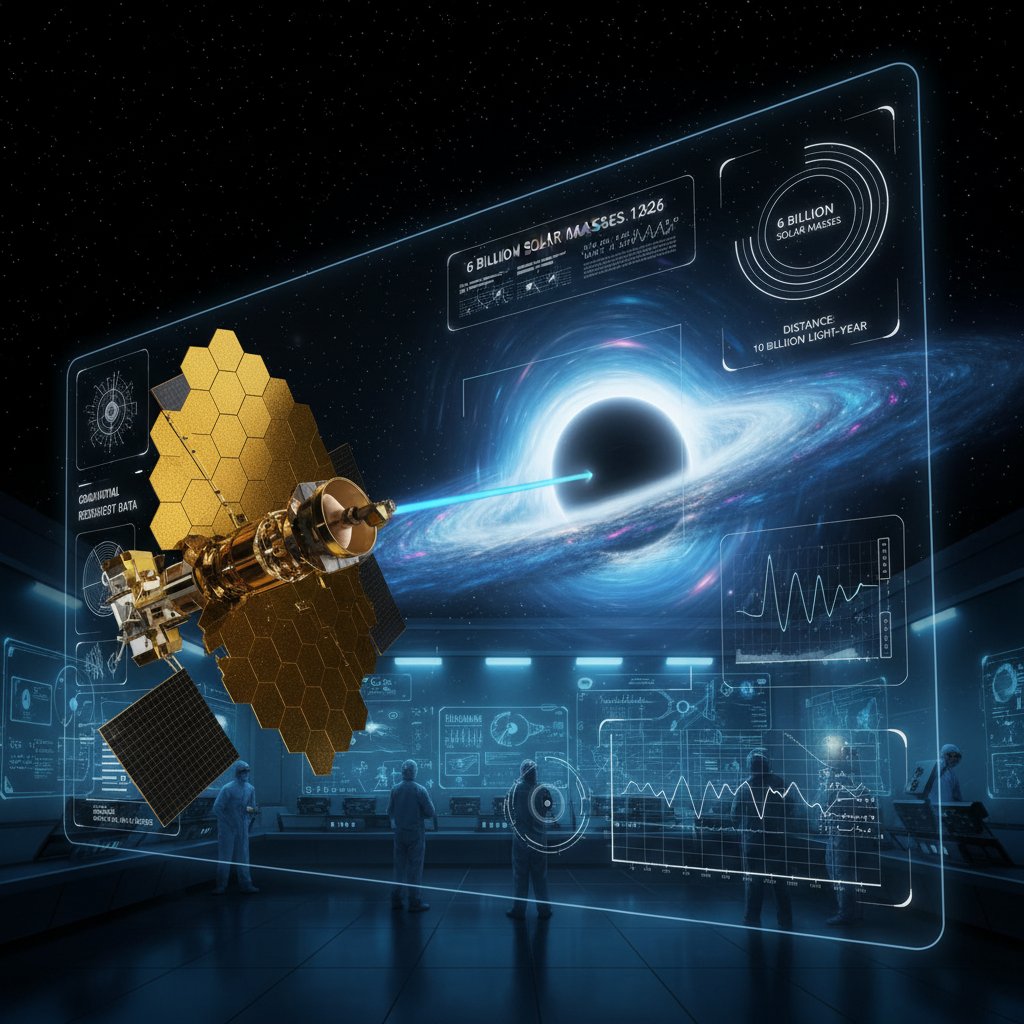
The James Webb Space Telescope (JWST) has done it again. By peering across 10 billion light-years of space, astronomers have weighed a dormant supermassive black hole that existed when the universe was just a toddler, barely 4 billion years old. The find, announced in early 2024, challenges our understanding of how these cosmic behemoths grow so quickly in the early universe.
The black hole resides in a galaxy cataloged as GS-10578, a faint smudge of light in the constellation Fornax. But within that smudge lies a monster — one that has stopped eating, yet still exerts a gravitational pull that shapes its entire host galaxy.
A Cosmic Ghost in the Machine
Most supermassive black holes we detect are active: they pull in gas and dust, heating it to millions of degrees and outshining entire galaxies. These are quasars, brilliant lighthouses that can be seen across the cosmos. But a dormant black hole is different. It’s quiet, almost invisible — a ghost.
“Imagine a lion that has just finished a huge meal and is now dozing under a tree,” said Dr. Rebecca Larson, an astrophysicist at the University of Texas at Austin who was not involved in the study. “You can’t tell how big it is just by looking at it sleeping. You need to measure its skeleton.”
For black holes, that skeleton is their gravitational influence on surrounding stars and gas. JWST used its Near-Infrared Spectrograph (NIRSpec) to dissect the light from GS-10578. The instrument found broad emission lines from ionized oxygen and hydrogen — signatures of gas whipping around the black hole at speeds exceeding 1,000 kilometers per second.
From those velocities, astronomers applied the virial theorem — a simple relation between speed and mass — to calculate the black hole’s heft. The result: 6 billion solar masses, give or take a few hundred million. That’s about 1,500 times the mass of the black hole at the center of the Milky Way.
Why This Sleeping Giant Matters
The discovery is a puzzle. Black holes grow by accreting matter, but that process takes time. To reach 6 billion solar masses by the time the universe was only 4 billion years old, this black hole must have grown at an extraordinary rate in its youth — and then stopped.
“This is a ‘you are what you eat’ problem,” said Dr. Priyamvada Natarajan, a theoretical astrophysicist at Yale University who studies black hole formation. “Either it had a very efficient feeding phase early on, or it started from a much larger seed than we usually assume.”
Current models suggest that the first black holes formed from the collapse of massive stars, producing seeds of about 100 solar masses. But growing from 100 to 6 billion in less than a billion years would require near-continuous feeding at the maximum possible rate — the so-called Eddington limit. That seems unlikely.
An alternative is direct collapse: a giant cloud of gas in the early universe might have collapsed straight into a black hole of 10,000 to 100,000 solar masses, giving it a head start. This sleeping giant may be evidence that such “heavy seeds” were common.
The James Webb Space Telescope’s Unique Eye
Before JWST, such a discovery would have been impossible. The light from GS-10578 has been stretched by the expansion of the universe — redshifted — so that its ultraviolet and optical emission now falls in the infrared. JWST’s 6.5-meter mirror and cryogenic instruments are optimised for exactly this kind of observation.
“We designed JWST to see the first galaxies, but it’s also perfect for finding quiet black holes in the early universe,” said Dr. Jane Rigby, JWST operations project scientist at NASA’s Goddard Space Flight Center. “This is exactly the kind of science we were hoping for.”
The telescope observed the galaxy for only a few hours — a testament to its sensitivity. The team is now planning follow-up observations to map the galaxy’s star formation and gas dynamics in more detail.
What Comes Next?
The discovery of this sleeping giant opens a new window on black hole evolution. If dormant black holes are common in the early universe, it would mean that the quasar phase — when black holes shine brightest — is just a brief episode in their lives. Most of the time, they lie quiet, waiting for their next meal.
“We’ve only scratched the surface,” said Dr. Juodžbalis. “JWST has the power to find dozens of these dormant giants. Each one will tell us a different piece of the story of how the universe built its most massive objects.”
The next steps include surveying larger areas of the sky with JWST’s NIRSpec instrument, and combining its data with X-ray observations from the Chandra X-ray Observatory to confirm that these black holes are truly dormant. The European Space Agency’s upcoming Athena mission, set to launch in the 2030s, will provide even sharper X-ray vision.
For now, though, the sleeping giant in GS-10578 is a reminder that the universe still holds surprises — and that the most powerful telescope ever built is only beginning to wake them up.