







What if a spider could launch itself like a coiled spring, snapping shut on prey faster than you can blink? That’s exactly what researchers have found in the forests of eastern Australia—a new species of spider that uses an unprecedented hunting method to catch dangerous ants. This isn’t your garden-variety web spinner; it’s a predator that has evolved a mechanical trap straight out of a physics textbook.
Meet the Danum platformi, a tiny spider no bigger than a grain of rice, discovered by a team from the University of Queensland and the Queensland Museum. Their findings, published in the journal Journal of Arachnology in March 2025, describe a hunting strategy never before documented in any spider species. Instead of building a web or actively chasing prey, this spider constructs a spring-loaded trap from silk and vegetation, then waits—sometimes for hours—for an unsuspecting ant to wander into the kill zone.
“It’s like a medieval catapult, but miniaturized and biological,” says Dr. Helena Richardson, lead author and arachnologist at the University of Queensland. “The spider builds a bent stem under tension, anchors it with silk, and when an ant triggers the tripwire, the stem snaps back, flinging the spider and its silk net onto the prey.” The entire sequence takes less than 50 milliseconds—faster than a housefly can react.
How the Trap Works: A Biological Crossbow
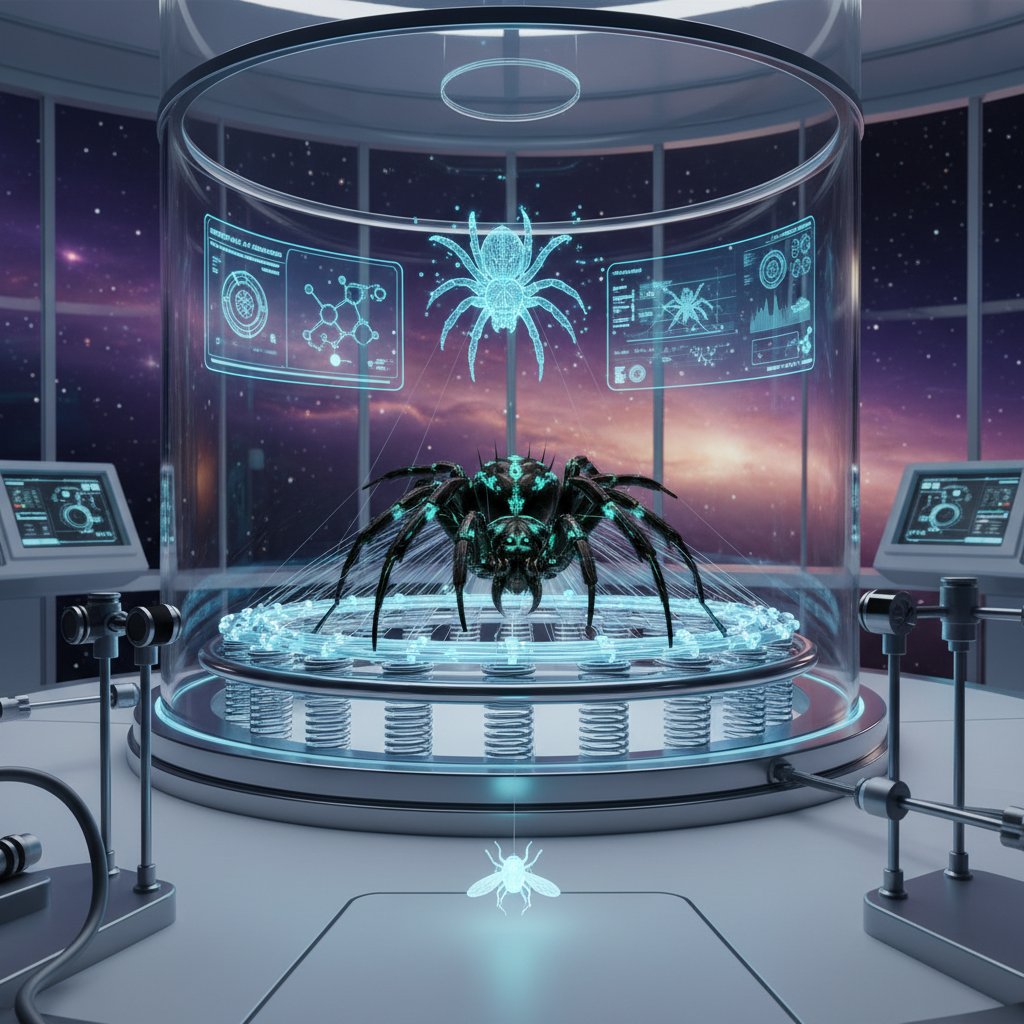
The spider’s engineering is deceptively simple. It selects a flexible plant stem, bends it into a U-shape, and ties it down with multiple strands of silk. At the apex of the bend, it attaches a small, sticky silk net. A single tripwire—a strand of silk—runs from the net to a nearby leaf or twig. When an ant steps on that tripwire, the tension releases. The stem straightens with explosive force, launching the spider and net forward to envelop the ant.
But here’s the kicker: the spider doesn’t just rely on speed. It also uses the element of surprise to target ants that are far more dangerous than itself. Many ants in the region, like the bulldog ant (Myrmecia gulosa), possess powerful mandibles and venomous stings that could easily kill a spider. “These ants are the lions of the insect world,” explains Dr. Richardson. “A direct confrontation would be suicide for a spider this size. So it evolved a way to strike from ambush, using physics to overcome biology.”
The trap’s mechanics are so efficient that the spider can capture prey up to three times its own body weight. Researchers observed 47 successful captures over a two-month field study in the rainforests of Lamington National Park, Queensland. The success rate? An astonishing 92%—far higher than the 30-40% typical for web-building spiders.
Why This Discovery Matters
This isn’t just a cool animal video for nature docs. The discovery challenges long-held assumptions about spider evolution and behavior. Spiders are ancient—they’ve been around for over 300 million years—and scientists thought they’d seen every trick in the arachnid playbook. Web spinning, burrowing, jumping, even fishing (yes, some spiders catch fish). But a spring-loaded trap? That’s new.
“It rewrites what we know about spider predation,” says Dr. Mark Elgar, an evolutionary biologist at the University of Melbourne who was not involved in the study. “We tend to think of spiders as either web-builders or active hunters. This species blurs that line completely. It’s a web-builder that uses the web as a weapon, not a net.”
The discovery also has implications for biomimicry—the design of technologies inspired by nature. Engineers have long studied spider silk for its strength and elasticity. But this trap adds a new dimension: a mechanical trigger system that stores and releases energy with precision. “Imagine a tiny, biodegradable spring that can be triggered by a single ant footstep,” says Dr. Richardson. “That could inspire new sensors or micro-robotic actuators.”
For the average reader, though, the takeaway is simpler: nature still has surprises. Even in well-studied groups like spiders, we’re finding creatures that operate on entirely different principles. “It’s a reminder that we’ve only scratched the surface of biodiversity,” adds Dr. Elgar. “Every time we look closely, something extraordinary pops out.”
What’s Next for the Spring-Loaded Spider
The research team is now investigating whether other spider species use similar traps. Preliminary surveys suggest at least two other related species in the same genus may employ variations of the spring mechanism. “We’ve only sampled a fraction of the rainforest canopy,” says Dr. Richardson. “There could be dozens of species out there doing this.”
Meanwhile, conservationists are concerned. The spider’s habitat—the subtropical rainforests of eastern Australia—is under threat from climate change and land clearing. The 2019-2020 bushfires destroyed large swaths of this ecosystem. “If we lose these forests, we lose these spiders before we even know they exist,” warns Dr. Elgar. “And who knows what other secrets they hold?”
So the next time you’re walking through a forest, take a closer look at the undergrowth. That bent stem might not be just a bent stem. It could be a loaded weapon, waiting for an ant to make a fatal misstep. And that’s the kind of science that makes you appreciate just how weird and wonderful our planet really is.
Frequently Asked Questions
How did researchers discover this spider’s hunting method?
Researchers from the University of Queensland and Queensland Museum observed the spider in the wild over two months in Lamington National Park, Australia. They used high-speed cameras to capture the trap mechanism in action, confirming it was a deliberate, repeatable behavior—not a one-off accident.
Is this spider dangerous to humans?
No. The spider is tiny—about 3-4 millimeters in length—and its venom is not considered medically significant to humans. Its trap is specifically designed to catch ants, which are its primary prey. So you can rest easy; it’s not coming for you.
Could this discovery lead to new technologies?
Possibly. The spider’s trap uses a mechanical trigger system that stores and releases elastic energy with high precision. Engineers are interested in mimicking this for applications like micro-robotics, sensors, or even biodegradable springs. But it’s early days—the research is still focused on understanding the biology first.