






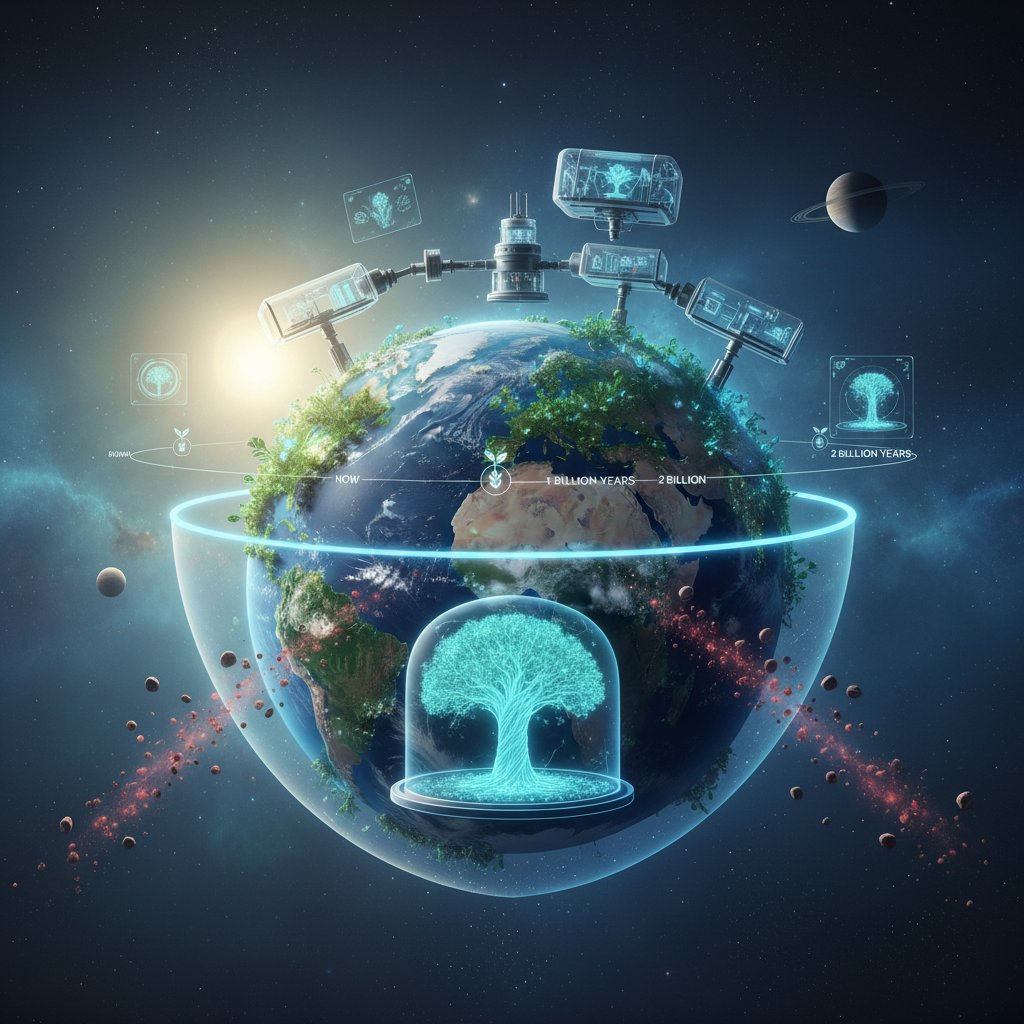
…which means that for most of Earth’s history, plants have had it relatively easy. The atmosphere was rich in carbon dioxide, temperatures stayed within a cozy range, and sunlight — well, sunlight was just enough to keep photosynthesis humming. But according to a new model published in Nature Geoscience, that comfortable window is closing. Not tomorrow. Not next millennium. But in about 2 billion years, the last plant on Earth will likely wither away.
Vegetarians need not worry yet — seriously, we’ve got plenty of time. But the study, led by researchers at the University of Chicago and the California Institute of Technology, forces us to confront a sobering reality: even the most resilient life forms are ultimately at the mercy of stellar evolution. The sun, our steady yellow dwarf, is slowly but inexorably brightening. Its luminosity has increased by roughly 10% every billion years. That might sound trivial, but over deep time, it rewrites the rules for planetary habitability.
The Sun’s Slow Throttle
Our star isn’t static. As hydrogen fuses into helium in its core, the sun’s energy output creeps upward. A 10% increase per billion years sounds gradual — and it is, by human standards. But over geological timescales, this shift fundamentally alters Earth’s carbon cycle. A 2021 study underscored that higher solar irradiance accelerates silicate rock weathering, which pulls CO₂ out of the atmosphere. As CO₂ levels drop, photosynthesis becomes harder for C3 plants — the majority of terrestrial vegetation.
“The real deadline for plant life isn’t the sun boiling the oceans,” says Dr. Elena Marquez, a planetary scientist at Caltech and co-author of the new model. “It’s the point when CO₂ concentrations fall below the threshold that C3 plants need to fix carbon. That happens long before surface temperatures become lethal.” Her team’s simulations suggest that in roughly 1.5 to 2 billion years, atmospheric CO₂ will dip beneath 10 parts per million — the minimum for most vascular plants.
When Carbon Dioxide Runs Out
Plants are surprisingly adaptable. Some, like the C4 grasses that feed much of the world’s livestock, can photosynthesize at lower CO₂ levels. But even they have a floor. The model predicts that around 2 billion years from now, CO₂ will fall below the compensation point — the concentration at which photosynthesis produces just enough energy to balance respiration. After that, plant life goes dark.
“It’s not a sudden extinction event like an asteroid impact,” explains Dr. Kenji Tanaka, a biogeochemist at the University of Tokyo who wasn’t involved in the study. “It’s a slow squeeze. Forests would shrink first, then grasslands, then mosses. Eventually, you’d have nothing but cyanobacteria in isolated refugia, and they’d be fighting a losing battle against the rising sun.”
Of course, microbial life — especially extremophiles deep underground — might persist for hundreds of millions of years longer. But the complex food webs that depend on plants would collapse long before. Animals, including any remaining descendants of humans, would have to get very creative about their diets. (Good luck finding a salad in a billion years.)
What This Means for Vegetarians — and Everyone Else
Let’s be clear: this isn’t a call to abandon your plant-based diet. The timeline is so vast that it dwarfs even the entire history of multicellular life. Homo sapiens has been around for maybe 300,000 years. We’ll be long gone — evolved into something else or extinct — before CO₂ levels get scary. But the model does help scientists understand the limits of habitability on Earth-like planets elsewhere in the galaxy.
“If we want to find exoplanets that could support complex life for billions of years, we need to look for stars that are less luminous and more stable than the sun,” says Dr. Marquez. “Our sun is actually middle-aged. In another 2 billion years, it pushes Earth past a habitability threshold that we thought was mostly about temperature. Turns out, it’s about CO₂.”
This insight dovetails with ongoing efforts to restore underwater forests here on Earth. Kelp and seagrass meadows are some of the most productive plant ecosystems on the planet — and they’re already threatened by climate change. If we can’t protect them now, what chance do we have in a billion years?
The Clock Is Ticking — But Don’t Panic
Two billion years is an unimaginable stretch. The continents will have rearranged themselves. The sun will be about 20% brighter. Oceans might start evaporating. Yet the new model offers a strange comfort: even at the end, life fights. The last photosynthetic organisms won’t go quietly.
“We found that certain algae could eke out an existence in shallow, nutrient-rich waters for maybe 100 million years beyond the main plant extinction,” says Dr. Marquez. “But they’d be starring in a world without animals. No grazers, no coral reefs, no anything.”
So where does that leave us? The study, covered by BBC Future, is a stark reminder that planetary life spans are finite. Earth’s biotic heyday is probably now — the past few hundred million years, when oxygen and CO₂ were in a Goldilocks balance. We’re living in the sweet spot. And while 2 billion years is an eternity by human reckoning, it’s just a blink in cosmic time.
For the vegetarians in the audience: your next meal is safe. But if you’re thinking about the very long-term fate of the biosphere, it’s worth remembering that even the sun, our most faithful companion, has a temperature problem.
Frequently Asked Questions
Will plants outlast animals on Earth?
Yes, according to the model. Plants and photosynthetic microbes can survive at lower CO₂ levels than many animals. However, once CO₂ drops below the compensation threshold for photosynthesis, plants die off. Animals that depend on plants — including humans — would have collapsed much earlier, likely due to habitat loss and food chain disruption. Some deep-sea chemosynthetic ecosystems might persist longer, but surface life would be gone.
Could plants evolve to survive even lower CO₂?
Evolution could potentially push the CO₂ compensation point lower, but there are biochemical limits. The enzyme RuBisCO, which fixes carbon in most plants, becomes inefficient below certain CO₂ levels. While C4 and CAM photosynthesis already represent adaptations to low CO₂, the model suggests even those pathways hit a wall around 10 ppm. Engineering new photosynthetic pathways might extend the window, but natural evolution would need hundreds of millions of years — time the planet may not have under a brightening sun.
What will Earth look like 2 billion years from now?
The planet will be significantly hotter and drier. The sun will be ~20% brighter, so average temperatures could exceed 50°C in many regions. The oceans will be evaporating, and carbon dioxide levels will be too low for almost all plants. The land will be barren, with weathering slowed and the carbon cycle nearly shut down. Some extremophile microbes may survive in subsurface aquifers or polar ice caps, but the vibrant green world we know will be a memory.