







… because the idea is so audacious it almost sounds like science fiction. The Solar Gravitational Lens (SGL) — a concept that uses the sun’s immense gravity as a natural telescope — has been kicking around academic circles for decades. But lately, it’s been gaining real traction. A flurry of new papers, many spearheaded by Dr. Slava Turyshev at NASA’s Jet Propulsion Laboratory, suggests we’re closer than ever to turning this theoretical curiosity into a working observatory. And the targets? Not just exoplanets. We’re talking about white dwarfs, neutron stars, and even black holes.
Let that sink in for a second. A telescope that could image the surface of a dead star light-years away — or peer at the silhouette of a black hole’s event horizon with enough resolution to test general relativity in ways we never have before. It’s not a pipe dream. It’s a physics problem, and Turyshev and his team are solving it, one paper at a time.
How Gravity Becomes a Lens
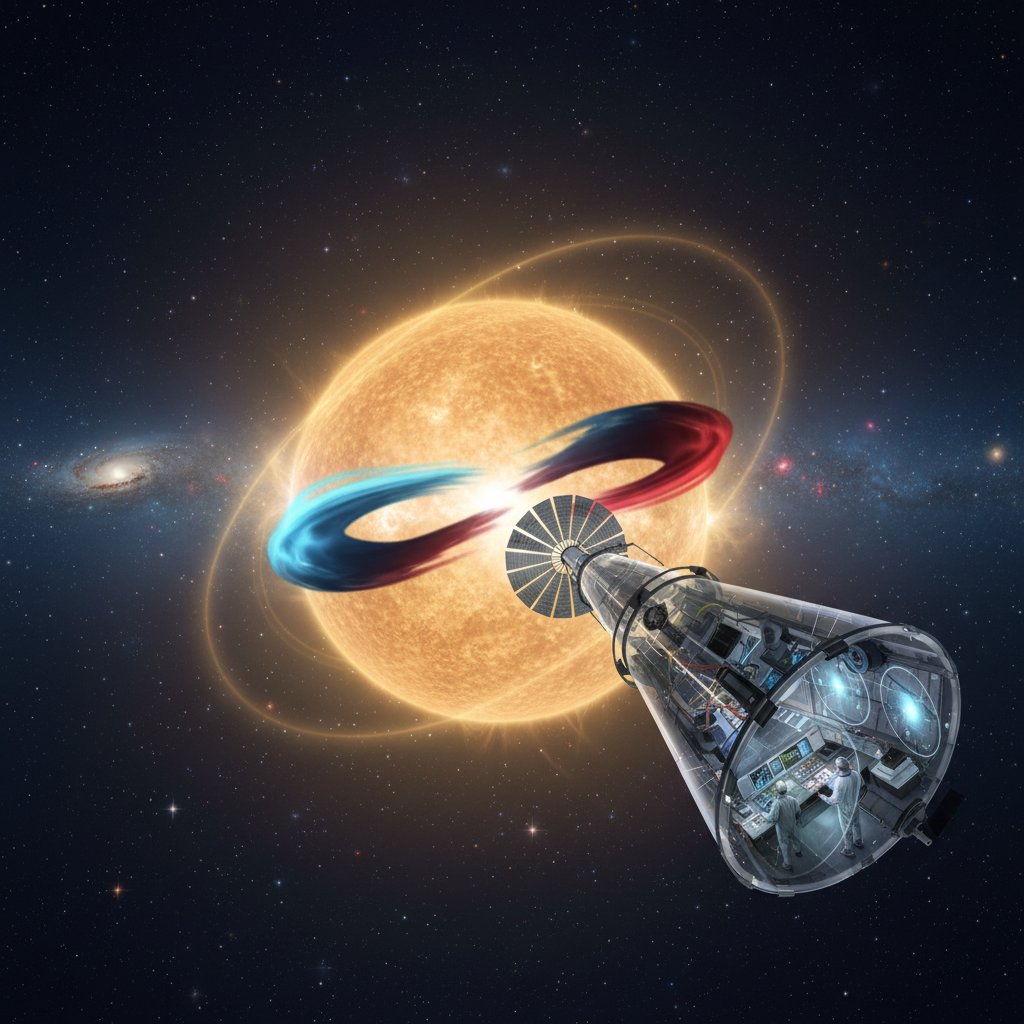
Einstein’s general relativity predicted it: massive objects bend light. The sun, being the heaviest thing in our neighborhood, creates a gravitational lens. But unlike the galaxy clusters we use to magnify distant galaxies, the sun’s lens is special. It’s what astronomers call a point-mass lens, and it produces a strange effect. If you sit far enough away — about 550 astronomical units (AU) from the sun, or roughly 14 times the distance to Pluto — the bending of light from a distant object creates a perfect ring of focus. That’s the SGL. At that distance, the sun’s gravity amplifies light from a target by a factor of 100 billion or more. A telescope the size of a dinner plate there could rival the resolving power of a Hubble-sized scope back home.
“The SGL offers a unique opportunity to directly image exoplanets and stellar remnants with resolution that is simply unattainable by any other means,” says Dr. Emily Rickman, an astrophysicist at the Space Telescope Science Institute who studies lensing phenomena. “It’s like having a microscope for the cosmos.”
The catch? We’ve never sent a spacecraft that far. Voyager 1, our most distant human-made object, is only about 160 AU out — and it took 45 years to get there. But with next-generation propulsion, like solar sails or nuclear-electric engines, a dedicated SGL mission could reach the 550 AU focal point in under 30 years. That’s a long time, but the payoff? Astronomical.
And here’s the thing: we don’t have to go all the way just to start. Recent simulations by Turyshev’s team show that even at 300 AU, the image quality is already groundbreaking. So maybe we don’t need to wait for the full monty. Incremental steps could start giving us data within a couple of decades.
Imaging the Unimaginable: White Dwarfs and Black Holes
White dwarfs are the cooling embers of stars like our sun. They’re tiny — Earth-sized — but incredibly dense. We’ve studied their spectra, their temperatures, their masses. But we’ve never seen one. Not a real image. With the SGL, we could. And that matters because white dwarfs are the end state of 97% of all stars. Understanding them means understanding the future of our own solar system.
But black holes? That’s where things get really wild. The Event Horizon Telescope gave us the first image of a black hole’s shadow — a fuzzy orange donut around M87* and Sagittarius A*. But those images took a global network of radio telescopes and years of computation. The SGL could deliver a direct image of a stellar-mass black hole’s event horizon, resolved to the point where we could see the photon ring — that bright loop of light orbiting just outside the hole. It’s the ultimate test of Einstein’s theory in the strong-field regime.
“The SGL could measure the spin of a black hole by imaging the distortion of the photon ring,” explains Dr. Kip Thorne, Nobel laureate and co-founder of LIGO, in a recent interview. “That’s something we can only dream of doing with current technology. It would be transformative.”
And it gets better. The same technique could map the surface of dead stars, revealing active geology — even potential clues about how ancient planetary systems survive stellar death. White dwarfs are often surrounded by debris disks — the remains of shattered worlds. The SGL could image those disks, maybe even see the orbits of surviving planets. For context, that’s like reading a license plate from across the Atlantic.
Why Now? The Technology Catch-Up
So why all the buzz now? Partly because of Turyshev’s sheer productivity — he’s published over a dozen SGL papers in the last five years — but also because the enabling technologies are maturing. Solar sails, like those tested by the Planetary Society’s LightSail 2, are getting better. Laser communications, which could handle the data rate needed to send images back from 550 AU, are being developed for NASA’s Psyche mission. And computational imaging algorithms — the software that reconstructs images from the distorted, ring-shaped light — are now advanced enough to handle the SGL’s weird optics.
It’s the perfect storm. We got climate science intensifying, yes, but also a quiet revolution in deep-space engineering. The SGL mission is no longer a “maybe in 100 years” idea. NASA’s Innovative Advanced Concepts (NIAC) program has funded multiple phases of the SGL study. The next step is a technology demonstration — maybe a cubesat that tries to image a distant white dwarf from 100 AU.
But there are hurdles. Big ones. The power required at 550 AU is enormous. The data rate is abysmal — think dial-up from Mars. And the pointing accuracy needed is insane: you’re aiming a telescope at a target billions of kilometers away, with the sun’s gravity as your lens, and the alignment has to be perfect to within micrometers. One wrong thruster pulse and you miss the focal line entirely.
Still, the team is optimistic. “We’ve solved the fundamental physics,” says Turyshev. “Now it’s an engineering problem. And engineers love a good challenge.”
What This Means for the Rest of Us
Let’s be honest: most of us won’t live to see the first image from an SGL telescope. But the science it enables will ripple through physics and astronomy for generations. Imagine being able to confirm — or refute — Hawking radiation by directly imaging the region around a black hole. Or mapping the chemical composition of a white dwarf’s surface to understand the end stages of stellar evolution. Or maybe even spotting the faint glint of an Earth-sized exoplanet, its continents and oceans resolved into actual pixels.
That last one — exoplanet imaging — is the main driver for the SGL. But the white dwarf and black hole applications are just as compelling, if less talked about. And they might come first, because stellar remnants are much smaller and easier to center in the focal line. The same mission that images a white dwarf could pivot and image a black hole. Two for the price of one.
So the next time you hear about the SGL — and you will, given Turyshev’s output — remember: it’s not just about exoplanets. It’s about seeing the invisible. Dead stars. The edges of spacetime. The places where physics breaks down and we get to watch it happen. That’s what this mission is about. And if it works? Well, we’ll finally have a way to look where no one has looked before.
Frequently Asked Questions
How does the solar gravitational lens actually work?
The sun’s gravity bends light from distant objects, focusing it into a ring at a specific distance — about 550 AU from the sun. A spacecraft placed there with a telescope can capture this magnified light, achieving resolution billions of times better than Earth-based telescopes.
Can we image a black hole with the SGL right now?
No. We haven’t built the spacecraft yet. Current plans are still in the study phase, but if funded, a mission could launch in the 2030s and reach the focal region within 20–30 years, providing first images of black hole event horizons and white dwarf surfaces.
What’s the biggest challenge for an SGL mission?
Precision pointing and power. The telescope must align perfectly with the sun and the target, and at 550 AU, solar panels produce very little energy. Engineers are working on nuclear power sources and advanced propulsion to overcome these hurdles.