








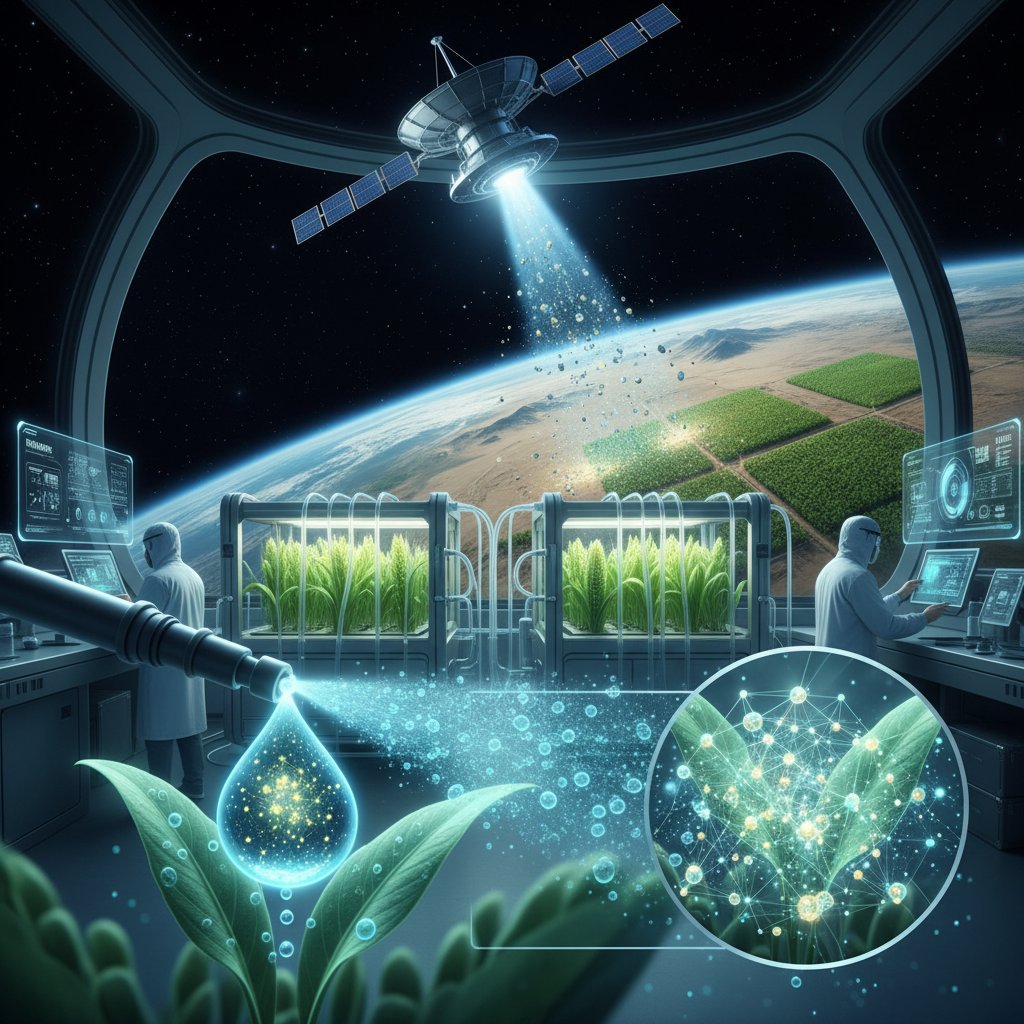
You’re standing in a field in Western Australia, watching the sky. It’s been dry for weeks. The forecast? More of the same. But what if you could spray something onto the soil that literally grabs water out of the air and funnels it straight to your seeds? That’s not science fiction anymore. It’s a biodegradable polymer spray, and it might just be the drought-proofing tool farmers have been praying for.
Researchers at the University of Western Australia have developed a spray-on coating made from a biodegradable polymer that captures atmospheric moisture—think fog, dew, even humidity—and redirects it to the root zone of crop seeds. The technology, detailed in a study published in Nature Communications in early 2025, could transform agriculture in regions where rainfall is becoming as reliable as a politician’s promise. And let’s be honest: with climate change cranking up the heat, farmers need every trick in the book.
How Does a Spray Capture Water from Thin Air?
The magic lies in the polymer’s structure. It’s a superhydrophilic material—basically, it loves water. When sprayed onto soil, it forms a thin, porous film that acts like a sponge. During cool nights or foggy mornings, the polymer absorbs moisture from the air. Then, as the sun warms the soil during the day, it slowly releases that water directly to the seeds below. No irrigation pipes. No energy-guzzling pumps. Just chemistry doing the heavy lifting.
Lead researcher Dr. Emily Chen, a materials scientist at UWA, explains: “We designed this polymer to mimic the way certain desert plants collect water from fog. It’s a passive system that works with the natural daily cycle of temperature and humidity. Farmers don’t need to change their planting methods—they just add a spray step.”
In field trials near Perth, wheat seeds treated with the spray showed a 40% higher germination rate compared to untreated seeds during a dry spell. That’s not a marginal gain—that’s the difference between a harvest and a write-off. The polymer itself breaks down into harmless compounds within 60 days, leaving no microplastic residue in the soil. So it’s not just effective; it’s environmentally sound.
Why Western Australia Is the Perfect Test Bed
Western Australia is ground zero for rainfall decline. Since the 1970s, the southwest region has seen a 20% drop in winter rainfall, according to the Australian Bureau of Meteorology. That’s a death sentence for dryland farming, which relies entirely on natural precipitation. Farmers here have already shifted to hardier crops and no-till practices, but they’re running out of options.
“We’ve been fighting a losing battle against the drying climate,” says Tom Whitfield, a fourth-generation wheat farmer in the Wheatbelt region, about 200 kilometers east of Perth. “If this spray can give us even a 10% boost in soil moisture during the critical germination window, that’s huge. It could mean the difference between staying on the land or selling up.”
The spray isn’t a silver bullet—it won’t work in hyper-arid deserts where humidity is near zero. But in semi-arid zones like the Mediterranean climate of southwestern Australia, where fog and dew are common, it’s a game-changer. And the team is already testing variants for different climates, including tropical regions where morning dew is heavy.
This innovation fits into a broader trend of climate-focused investments that reward companies setting ambitious environmental targets. Investors are increasingly backing agtech startups that offer scalable solutions to water scarcity—and this spray is exactly the kind of tech that could attract funding.
From Lab to Field: The Road Ahead
The polymer spray is still in the prototype stage. The UWA team is scaling up production and partnering with a Perth-based agricultural chemical company to commercialize it. They hope to have a market-ready product within two years, pending regulatory approvals in Australia and other countries.
But there are hurdles. Cost is a big one—the polymer is currently expensive to synthesize, though Dr. Chen says they’ve identified cheaper raw materials. “We’re looking at using plant-based cellulose derivatives instead of synthetic precursors,” she says. “That could cut the cost by half and make it accessible to smallholder farmers.”
Another challenge is application. The spray needs to be applied at planting time, which means farmers need to have it on hand and be willing to adopt a new step in their routine. But given the stakes—and the fact that extreme weather events like heat waves are becoming more common—the motivation is there.
Dr. Chen is optimistic: “We’ve shown it works in the lab and in small field trials. The next step is large-scale demonstrations across different soil types and climates. If we can prove it’s robust and cost-effective, adoption could be rapid.”
What This Means for Global Food Security
Look, the world’s population is heading toward 10 billion by 2050. We need to produce 70% more food than we do now, according to the UN Food and Agriculture Organization. And we have to do it with less water, less arable land, and a more volatile climate. Technologies like this spray aren’t just nice-to-haves—they’re essential.
Consider this: agriculture accounts for 70% of global freshwater withdrawals. If we can reduce that by even a fraction through passive moisture capture, the ripple effects are enormous. Less pressure on rivers and aquifers. More water for cities and ecosystems. And for farmers in developing nations who can’t afford expensive irrigation systems, a low-cost spray could be a lifeline.
The UWA team is already in talks with NGOs in sub-Saharan Africa and South Asia to test the spray in those regions. “The beauty of this technology is its simplicity,” says Dr. Chen. “It’s a spray. You don’t need a PhD to use it. You don’t need a bank loan for a drip irrigation system. You just need a backpack sprayer and the will to try something new.”
And that’s the thing about innovation—it often comes from the most unexpected places. A polymer that mimics a desert beetle’s back. A spray that turns fog into food. It’s not just clever science; it’s a reminder that sometimes the best solutions are the ones that work with nature, not against it.
So the next time you see a farmer looking at a cloudless sky, don’t feel sorry for them. They might just have a secret weapon in their shed. And it’s not a rain dance—it’s a spray.
Frequently Asked Questions
How does the polymer spray work exactly?
The spray forms a superhydrophilic film on the soil that absorbs moisture from the air—fog, dew, and humidity—during cool periods. When the soil warms up, the polymer releases that water directly to the seeds’ root zone, improving germination without additional irrigation.
Is the spray safe for the environment?
Yes. The polymer is biodegradable and breaks down into harmless compounds within 60 days, leaving no microplastic residue. The team is also exploring plant-based cellulose derivatives to make it even more eco-friendly.
When will this spray be available for farmers?
The UWA team aims to commercialize the product within two years, pending regulatory approvals and large-scale field trials. They are currently partnering with an agricultural chemical company to scale up production and reduce costs.