






For more than half a century, commercial supersonic flight over land has been effectively banned—a direct result of the ear-shattering sonic booms that rattled communities and shattered windows. But that era of silence may finally be coming to an end. NASA’s experimental X-59 QueSST (Quiet SuperSonic Technology) aircraft is now preparing for its most critical test yet: flying faster than the speed of sound for the first time, producing nothing more than a soft thump instead of a deafening boom.
This isn’t just another test flight. It’s the culmination of decades of aeronautical research, a bold step toward rewriting the rules of supersonic travel, and a potential game-changer for how we move across the planet.
From Boom to Thump: The Science Behind the X-59
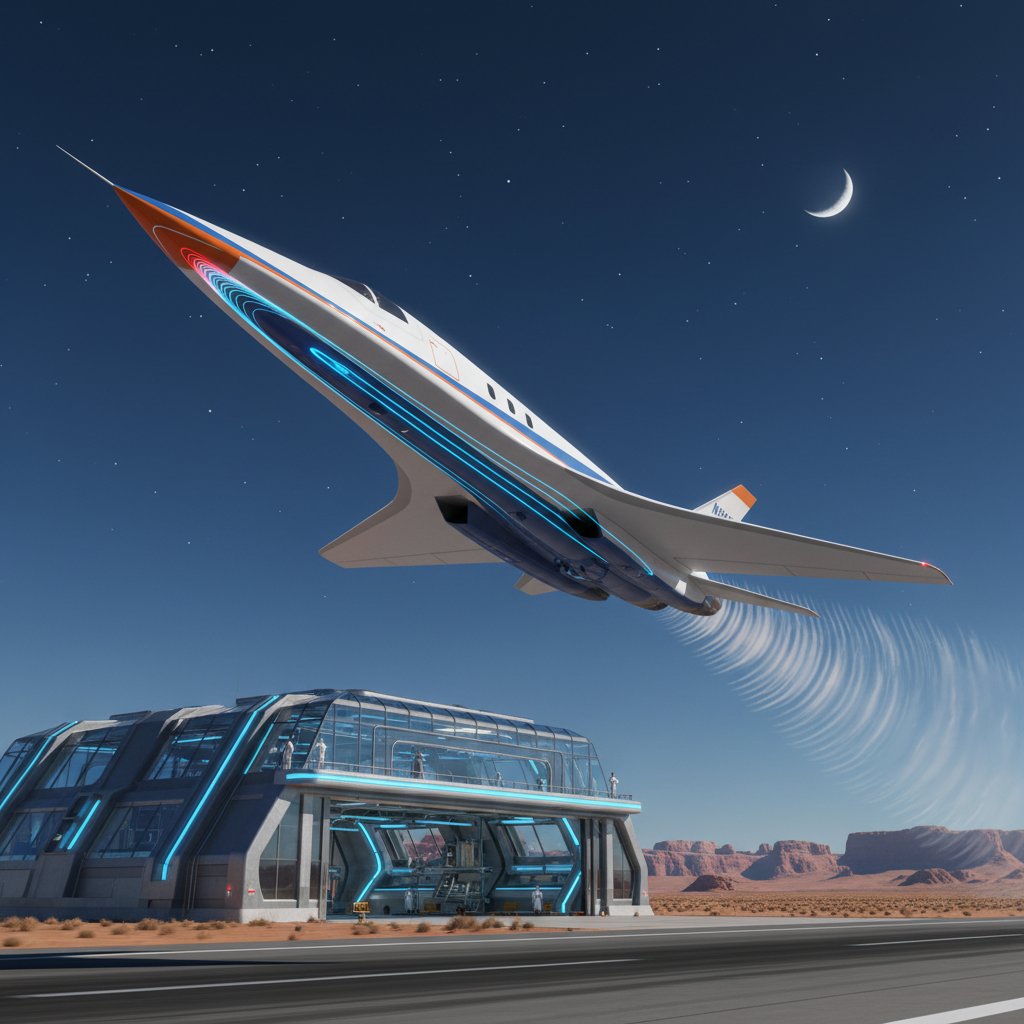
The X-59 is a marvel of engineering. At nearly 100 feet long with a slender, needle-like nose that accounts for almost a third of its length, the aircraft is designed to shape the shockwaves produced during supersonic flight. Normally, those shockwaves merge into a powerful double boom—the sonic boom. The X-59’s unique shape spreads them out, keeping them separate so they reach the ground as a much quieter sonic “thump.”
“We’re not trying to eliminate the shockwaves entirely—that’s physically impossible,” explains Dr. Catherine “Cathy” Bahm, NASA’s Quesst mission project manager. “What we’re doing is carefully managing how those waves form and travel through the atmosphere. The goal is to reduce the perceived loudness from 105 PLdB (perceived level decibels) down to about 75 PLdB—roughly the sound of a car door closing 20 feet away.”
That reduction is transformative. A traditional sonic boom can startle people, damage structures, and even trigger anxiety in animals. The X-59’s thump, by contrast, is designed to be barely noticeable—especially indoors. To achieve this, NASA and Lockheed Martin Skunk Works have integrated advanced computational fluid dynamics, refined wind tunnel testing, and a groundbreaking external vision system (XVS) that replaces the forward cockpit window with a 4K camera display.
The Road to Supersonic: What’s Happening Now
The X-59 completed its first conventional flight on January 12, 2024, from Lockheed Martin’s facility in Palmdale, California. Since then, the team has been methodically expanding the flight envelope—testing handling, avionics, and the XVS at subsonic speeds. Now, with those checks nearly complete, the aircraft is being prepared for its first supersonic sortie, expected to occur over the desert of Edwards Air Force Base in the coming weeks.
“We’ve spent months making sure every system is perfect,” says Jim Less, NASA’s chief pilot for the X-59 program. “When we do go supersonic, it will be at Mach 1.4 and an altitude of around 55,000 feet. That’s a sweet spot where the shockwave shaping works best. But we’ll start conservatively, step up in Mach increments, and listen to the acoustic data from ground stations.”
The flight itself will be a carefully choreographed affair. A chase plane—an F-15B equipped with special instrumentation—will fly alongside to capture imagery and telemetry. On the ground, a network of over 50 microphones arrayed across the Mojave Desert will record the sonic signature. If all goes to plan, the data will confirm that the X-59’s design produces a noise level far below the FAA’s current threshold for overland supersonic flight.
Why This Matters: The Future of Supersonic Travel
The stakes go far beyond a single test flight. The X-59 is the centerpiece of NASA’s Quesst mission, which aims to provide regulators with the evidence needed to update the ban on civil supersonic flight over land. Current rules, in place since 1973, prohibit any aircraft from flying faster than Mach 1 over U.S. territory unless the boom is completely eliminated. The X-59 is designed to prove that “acceptable” noise levels are possible.
If successful, the next phase will involve flying the X-59 over select U.S. cities—starting with remote communities and eventually moving to urban areas—to gather public perception data. NASA will ask residents: Did you hear it? Was it bothersome? The answers will be handed to the International Civil Aviation Organization (ICAO) and the FAA to help craft new noise standards.
“This is about opening up a new market for faster air travel,” says Dr. Peter Coen, Quesst mission integration manager. “Imagine flying from New York to Los Angeles in under three hours—without waking up half the country. That’s the promise of quiet supersonic flight.”
Several companies, including Boom Supersonic and Spike Aerospace, are already developing commercial supersonic jets that could benefit from relaxed noise regulations. Boom’s Overture, for example, aims to carry 65–80 passengers at Mach 1.7, with a range that could cover transatlantic routes. But those aircraft will only be viable if they can fly over land—and that requires the regulatory foundation that the X-59 is helping to build.
Challenges Ahead: Noise, Cost, and Certification
Of course, transforming supersonic flight from a niche novelty into a mainstream reality won’t happen overnight. The X-59 is a single-seat demonstrator, not a production aircraft. Scaling its design to a commercial airliner—with multiple passengers, longer range, and higher efficiency—presents enormous engineering challenges. The long nose that reduces the boom also reduces visibility and complicates airport operations. The XVS system, while clever, must be certified for all weather conditions.
There’s also the question of cost. Supersonic jets burn significantly more fuel than subsonic ones, raising both ticket prices and emissions. NASA is investing in sustainable aviation fuels and advanced engine designs, but environmental concerns remain a barrier. “We can’t ignore the carbon footprint,” notes Dr. Bahm. “But if we can combine quiet supersonic technology with next-gen propulsion, we might see a new generation of aircraft that are both fast and green.”
Despite these hurdles, the mood at NASA’s Armstrong Flight Research Center is electric. The X-59 represents a rare blend of pure research and practical ambition—a flying laboratory that could reshape an entire industry. Every test flight brings new data, new insights, and one step closer to the day when a quiet thump replaces the boom, and the sky becomes a little faster for everyone.
As the X-59 sits on the tarmac in Palmdale, its engine humming and its cameras focused on the horizon, the world waits. In a few weeks, for the first time in decades, a supersonic aircraft will break the sound barrier over American soil—and if NASA’s engineers are right, almost nobody will notice. That, in itself, will be the loudest statement of all.