







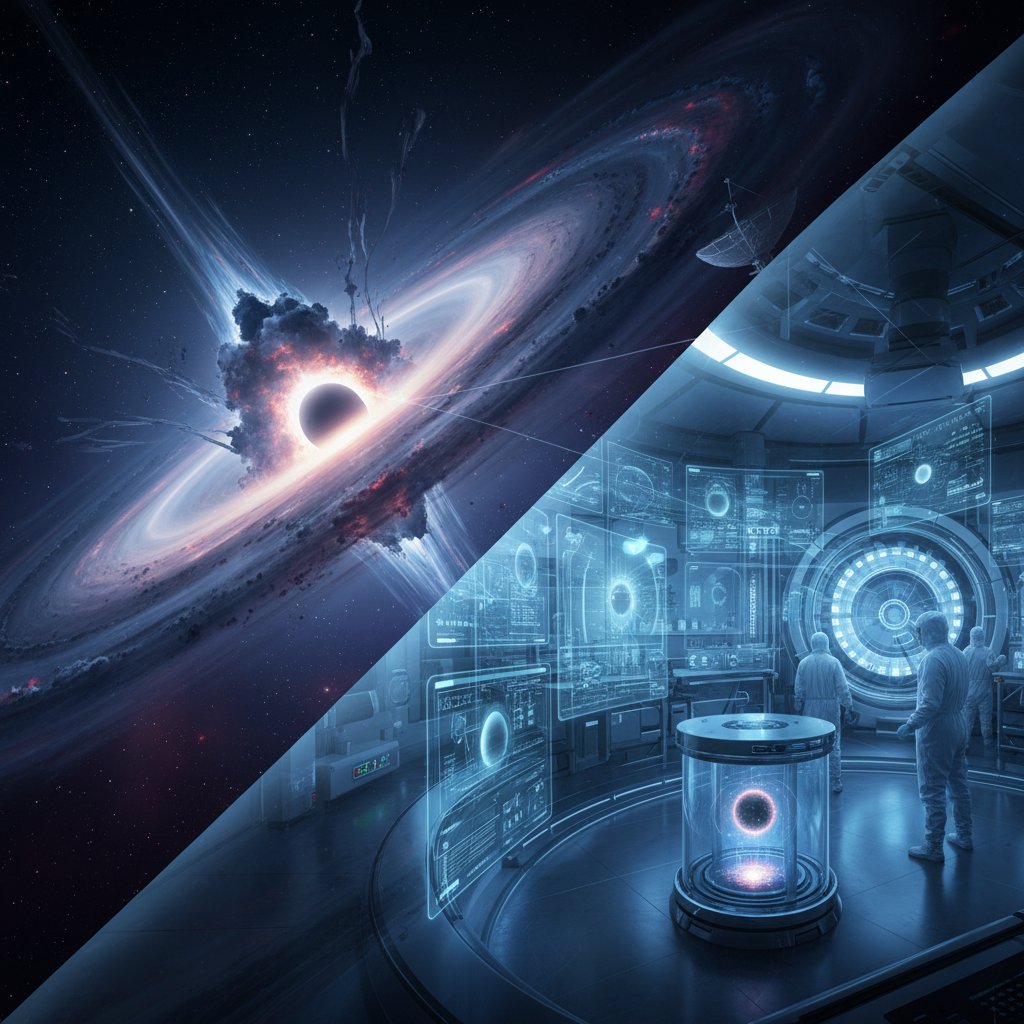
For decades, we assumed every black hole began its life the same way: a massive star exhausts its nuclear fuel, collapses under its own weight, and explodes as a supernova. The result is a stellar-mass black hole, typically no more than a few dozen times the mass of our Sun. But what about the monsters that lurk at the centers of galaxies—the supermassive black holes that can weigh millions or even billions of solar masses? New research, published in The Astrophysical Journal Letters, offers the clearest evidence yet that these cosmic giants can skip the stellar collapse entirely, forming directly from collapsing clouds of gas in the early universe.
That changes everything. It means supermassive black holes aren’t just grown-ups that started small. Some were always big.
How to Grow a Black Hole: The Standard Recipe, and Its Limits
The traditional story of black hole formation is a tale of stellar evolution. A star at least 20 times the mass of our Sun burns hot and fast. When it runs out of fuel, its core collapses into a singularity, and the outer layers are blasted into space as a supernova. The result is a black hole with a mass of roughly 5 to 100 Suns. To reach supermassive status—think of the 4.3-million-solar-mass beast at the center of our Milky Way, Sagittarius A*, or the 6.5-billion-solar-mass giant in galaxy M87—these seed black holes would need to accrete gas and merge with other black holes over cosmic time.
But there’s a problem. Observations from the James Webb Space Telescope (JWST) have revealed surprisingly massive black holes—on the order of millions of solar masses—existing less than 700 million years after the Big Bang. That’s not enough time for the standard growth pathway to work, even under the most optimistic assumptions. As Dr. Marta Volonteri, an astrophysicist at the Institut d’Astrophysique de Paris, explains: “The growth rates required to produce these early monsters are simply not physically plausible through accretion alone. You’d need an almost constant supply of gas, and the black hole would have to eat without any feedback shutting down its meal. It’s like trying to fill a swimming pool with a garden hose in a thunderstorm.”
Direct Collapse: A Shortcut to Immensity
Enter the direct collapse model. The idea has been around since the early 2000s, but the new study provides the strongest observational support to date. A team led by Dr. Yuki Nakagawa at the National Astronomical Observatory of Japan used data from JWST and the Chandra X-ray Observatory to study a galaxy known as GHZ9, located 13.4 billion light-years away, when the universe was just 3% of its current age. They found a quasar—an actively feeding supermassive black hole—with an estimated mass of 40 million Suns, far too large to have originated from a stellar collapse.
The scenario works like this: in the early universe, pristine clouds of hydrogen and helium gas could collapse directly into a black hole, skipping the star phase entirely. The key is that the gas must be prevented from fragmenting into smaller clumps that would form stars. This requires a strong ultraviolet background radiation from nearby galaxies, or a high streaming velocity of gas relative to dark matter, which heats the cloud and suppresses star formation. The cloud then collapses under its own gravity, bypassing the stellar stage and forming a direct collapse black hole with an initial mass of 10,000 to 100,000 Suns. Dr. Nakagawa puts it succinctly: “Imagine trying to build a sandcastle on the beach. Normally, you’d start with a small pile and add more sand. But if you could somehow drop a giant bucket of wet sand all at once, you’d have a castle instantly. That’s what direct collapse does for black holes.”
“The implications are profound. We’ve been looking for this smoking gun for nearly two decades, and now we have it. The early universe was far more efficient at making black holes than we ever imagined.” — Dr. Priyamvada Natarajan, Professor of Astronomy and Physics, Yale University
The team identified a cluster of dense, massive gas clouds in GHZ9 that showed no signs of star formation—a key signature predicted by the direct collapse theory. The clouds were too hot and turbulent to form stars, yet they were gravitationally bound and appeared to be in the final stages of collapse into a black hole. The Chandra data revealed X-ray emissions exactly where the gas density peaked, consistent with a newly formed supermassive black hole beginning to accrete matter.
What This Means for Our Understanding of Cosmic History
The discovery doesn’t invalidate the stellar-collapse pathway—many supermassive black holes likely grew from smaller seeds. But it reveals a dual origin story. Some black holes are born small and grow large; others are born large and stay that way. This has cascading implications for galaxy formation. Supermassive black holes are not just passive objects at the centers of galaxies; they actively regulate star formation through energetic outflows and jets. If these black holes appear earlier and grow faster than previously thought, it means galaxies in the early universe were shaped by feedback from black holes much sooner than models predict, potentially explaining some of the puzzling structures seen in JWST’s deep fields.
For everyday readers, this research offers a humbling perspective. Black holes are no longer just the end of stellar life—they are a fundamental part of cosmic beginnings. The same kind of supermassive black hole that resides at the heart of our own galaxy may have started not as a star, but as a direct collapse of the very fabric of the early universe. As Dr. Nakagawa notes, “We are literally made of the elements forged in stars. But the engines that drive galaxies—the black holes—might have a more direct, primordial origin.”
The next step is to find more examples. JWST is scheduled to observe a dozen more candidate galaxies over the next year, seeking direct collapse black holes at different cosmic epochs. If the pattern holds, it may force a rewrite of textbooks—and a deeper appreciation for the bizarre, efficient universe we inhabit. The giant black holes aren’t just the end of the road; they may be the starting point.