






In a decisive move toward establishing a permanent human presence beyond Earth, NASA has selected Jeff Bezos’s Blue Origin to execute the first of three uncrewed lunar landing missions scheduled for 2025. These landings are the critical precursors to constructing a $20 billion moon base, a cornerstone of the agency’s Artemis program. The contract, valued at $3.4 billion, marks the first time Blue Origin will lead a major NASA surface operation, signaling a shift in the commercial space landscape.
The missions, designated Blue Moon Pathfinder 1 through 3, will deliver over 12 metric tons of cargo and infrastructure components to the lunar south pole. This region, perpetually shadowed in some areas and bathed in near-constant sunlight on ridges, is believed to harbor water ice—a resource that could be converted into drinking water, breathable oxygen, and rocket fuel.
“This is not just about flags and footprints anymore,” said Dr. Sarah H. Miller, a planetary geologist at the University of Colorado Boulder who studies lunar polar volatiles. “We are building the supply chain for a sustained off-world economy. These three missions will validate the landing precision, thermal management, and robotic offloading systems that are non-negotiable for a base.”
The Pathfinder Trio: A Phased Approach to a Lunar Base
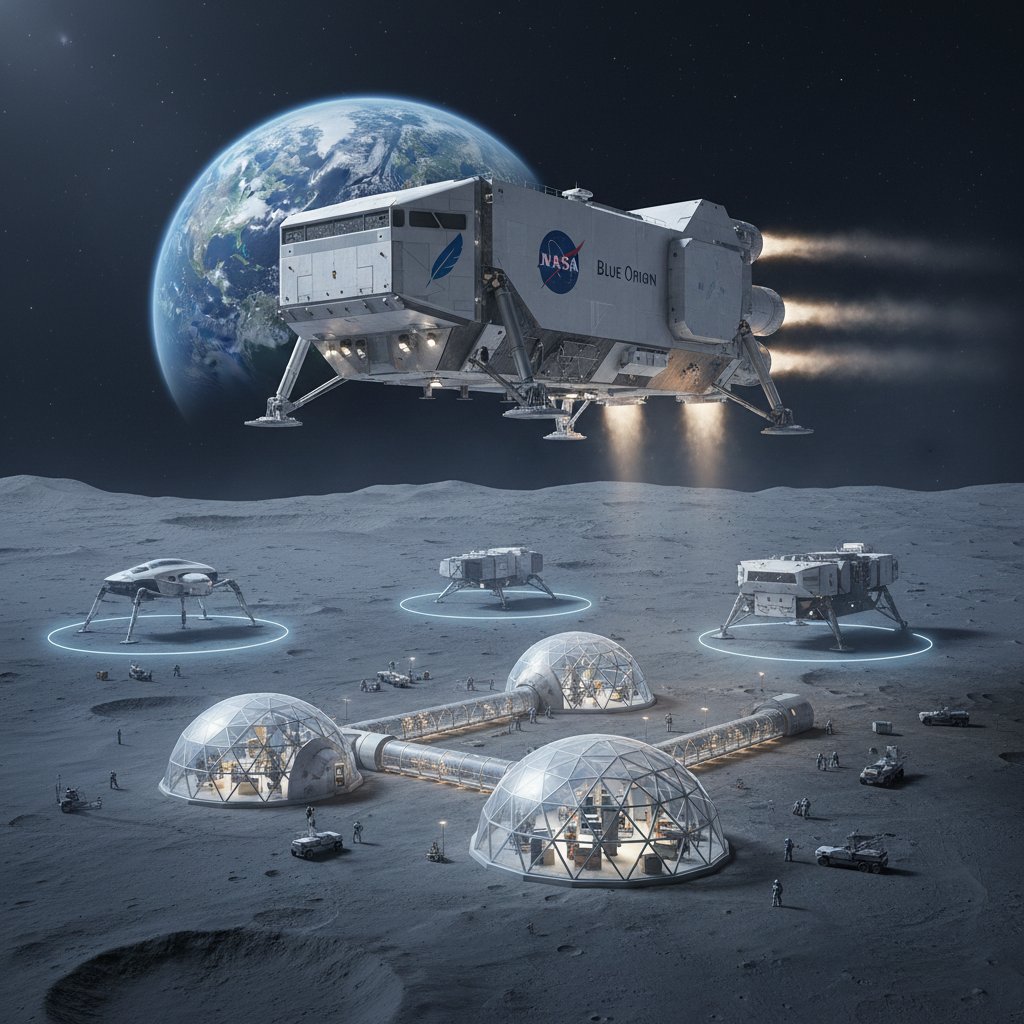
The first mission, slated for launch as early as March 2025 aboard a New Glenn rocket from Cape Canaveral, Florida, will test Blue Origin’s Blue Moon Mark 2 lander. This vehicle, standing 16 meters tall and capable of delivering 3.5 metric tons of payload, will set down near the Shackleton connecting ridge. Its primary objective is to deploy a communications relay and a solar array to power future operations.
Mission two, planned for June 2025, will deliver a 5-ton habitat module—a pressurized cylinder built by Lockheed Martin—along with a small rover to scout for ice deposits. The third mission, targeted for October 2025, will bring a second habitat, a power management unit, and the first components of a 100-kilowatt nuclear fission reactor developed by NASA’s Kilopower project.
“The sequencing is deliberate,” explained Dr. James T. Okonkwo, a space infrastructure engineer at the Massachusetts Institute of Technology who consulted on the mission architecture. “You don’t throw all your eggs in one lunar lander. You test the landing systems, then the habitats, then the power supply. Each mission reduces risk for the next. By the end of 2025, we’ll have a functional core that can support short crewed stays by 2027.”
The $20 Billion Question: Why Build a Moon Base Now?
The estimated $20 billion price tag for the base—formally called the Artemis Base Camp—has drawn skepticism from budget hawks in Congress and the public. Yet, NASA argues the investment is a necessity, not a luxury. The base will serve as a proving ground for technologies required for crewed Mars missions, which could cost upward of $100 billion.
“The Moon is our testbed,” said NASA Deputy Administrator Dr. Pamela A. Rollins during a press briefing at the Johnson Space Center in Houston last month. “We need to learn how to live and work on another world for months at a time. We need to recycle water, grow food, and manage radiation. You cannot simulate that for Mars anywhere on Earth.”
The base will consist of three main modules: a habitation core for up to four astronauts, a laboratory for geology and biology experiments, and an in-situ resource utilization (ISRU) plant. The ISRU plant will extract water ice from the regolith, splitting it into hydrogen and oxygen via electrolysis. The oxygen will be used for life support, while the hydrogen could power fuel cells or be combined with carbon to produce methane for rocket propulsion.
“The ice at the lunar poles is a game-changer,” said Dr. Okonkwo. “Every kilogram of water we don’t have to launch from Earth saves roughly $90,000 in launch costs. If we can produce 50 metric tons of water annually, the base starts to pay for itself in logistics savings.”
A Competitive Landscape: Blue Origin vs. SpaceX
The selection of Blue Origin for these missions comes amid fierce rivalry with SpaceX, which won a $2.9 billion contract in 2021 to develop the Starship Human Landing System for the Artemis III crewed mission. SpaceX’s approach relies on a single, massive lander that requires orbital refueling, while Blue Origin’s strategy emphasizes smaller, reusable landers that can be launched more frequently.
“Blue Origin’s win is a validation of the ‘many small steps’ philosophy,” noted Dr. Miller. “SpaceX is betting on scale—one giant ship that lands everything at once. Blue Origin is betting on agility—multiple landings over months, each one reducing risk. Both have merit, but for a base that needs continuous resupply, the Blue Origin model may be more resilient.”
The three missions will also feature a significant scientific component. Each lander will carry a suite of instruments, including spectrometers to map ice purity, seismometers to measure moonquakes, and radiation dosimeters to assess the hazard to future crews. Data from these instruments will inform not only base construction but also the search for ancient volcanic deposits and potential biosignatures.
“We know the Moon is geologically active,” said Dr. Miller. “We’ve detected moonquakes up to magnitude 5.5 on the Richter scale. Understanding how the base site responds to shaking is critical for structural integrity. These uncrewed missions are our first chance to get on-the-ground data.”
What It Means for the Reader: The Dawn of a Lunar Economy
For the average taxpayer, the $20 billion moon base represents a significant public investment. But proponents argue the returns will ripple through the economy. Technologies developed for lunar habitation—advanced water recycling, high-efficiency solar panels, and autonomous robotics—have already found applications in remote terrestrial environments, from deserts to polar stations.
“Think of it like the Apollo program,” said Dr. Rollins. “The investments we made in the 1960s gave us integrated circuits, satellite communications, and freeze-dried food. The Artemis base will accelerate breakthroughs in closed-loop life support, nuclear power, and 3D printing using local materials. Those are technologies that will help us fight climate change and improve life on Earth.”
If the three 2025 missions succeed, NASA plans to follow with crewed flights in 2027 and 2028, gradually expanding the base to accommodate up to 12 astronauts by 2030. The first crew will likely stay for two weeks, but later rotations will extend to 60 days, then six months.
“We are witnessing the birth of a new era,” concluded Dr. Okonkwo. “By the end of this decade, there will be humans living on the Moon permanently. That’s not science fiction anymore. It’s engineering. And it’s happening this year.”