







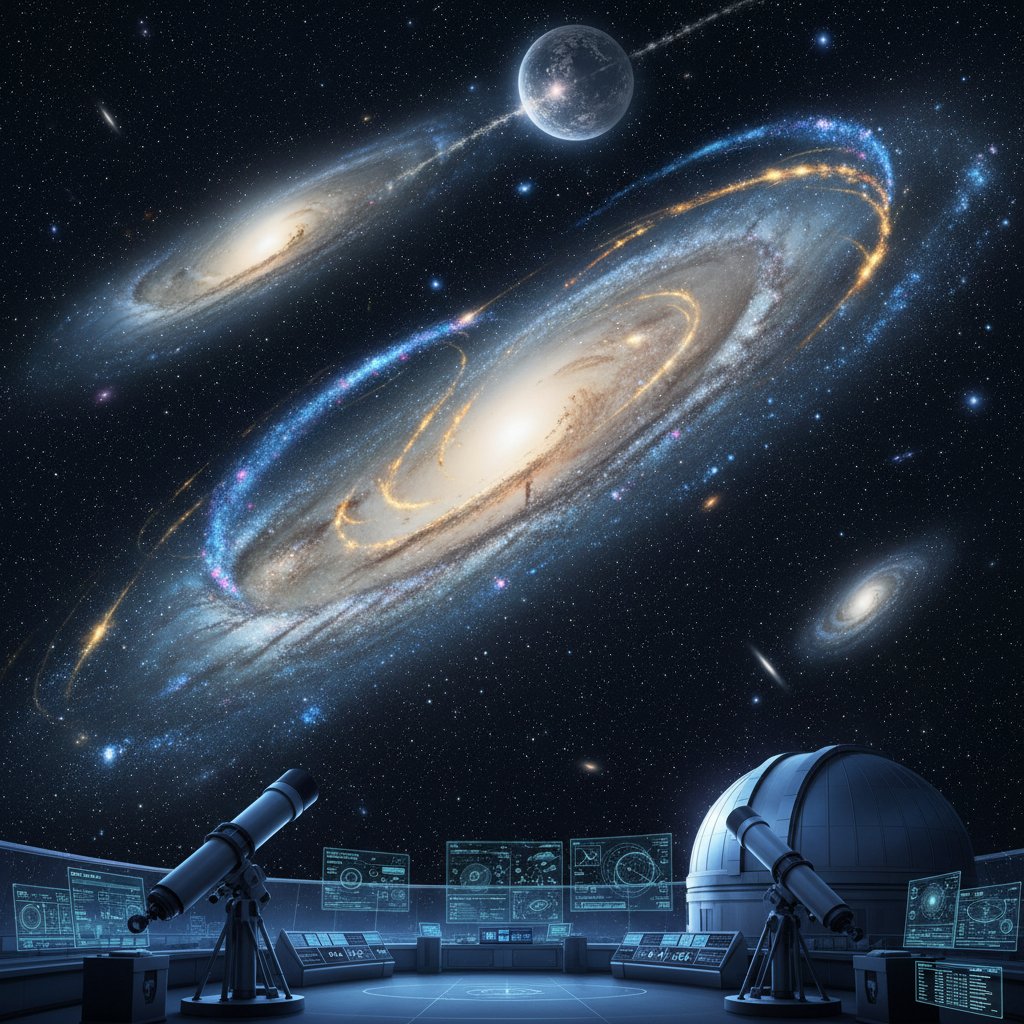
Billions of years ago, a cataclysmic collision reshaped the Milky Way, rewiring its structure and setting the stage for its future. Now, astronomers warn that our galaxy is on a collision course with another, the Andromeda Galaxy, a merger that will irrevocably transform the night sky. The evidence, drawn from recent studies using the European Space Agency’s Gaia satellite, paints a picture of a galaxy scarred but not broken by its violent past.
The latest findings, published in the Monthly Notices of the Royal Astronomical Society, reveal that the Milky Way’s spiral arms and central bar were significantly altered by a merger with a smaller galaxy, Gaia-Enceladus, approximately 8 to 10 billion years ago. “This was not a gentle interaction,” explains Dr. Elena Chisari, an astrophysicist at the University of Oxford and lead author of the study. “It was a full-scale collision that effectively rewired the galaxy’s internal structure, influencing star formation and the distribution of dark matter.”
The Ghost of Gaia-Enceladus
The Gaia satellite, which has been mapping the positions, distances, and motions of nearly 1.8 billion stars since its launch in 2013, has been instrumental in uncovering these ancient events. By tracking the movements of stars in the Milky Way’s halo—the diffuse sphere of stars surrounding the main disk—researchers identified remnants of the Gaia-Enceladus collision. Stars from this dwarf galaxy have distinct chemical compositions and orbital patterns, like fossils in the galactic record.
Chisari and her team used computer simulations to model how such a collision would have played out. They found that Gaia-Enceladus, with a mass about one-quarter of the Milky Way’s at the time, plowed through the disk, triggering a burst of star formation and heating the gas. This process, they argue, thickened the galactic disk and formed the Milky Way’s prominent central bar—a structure of stars and gas that funnels material toward the supermassive black hole at the galaxy’s core. “The bar is like a cosmic conveyor belt,” says Chisari. “Without that collision, it might not exist today.”
“The Milky Way is not a static entity; it’s a living, evolving system shaped by violent events.” — Dr. Elena Chisari, University of Oxford
This discovery challenges earlier models that suggested the bar formed through internal instabilities alone. Instead, external forces—galactic mergers—appear to be key drivers. The findings also align with other studies, including research from the Astrophysical Journal in 2023, which linked the Gaia-Enceladus merger to the formation of the thick disk, a population of older, metal-rich stars that now forms the galaxy’s structural backbone.
The Impending Andromeda Collision
While the past offers a window into galactic evolution, the future holds a more dramatic event. The Andromeda Galaxy (M31), our nearest large neighbor, is hurtling toward the Milky Way at about 110 kilometers per second. Current calculations, based on Hubble Space Telescope observations and updated with Gaia data, suggest the two galaxies will collide in roughly 4.5 billion years. Unlike the Gaia-Enceladus crash, this will be a merger of near-equals: Andromeda is slightly larger, with a mass of about 1.5 trillion solar masses, compared to the Milky Way’s 1 trillion.
Dr. Robert van der Marel, an astronomer at the Space Telescope Science Institute in Baltimore, has tracked Andromeda’s motion for decades. “The collision is inevitable,” he says. “When it happens, the two galaxies will pass through each other, with gravity pulling them together before they eventually merge into a single elliptical galaxy, sometimes called ‘Milkomeda.'” The process, he notes, will take about 2 billion years to complete, with stars flung into chaotic orbits. Will Earth survive? “The probability of our solar system being ejected or disrupted is low, but not zero,” van der Marel adds. “The bigger change will be for future observers: the night sky will be a swirl of new stars.”
“We’re looking at a future where the Milky Way as we know it ceases to exist, replaced by something entirely new.” — Dr. Robert van der Marel, Space Telescope Science Institute
Simulations predict that the merger will trigger a wave of star formation as gas clouds collide, but it could also fuel the central black holes. Both galaxies host supermassive black holes, which might eventually merge, releasing gravitational waves detectable across the universe. For now, these events are too far off to worry about, but they offer a sobering reminder of galactic impermanence.
What This Means for Our Understanding of Galaxies
These findings reshape how we view galaxy formation. The Milky Way was once thought to be a relatively quiet, stable spiral. Now, evidence suggests it has survived multiple major mergers—with Gaia-Enceladus and perhaps others, like the smaller Sagittarius dwarf galaxy, which is currently being absorbed. Each event left its mark. “The galaxy’s structure is a palimpsest of ancient collisions,” says Chisari. “By reading these imprints, we can reconstruct its history.”
For readers, this research connects cosmic events to life on Earth. The heavy elements—carbon, oxygen, iron—that make up our bodies were forged in stars formed during these mergers. Without such collisions, the galaxy might have been a sparse, barren place, lacking the raw materials for planets. The Gaia mission continues to refine these narratives; future data releases will map even more stars, potentially revealing additional ancient relics.
Yet the bigger implication is scale. The Andromeda merger will not only reshape our galaxy but also offer a test case for models of galactic evolution. Astronomers like van der Marel hope to observe similar mergers in distant galaxies to refine predictions. “We have a front-row seat to one of the most dramatic events in cosmic history,” he says. “It will take billions of years to unfold, but we can watch it in slow motion using our telescopes.”
As the Milky Way hurtles toward its next encounter, the past and future converge. The collision billions of years ago rewired our galaxy, perhaps setting the conditions for life itself. The next one, billions of years hence, will end the Milky Way as a distinct entity. For now, we stand in the middle of this story, with Gaia data revealing the past and simulations forecasting the future. The universe, it seems, is always in motion.