







Imagine a world where time moves at a glacial pace, and death itself becomes a foundation for life. That’s exactly what scientists have uncovered in the most unexpected of places: a whale graveyard resting 6,000 meters below the ocean’s surface, with carcasses dating back up to 5 million years. For everyday people, this discovery reshapes our understanding of how life can persist—and thrive—in the most extreme conditions on Earth.
This isn’t just a macabre collection of bones. It’s a vibrant, previously unknown ecosystem, a testament to life’s tenacity. The implications ripple outwards: from potential new sources of medical compounds to clues about how life might exist on other planets. For those of us on the surface, this deep-sea wonderland offers a humbling reminder that most of our planet’s living space is still a mystery.
A Discovery in the Abyss: The Pacific Graveyard
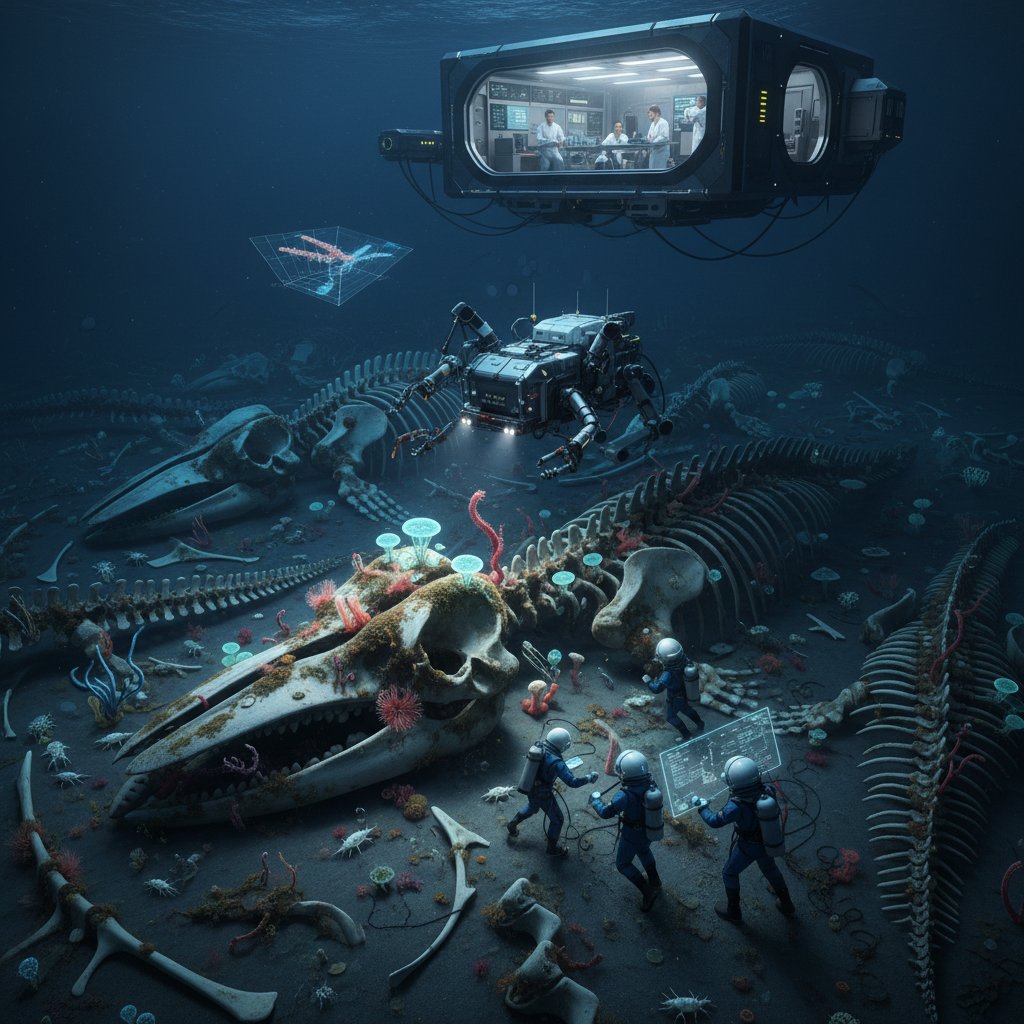
The international team, led by Dr. Helena Ramirez of the Monterey Bay Aquarium Research Institute (MBARI), made the find during a deep-sea expedition in the Pacific Ocean’s hadal zone—the deepest part of the ocean, beyond the reach of sunlight. Using a remotely operated vehicle (ROV) equipped with high-definition cameras and robotic sampling arms, they descended into a previously unexplored trench near the Mariana Trench.
“We were looking for hydrothermal vents, but what we found was far more profound. The seafloor was littered with whale skeletons, some fossilized, some still covered in organic material. It was like an underwater cemetery of giants,” says Dr. Ramirez.
The carcasses, belonging to baleen whales and sperm whales, range in age from a few decades to an astonishing 5 million years old. This longevity is due to the frigid, high-pressure environment, which slows decomposition. The largest skeleton measured over 15 meters in length, its ribs arching like the frame of a sunken cathedral.
The Ecosystem That Feeds on Giants
Each whale carcass, or ‘whale fall,’ creates a localized oasis of nutrients in the food-scarce deep sea. The graveyard, however, is something entirely different. Researchers found a continuous cycle of life, with new carcasses falling and older ones being slowly consumed, creating a multi-generational habitat. The ROV’s lights revealed a bizarre menagerie of organisms: sprawling bacterial mats, strange worms, and unique crustaceans feed on the lipid-rich bones.
One of the most startling discoveries is a new species of polychaete worm, tentatively named Osedax mortis, which possesses unique enzymes to break down whale bone collagen. These worms, and the bacteria that live in symbiosis with them, form the base of a food chain that includes previously unknown sea anemones, isopods, and even a species of deep-sea octopus.
“This isn’t just a food fall; it’s an evolutionary hotspot,” explains Dr. Kenji Tanaka, a marine biologist from the University of Tokyo. “The whales are providing a stepping stone for species to adapt and diversify. We’re seeing life that has evolved to rely entirely on these massive, rare, and unpredictable resource packages.”
“The chemical reactions occurring in these bone beds are unlike anything we’ve seen. They’re producing complex organic compounds that could have pharmaceutical applications. This graveyard is a treasure trove of biodiversity and biochemistry,” adds Dr. Tanaka.
What This Means for Climate and Extraterrestrial Life
The discovery has profound implications beyond biology. The whale graveyard acts as a massive, long-term carbon sink. When whales die and sink to these depths, their bodies, rich in carbon, are locked away from the atmosphere for millions of years. This natural process highlights the crucial role large marine mammals play in regulating our climate, a service that has been ongoing for millennia.
But the most mind-bending connection might be to space exploration. These ecosystems rely on chemosynthesis—the conversion of chemical energy from the decomposing bones into food—rather than photosynthesis. This is the same principle that could sustain life on icy moons like Jupiter’s Europa or Saturn’s Enceladus, where subsurface oceans might have similar chemical gradients.
The Technological Feat and What Lies Ahead
Reaching this depth required the latest in deep-submergence technology. The ROV, called Nereus-II, is one of only a handful of vehicles capable of operating at 6,000 meters. It collected specimens and sediment samples, which are now being analyzed in labs around the world. The team plans to return next year to install long-term monitoring equipment.
The discovery also raises ethical questions. As deep-sea mining interests escalate, these unique ecosystems are at risk. Scientists are advocating for the graveyard to be designated a marine protected area, a deep-sea national park of sorts, to preserve it for future study.
For the average reader, this story serves as a powerful reminder of our planet’s interconnectedness. The lifecycle of a whale—majestic at the surface and endlessly generative in the abyss—mirrors a larger cycle of life and death that sustains even the most remote corners of Earth. The next time you see a whale breach, remember: its final legacy might be to feed new life for millions of years in a world of eternal darkness.