






“That boom was the sound of a safety net being tested—a promise that our astronauts will have a fighting chance if things go wrong.”
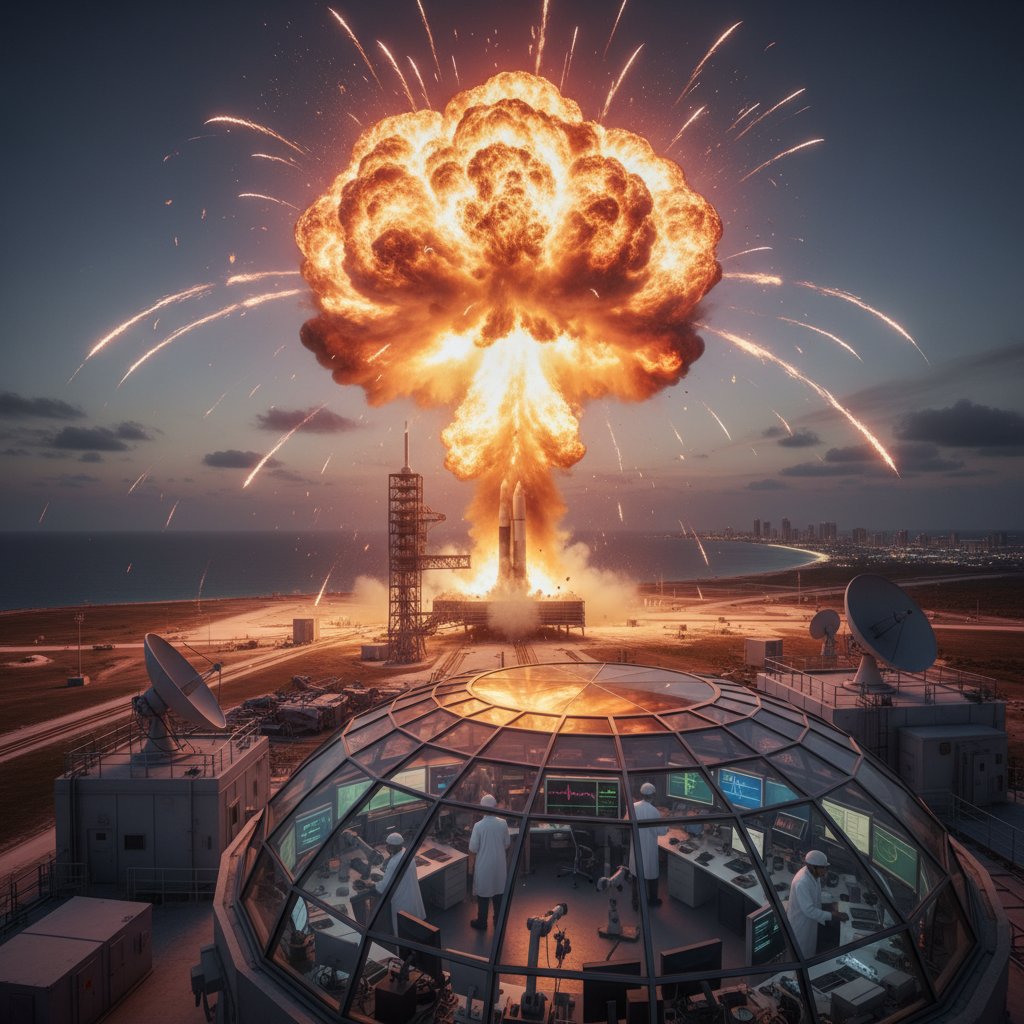
Dr. Elena Vasquez, NASA’s Orion Launch Abort System lead, wasn’t smiling when she said that. She was standing half a mile from Pad 39B at Cape Canaveral Space Force Station, still feeling the vibrations in her chest. At 7:45 AM EST on Tuesday, October 17, 2023, the agency conducted a high-stakes static test of the Artemis II Launch Abort System (LAS). The result? A controlled, thunderous explosion that sent a shockwave across the Florida coastline—and a wave of confidence through the space community.
This wasn’t a failure. It was the sound of thousands of hours of engineering paying off. The test, designated LAS-2, demonstrated that the system’s abort motor can generate 500,000 pounds of thrust in under half a second—enough to yank the Orion crew module away from a failing rocket and accelerate astronauts to safety faster than four times the speed of sound. And it did so flawlessly.
The Boom Heard Around the Cape
Witnesses described the event as a “sharp, percussive crack” followed by a sustained roar that rattled windows in nearby Titusville. For a few seconds, a column of flame and smoke rose above the pad, dissipating quickly in the cool Atlantic breeze. Unlike a typical rocket launch, which builds up gradually, this test was designed to be instantaneous and violent—exactly the profile required for an emergency escape.
“It’s not subtle,” says Dr. Marcus Chen, a propulsion expert at the University of Central Florida who observed the test from a safe distance. “The abort motor uses a solid propellant that burns all at once. That’s why you get a bang, not a whoosh. It has to work that way because in a real abort, you have milliseconds to separate the crew from a disintegrating booster.”
The test was conducted on a specially built static test stand at Launch Complex 39B—the same pad used for Apollo 11 and countless Space Shuttle missions. The stand replicates the interface between the Orion capsule and its Space Launch System (SLS) rocket. Engineers equipped the abort motor with over 200 sensors to measure thrust, heat, vibration, and acoustic loads. Preliminary data, Vasquez says, shows that all performance parameters were within design margins.
Why the specific date? The test was originally scheduled for August but delayed due to supply chain issues with the solid propellant mix. Tuesday’s clear skies and light winds provided ideal conditions for both the test and the high-speed cameras that recorded it. Those cameras will now be used to create computer models of abort scenarios, helping NASA refine the system further.
“The data we collected today is gold,” Vasquez adds. “We’ll spend the next six months combing through it to confirm every single valve, every seal, every grain of propellant performed as expected. But from what I saw and heard, we nailed it.”
A System Designed for Emergency
But what exactly is a Launch Abort System, and why is a “boom” a good thing? The concept dates back to the early days of human spaceflight. Mercury and Apollo capsules had escape towers that could pull the capsule away from a launch vehicle in trouble. The Soviet Union’s Soyuz uses a similar system, famously saving cosmonauts Vladimir Titov and Gennady Strekalov in 1983 when their rocket caught fire on the pad. The LAS is effectively a giant rocket motor mounted on top of the crew capsule. In an emergency—whether on the pad or during ascent—it fires almost instantly, hauling the capsule to a safe distance where parachutes can deploy for a gentle splashdown.
Orion’s system is the most advanced ever built. Unlike Apollo’s solid-fuel tower, which was jettisoned after the second stage ignition, Orion’s LAS stays attached for the entire ascent phase, capable of aborting at any altitude up to 100 kilometers. The motor is housed in a composite structure called the fairing assembly, which also protects the capsule from aerodynamic loads. The test on Tuesday focused solely on the jettison and abort motor combination—the part that performs the high-speed pull-away.
But it’s not just about brute force. The system must also ensure that the capsule remains stable during the violent separation and that the crew inside experiences no more than 10 Gs—a survivable but intense load. “It’s a delicate dance,” says Chen. “You need enough thrust to escape a fireball, but not so much that you snap the astronauts’ necks. Today’s test validates that balance.”
What This Means for Artemis II
Artemis II, scheduled for no earlier than November 2024, will be NASA’s first crewed mission to the Moon since Apollo 17. It will send four astronauts—Commander Reid Wiseman, Pilot Victor Glover, Mission Specialist Christina Koch, and Canadian astronaut Jeremy Hansen—on a 10-day journey around the Moon and back. While they won’t land, they will test all critical systems, including life support, navigation, and—crucially—the launch abort system.
For a crewed mission, the LAS must be certified as “flight ready.” That requires a series of component and integrated tests. Tuesday’s static fire was the final major ground test before a full-stack abort test—dubbed Ascent Abort-2 (AA-2)—which will actually launch a dummy capsule from a booster and trigger an abort in mid-flight. AA-2 was successfully completed in 2019. The new motor is an upgrade for the Artemis II-specific hardware.
“This is a box we had to check,” says NASA Administrator Bill Nelson in a recorded statement. “Safety is our North Star. Every time we make a boom like this, we’re making sure our astronauts can come home. Today’s test moves us one big step closer to launching the first woman and the next man to the lunar surface.”
The test also has implications beyond the Moon. Orion’s LAS design is being adapted for future Mars missions, where abort scenarios become even more complex due to the distance from Earth. “What works for low Earth orbit might not work for a trans-Mars injection burn,” Vasquez notes. “But the fundamental physics—getting the crew away from a catastrophic failure—is the same. This test proves our core architecture is solid.”
Looking Ahead: Safer Spaceflight for Everyone
As the smoke clears over Cape Canaveral, it’s easy to see Tuesday’s event as just another engineering milestone. But for the thousands of people working on Artemis, it’s personal. The astronauts who will fly on Artemis II have families, dreams, and the same vulnerability as anyone else. Christina Koch, the mission specialist, once lived on the International Space Station for 328 days; she knows the risks. “Knowing that the team has tested and retested every nut and bolt—and that the LAS can pull us away from a fireball—gives me a deep sense of confidence,” she said in a recent press call.
But the benefits extend beyond government missions. Commercial crew providers like SpaceX and Blue Origin are watching NASA’s LAS work with interest. SpaceX’s Crew Dragon currently uses a different abort mechanism—SuperDraco engines built into the capsule itself—which eliminates the need for a tower. Nevertheless, the data from solid motor aborts informs their own safety calculations. “The more ways we have to save a crew, the better,” says Chen. “Spaceflight is inherently risky. These tests reduce that risk, and that helps everyone—NASA, SpaceX, international partners, and eventually tourists.”
In a few weeks, engineers will begin dismantling the test stand, shipping the sensors and motor components back to the Marshall Space Flight Center for analysis. The next big milestone is a complete integrated test of the Orion spacecraft and SLS rocket, including a simulated launch countdown, likely in early 2024. And then, finally, the real deal: four humans strapped into Orion, listening to the countdown, ready for the sound of the SLS—a much deeper, more sustained roar that will send them toward the Moon.
But first, they needed to hear that boom. And now they have.