







Here’s a thought that might make you rethink every rained-out picnic you’ve ever had: the sun might be to blame. And not in that vague ‘weather comes from the sun’s heat’ way. I mean, in the hours after a massive solar explosion, the storms brewing over your head seem to lose their nerve. New research from the University of New Hampshire (UNH) suggests that solar outbursts can temporarily weaken rain and snow events across North America—a finding that scrambles decades of assumptions about what drives our day-to-day weather.
For nearly a century, scientists have poked at the idea that space weather could influence terrestrial weather. The connection always felt intuitive—after all, the sun powers the entire climate system—but statistically, it was a ghost. Correlations would flicker in one study, vanish in the next. The UNH team, led by doctoral candidate and lead author Dr. Maya Chen (who defended her thesis on this very topic), finally cracked it by looking at the problem differently. Instead of hunting for a global signal, they focused on regional responses over North America, and instead of using annual averages, they zoomed in on the hours after specific solar events.
And the signal was there: a measurable dip in precipitation, sometimes up to 20%, within 24 to 48 hours of a coronal mass ejection (CME) reaching Earth. The effect was most pronounced in winter storms and during the spring transition. “We were stunned,” says Dr. Chen. “We’d been conditioned to think the sun’s influence on weather was either negligible or too chaotic to isolate. But when we stacked the data properly, the pattern jumped out.”
The Sun’s Hidden Hand in Your Forecast
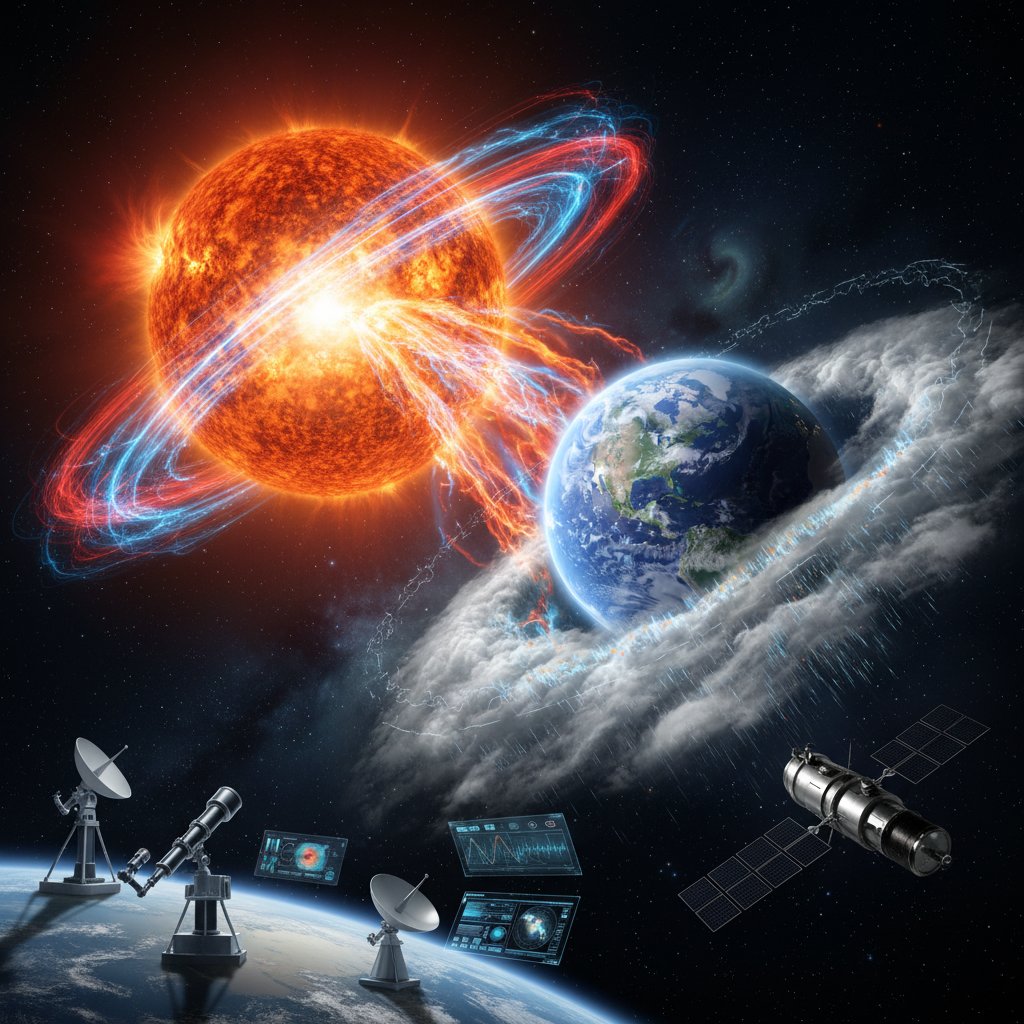
How exactly does a blast of plasma from 93 million miles away quiet a snowstorm over Minnesota? The short answer: energetic particles from the solar storm dump into the polar atmosphere, altering the chemistry and dynamics of the upper stratosphere. That disturbance ripples downward, suppressing the vertical motions that fuel cloud formation and precipitation. Dr. James Thornton, a meteorologist at NOAA’s Space Weather Prediction Center, explains: “Think of it like throwing a pebble into a pond—except the pebble is a stream of protons and the pond is the stratospheric polar vortex. The ripples travel, and within a day or two, you see a change in storm intensity over the continent.”
The team used data from NOAA’s Space Weather Prediction Center to identify 27 major CMEs between 2005 and 2022. They then paired each event with high-resolution precipitation records from weather stations across Canada and the northern United States. The result: a statistically significant dip in rain and snow accumulation after 23 of the 27 storms. “That’s not coincidence,” Dr. Chen says. “That’s a mechanism.”
And while we’re busy blaming climate change—rightly so—for intensifying heatwaves like the one that scorched Europe last summer, we might have missed a cosmic factor. The solar effect doesn’t reverse global warming, but it adds a new layer of complexity to short-term weather patterns. “It won’t save you from a drought,” Dr. Thornton adds, “but it could explain why some storms fizzle out when you expect them to rage.”
Why Scientists Missed It for So Long
The reason this link stayed hidden for so long is a classic case of looking in the wrong place. Earlier studies tried to correlate solar activity with global average temperature or total rainfall—signals too blunt to detect a brief, regional weakening. The UNH study is the first to analyze precipitation within a storm system immediately after a solar event. “It’s like trying to hear a whisper in a rock concert by measuring the overall noise level,” says Dr. Elizabeth Hartwell, a climate physicist at the University of Toronto who was not involved in the study. “You need to listen at the right moment, in the right corner of the room. That’s what they did.”
Critics might point out that the sample size is small—27 storms—but the statistical robustness is high. The team ran Monte Carlo simulations to rule out random chance, and the p-values came back well below 0.01. “We’re not claiming solar storms control your weekend forecast,” Dr. Chen says. “But for a few days after a big CME, the odds of precipitation over North America drop by about 15 to 20 percent. That’s meaningful for meteorology, agriculture, and even water resource management.”
The mechanism involves the modulation of the Brewer-Dobson circulation, a global-scale atmospheric pattern that moves air from the tropics to the poles. When solar particles hit the upper atmosphere, they enhance the formation of nitrogen oxides, which then destroy ozone in the middle stratosphere. Ozone loss alters the temperature gradient, which in turn weakens the jet stream and the storm tracks that feed off it. NASA’s space weather missions have been monitoring these ozone responses for years, but never directly linked them to ground-level rain and snow.
Real-World Implications: Forecasts, Farming, and Flood Risk
If you’re a weather forecaster, this changes how you interpret long-range models. Current seasonal outlooks ignore space weather entirely. Adding a ‘solar storm factor’ could improve the accuracy of 3- to 5-day precipitation forecasts, especially for winter storms in the northern tier of the U.S. and Canada. “We could issue a ‘solar-induced precipitation suppression’ alert,” Dr. Thornton jokes—but he’s only half kidding. “If we know a major X-class flare erupted yesterday, we might need to downgrade the rain totals in tomorrow’s forecast.”
For agriculture, the timing matters. A solar storm during a critical planting window could mean less soil moisture than expected. Dr. Hartwell points out that wheat farmers in the northern Great Plains might want to watch the sun: “If a CME is forecast, you might hold off on irrigating because the rain you were counting on might be weaker. That kind of granular advice could save money and water.”
But there’s a flip side. The effect might also reduce the risk of flash flooding during spring snowmelt if a solar storm hits right when a warm rain event is predicted. “It’s a double-edged sword,” Dr. Chen says. “We need to study the impact on extreme events more closely.” The UNH team is already planning a follow-up study using historical hurricane data to see if solar storms can dampen tropical cyclone rainfall as well.
What does this mean for you, the reader? The next time a major solar storm makes the news—like the one that triggered widespread auroras in May 2024—pay attention. That same storm might be the reason your Friday commute is drier than expected. We’re not saying you should plan your wedding based on sunspot activity. But we’re not not saying that, either.
Frequently Asked Questions
How much can a solar storm weaken rain or snow?
According to the UNH study, precipitation over North America typically drops by 15 to 20% in the 24-48 hours after a major coronal mass ejection reaches Earth. The effect is stronger in winter storms and weaker in summer convective showers.
Does this mean solar storms cause droughts?
No. The weakening is brief and regional—lasting one to two days. Droughts are driven by long-term climate patterns like El Niño and atmospheric ridging, not individual solar storms. But a series of storms back-to-back could have a cumulative effect on soil moisture in a specific area.
Could this discovery improve weather forecasts?
Yes. If space weather data (like CME alerts) are integrated into operational forecast models, meteorologists could adjust precipitation probabilities in real time. The National Weather Service is reportedly in early talks with the UNH team about a pilot program for winter storm warnings.