








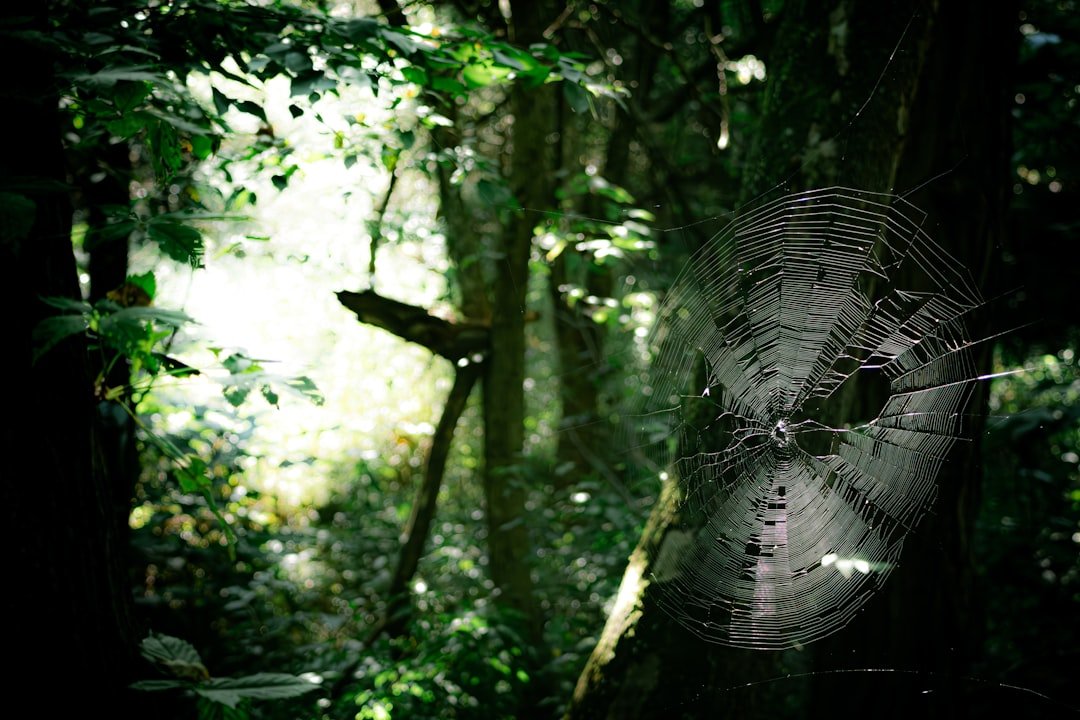
Step into a forest that’s been managed for timber — row after row of identical pines, the understory swept clean, not a fallen log in sight. It looks dead. Lifeless. Ecologists have long told us that such “monotonous” habitats are biodiversity deserts. You want to save species? You need mess: clearings, deadwood, a patchwork of light and shadow. But a new study turns that dogma on its head — at least for spiders.
It turns out that some spider communities, particularly ground-dwelling hunters like wolf spiders, don’t just tolerate uniform forests. They thrive in them. And that forces conservationists to rethink what “healthy” really means.
The Myth of Messy Forests
The principle is nearly gospel in ecology: habitat heterogeneity drives species diversity. A 2020 meta-analysis found that in over 80% of studies, increasing structural complexity boosted species richness. Forests with clearings, varied tree ages, snags, and downed wood usually host more birds, beetles, and bats. So forest managers worldwide deliberately create gaps and leave deadwood to mimic natural disturbance.
But spiders? They’re reading a different playbook.
“We used to assume more structure always means more niches,” says Dr. Elena Voss, arachnologist at the University of Freiburg and lead author of the new study published in Journal of Applied Ecology. “But spiders are ambush predators with very specific microhabitat needs. For them, a cluttered forest floor can be a nightmare — literally trapping their webs or blocking their hunting runs.”
Voss’s team surveyed spider communities across 45 forest plots in southwestern Germany over two years. Half were “structurally rich” with clearings, deadwood piles, and diverse understory. The other half were monotonous managed stands of Norway spruce — dense, dark, tidy. The results were stark: total spider abundance was 34% higher in the monotonous plots. Wolf spider density? 52% higher.
So much for the heterogeneity credo.
Why Spiders Don’t Need Variety
To understand why, you have to think like a spider. A wolf spider doesn’t weave an orb web; it runs down prey on the forest floor. That requires open ground with minimal obstacles. Deadwood snags, thick leaf litter, and herbaceous plants are not features — they’re furniture to trip over.
“For these hunters, a clean understory is like a freeway,” explains Dr. Mark Li, a behavioral ecologist at the University of Zurich who wasn’t involved in the study. “You can accelerate, you can pivot, you can chase. In a messy forest, you’re stuck navigating an obstacle course. The prey gets away.”
Web-building spiders (orb-weavers, sheet-web weavers) also showed a preference for simplicity, though less pronounced. They need anchor points for webs, but too many twigs can tear the silk. In monotonous forests, the consistent spacing of branches and stems provides predictable attachment points — a stable platform for their snare.
And what about prey availability? Conventional logic says more plant diversity equals more insect diversity equals more spider food. But Voss’s team found that total insect biomass (flies, beetles, springtails) was only 9% lower in monotonous forests — not enough to offset the foraging advantage. “The payoff structure favors speed over variety,” she says.
Look, this isn’t to say that forest heterogeneity is worthless. Birds, bats, and many insects clearly need it. But the one-size-fits-all “more mess = more good” assumption is cracking. Satellite data from programs like NASA’s Earth Eyes now let researchers map forest structure at unprecedented scales, comparing canopy gaps, understory density, and deadwood distribution. Those tools are revealing that the relationship between structure and biodiversity isn’t a straight line up — it’s a web of trade-offs.
What This Means for Conservation
Forest managers face a delicate balancing act. Create clearings for sun-loving butterflies? That might crush wolf spider populations. Leave deadwood for beetles? You could accidentally bury web-sites for orb-weavers. “We can’t just apply a heterogeneity blanket,” says Dr. Inge Petersen, a conservation biologist at the Swedish University of Agricultural Sciences. “We need to know which species groups we’re targeting. For spiders, sometimes the best habitat is the one that looks most boring.”
That has immediate practical implications. In European production forests, managers often create “retention patches” with varied structure to boost biodiversity. But Voss’s work suggests these patches should be strategically placed, not scattered uniformly. “If your goal is spider conservation, you might want to leave large, uninterrupted blocks of even-aged monoculture alongside your heterogeneous zones,” she advises.
Curiously, this echoes findings from other predator-poor systems. Red-tailed hawks, for instance, adjust their hunting strategy when feather loss limits maneuverability — a reminder that predators are exquisitely sensitive to habitat geometry, not just resource abundance.
The study also raises questions about old-growth forests. Virgin forests are often structurally complex: big trees, fallen giants, multiple canopy layers. Spiders there show different adaptations. But in the fragmented, heavily managed landscapes that cover most of Europe and North America, simple stands might act as refuges. “We’ve been so focused on restoring complexity that we overlooked the value of simplicity,” says Voss.
So next time you walk through a “boring” pine plantation — no sunny gaps, no rotting logs, just straight trunks and a floor of needles — take a closer look. That forest might look dead. But it’s crawling with eight-legged hunters, silently disproving ecology’s most comfortable assumption.
The next step? Voss’s team is now testing whether the pattern holds for other arthropod predators, such as centipedes and ground beetles. And they’re working with forestry agencies to design “spider-friendly” management protocols. Because in conservation, sometimes the most valuable habitat is the one we’ve been dismissing as too monotonous to matter.
Frequently Asked Questions
Why do monotonous forests benefit spiders but not other animals?
Spiders, especially ground-hunting species, rely on open terrain to chase prey. Dense understory or deadwood creates physical obstacles that slow them down. Other animals like birds or bats benefit from structural complexity because it offers nesting sites, perches, or diverse insect prey. So the same features that help one group can hinder another.
Should forest managers stop creating clearings and leaving deadwood?
Not entirely. Clearings and deadwood benefit many species — beetles, woodpeckers, fungi. The key is strategic placement: concentrate heterogeneous patches in some areas while leaving large simple blocks intact for spider and arthropod communities. A mosaic approach that preserves both monotony and mess likely maximizes overall biodiversity.
Does this apply only to European spruce forests, or to other forest types?
The study focused on Norway spruce plantations in Germany, but the researchers suspect the principle holds broadly. Preliminary data from pine forests in the U.S. Southeast and eucalyptus plantations in Australia show similar trends. Any structurally simple, even-aged stand with a clean floor may offer hunting advantages for cursorial spiders. More research is needed in tropical systems where the prey base is richer.