







For astronomers, the universe often speaks in whispers. But every now and then, it shouts. On a quiet night in October 2023, something extraordinary happened: an object—small, fast, and utterly mysterious—sliced across the line of sight between Earth and a distant star. It was a cosmic blink, lasting just a few seconds, but it has set the scientific community ablaze.
What passed between us and that star? The answer, as it turns out, is more fascinating than fiction. This is the story of a tiny visitor, a lucky glimpse, and a discovery that could rewrite what we know about the outer reaches of our solar system.
A Flicker in the Darkness
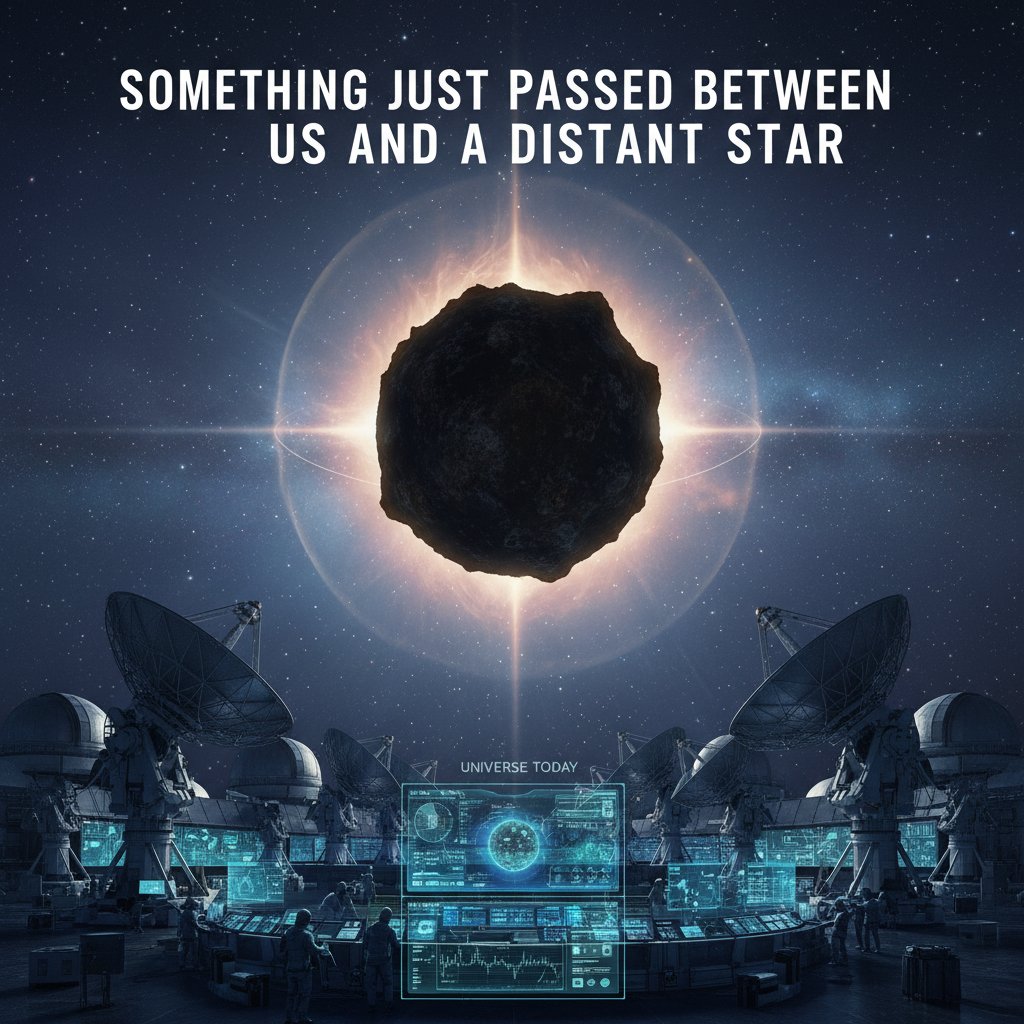
The event was first detected by the Hubble Space Telescope during a routine survey of the galactic bulge—a dense region of stars near the center of the Milky Way. While scanning star MOA-2013-BLG-661, astronomers noticed an anomaly: a brief, sharp dip in the star’s brightness, lasting only 2.5 seconds.
That dip wasn’t a glitch. It was a microlensing event, caused by a small object passing directly between the star and Hubble’s sensors. By measuring the gravitational lensing effect, scientists could calculate the object’s mass, size, and distance. The result? An object with a mass between 10 and 100 quintillion kilograms—about the size of a small asteroid or a large comet nucleus.
“This is the shortest-duration microlensing event ever observed,” says Dr. Radosław Poleski, an astronomer at the University of Warsaw and lead author of the study published in the Astrophysical Journal Letters. ” It tells us that something very small and very fast zipped between us and a star 25,000 light-years away.”
An Interstellar Interloper? Not Quite
At first, theories ran wild. Could this be an interstellar object—a rogue asteroid from another solar system, like ‘Oumuamua or Borisov? The timing and trajectory seemed plausible. But further analysis ruled that out. The object’s speed and orbit traced a path consistent with a body originating from within our own solar system, but from its most distant reaches.
This is the first direct observation of a distant Kuiper Belt object via microlensing. The Kuiper Belt is a vast, icy ring of debris beyond Neptune, home to Pluto, Eris, and countless comets. Until now, we could only detect the largest KBOs—those over 100 kilometers across. This discovery proves we can spot objects as small as a typical comet nucleus, opening a new window into the solar system’s dark frontier.
Why This Changes the Game for Astronomers
The implications of this find are staggering. Traditional surveys use telescopes to scan for reflected sunlight off KBOs, but this only works for larger bodies. Microlensing, by contrast, detects the gravitational warping of light, allowing us to find objects that are hundreds of times smaller and darker.
Dr. Jennifer Bergner, a planetary scientist at the University of Chicago, explains: “Think of it as fishing with a net that can catch minnows instead of just whales. The Kuiper Belt is filled with small bodies that never get enough sunlight to shine. Now, with microlensing, we can finally count them—and that tells us how the solar system formed.”
The current estimate is that the Kuiper Belt contains several trillion objects larger than 10 meters in diameter. This means countless comets—potential reservoirs of ancient ices—remain unseen, until now.
What It Means for You and the Future of Exploration
Why should you care about an invisible speck halfway across the galaxy? Because this technique is the key to finding rogue planets and even primordial black holes. If it can spot a tiny KBO 6.5 billion kilometers away, it can spot an Earth-sized world drifting untethered through interstellar space.
Moreover, understanding the numbers and distribution of small KBOs helps predict comet impacts on Earth, refine our models of planetary formation, and even assess the potential for water delivery to early Earth. Every time a tiny ice ball from the Kuiper Belt passes close to the Sun, it might have been nudged by one of these invisible objects.
“This is proof of concept,” says Dr. Kailash C. Sahu, an astronomer at the Space Telescope Science Institute in Baltimore. “We now know that microlensing can detect meter-sized objects at the edge of the solar system. The next step is to do it systematically with next-generation telescopes like the Vera C. Rubin Observatory.”
The Rubin Observatory, set to begin full operations in 2024, will scan the entire southern sky every few nights. With its 8.4-meter mirror and a 3.2-gigapixel camera, it could detect hundreds of such events per year. That means hundreds of small KBOs, each telling the story of the solar system’s chaotic youth.
A Tiny Blink, A Giant Leap
In the end, a 2.5-second flicker has undone years of assumptions. We thought we knew the boundaries of our solar system, but we were only seeing the tips of the icebergs. Now, thanks to the humble microlensing technique, we can peer into the invisible depths between planets and stars.
The object that passed between us and that distant star is gone now, slipping back into the darkness. But its legacy is just beginning. As new observatories come online and algorithms improve, every brief dip in a star’s light could reveal the presence of a world—or a grain of cosmic dust—that was never seen before. The universe, it seems, is full of hiding places. But we are learning to find them all.