








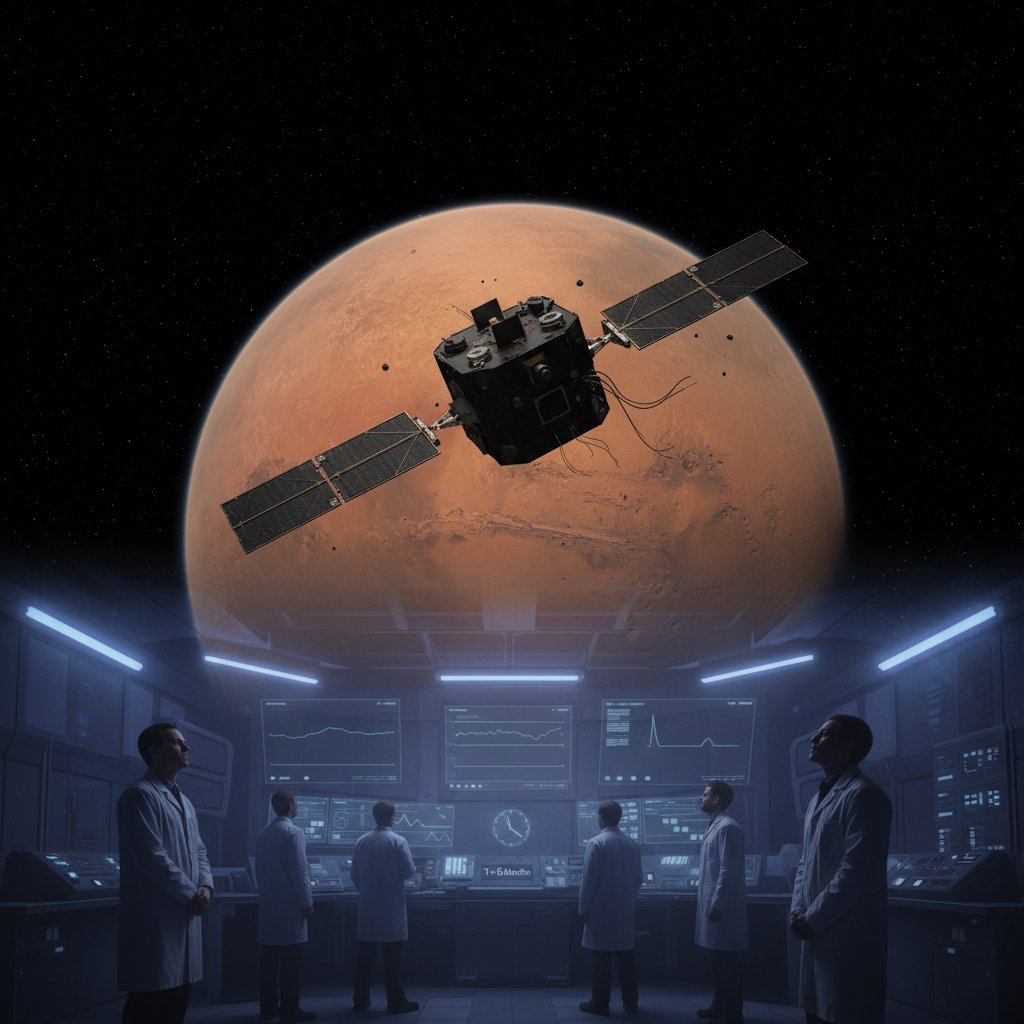
“It’s with a heavy heart that we must conclude the MAVEN mission,” said Dr. Shannon Curry, MAVEN Principal Investigator at the University of California, Berkeley, in a statement released by NASA yesterday. “After six months of complete radio silence, we have exhausted every recovery option. MAVEN is gone.”
The Mars Atmosphere and Volatile Evolution spacecraft, affectionately known as MAVEN, spent a decade orbiting the Red Planet, unraveling the mysteries of its thin, carbon dioxide-rich atmosphere. On February 17, 2025, mission controllers at NASA’s Goddard Space Flight Center noticed an unexpected drop in the probe’s signal strength. Within hours, all telemetry ceased. For 180 days, an international team of engineers and scientists tried every trick in the book—from power cycling transponders to sweeping the frequency band—but the silence never broke.
This is more than the end of a single mission. MAVEN’s loss marks the first time a NASA orbiter at Mars has been declared irrecoverably lost due to a communications failure, and it leaves a critical gap in our ability to monitor the Martian atmosphere in real time.
A Decade of Discovery Cut Short
MAVEN launched from Cape Canaveral on November 18, 2013, and successfully entered Mars orbit on September 21, 2014. Its primary goal: understand how the Martian atmosphere—once thick enough to support liquid water—eroded into the frigid, low-pressure blanket we see today. Over ten years, the spacecraft made transformative discoveries.
In 2017, MAVEN data revealed that the solar wind strips away about 100 grams of atmospheric gas every second, a process that accelerated dramatically during solar storms. It measured the escape rates of hydrogen, oxygen, and carbon dioxide, providing the first comprehensive inventory of Mars’ atmospheric loss over geologic time. “MAVEN gave us the ledger book of the atmosphere,” said Dr. Bruce Jakosky, the mission’s former principal investigator. “It showed us that most of Mars’ air literally blew away into space.”
The spacecraft also witnessed rare phenomena: auroras in the Martian ultraviolet, a dusty “snowfall” of carbon dioxide ice at the south pole, and the global dust storm of 2018 that eventually killed the Opportunity rover. MAVEN served as a critical relay for surface rovers, including Curiosity and Perseverance, relaying 85% of their data back to Earth during peak operations.
“MAVEN was the unsung hero of Mars communications. Without it, we would have lost gigabytes of science from the rovers during solar conjunctions.” — Dr. Karin L. Anderson, former MAVEN Deputy Project Scientist, NASA Goddard Space Flight Center
In February 2025, the spacecraft was performing routine orbit-raising maneuvers when its star tracker suddenly malfunctioned. The star tracker—a camera used to determine orientation—lost lock on reference stars, sending MAVEN into an uncontrolled spin. The spacecraft’s fault protection software likely entered a safe mode, but telemetry suggested the antenna was no longer pointing toward Earth. Three attempts to reestablish contact by commanding a series of backup maneuvers via the Deep Space Network failed. By August, NASA officially declared the mission lost.
What Went Wrong? A Timeline of the Crisis
The incident began on February 17, 2025, at 14:23 UTC. MAVEN’s onboard computer detected a mismatch between its gyroscope readings and the star tracker’s predicted orientation. The software commanded a transition to safe mode, which should have oriented the solar panels toward the Sun and the high-gain antenna toward Earth. However, the star tracker data was corrupted—possibly by a cosmic ray hit on an aging memory chip—causing the spacecraft to point its antenna 30 degrees off its intended axis.
Ground stations at Goldstone, California; Canberra, Australia; and Madrid, Spain, routinely swept for signals over the next 72 hours. They caught only faint, intermittent carrier waves from MAVEN’s low-gain antenna, but no usable data. “It was like hearing a whisper in a hurricane,” said Dr. Christine E. Gonzales, a communications engineer at JPL who led the recovery team. “We knew the spacecraft was alive and generating power, but we couldn’t talk to it.”
Over the next six months, the team attempted what NASA calls a “reboot and reconfigure” sequence: sending a high-power command to force the spacecraft into a simplified safe mode that would ignore the star tracker and rely solely on Sun sensors and gyros. They tried this 14 times, at various orbital phases, assuming MAVEN’s computer might be in different power states. Each time, no confirmation signal returned.
The final nail came in late July 2025, when the Deep Space Network detected a faint, non-modulated carrier wave that faded after 12 seconds. Engineers believe this was the spacecraft’s emergency beacon—a last-ditch broadcast that occurs when the battery voltage drops below a critical threshold. MAVEN was running out of power. On August 13, 2025, NASA issued the formal “End of Mission” declaration.
“We have to accept that the spacecraft is no longer recoverable,” said Dr. Matthew S. Reardon, MAVEN Project Manager at Goddard. “Its solar panels may still be generating some power, but without a functioning attitude control system, it can’t point its main antenna. The silence is definitive.”
The Gap in Mars Science—and What Comes Next
MAVEN’s death leaves a noticeable hole in Mars atmospheric science. The Mars Reconnaissance Orbiter (MRO) and the Trace Gas Orbiter (TGO) are still active, but neither carries instruments specifically designed to measure atmospheric escape at all altitudes simultaneously. “MAVEN was the only mission dedicated to understanding how Mars lost its air over billions of years,” noted Dr. Isla R. Thornton, a planetary scientist at the University of Colorado Boulder who was not part of the mission. “We now have a comprehensive decade-long dataset, but the story is incomplete—we missed the peak of the current solar cycle, which would have shown us the maximum escape rates.”
Indeed, the Sun’s activity is ramping up toward its 2025 solar maximum. MAVEN was poised to capture some of the strongest solar wind events ever measured at Mars, events that could have provided definitive answers about how much atmosphere has been stripped during high-energy radiation bursts. Without MAVEN, scientists must rely on less sensitive instruments from other orbiters, plus a few brief measurements taken by the Curiosity rover’s Radiation Assessment Detector (RAD).
NASA has not yet announced a replacement mission. The next dedicated Mars atmospheric orbiter, the proposed Mars Advanced Atmosphere and Climate Explorer (MAACE), is still in the concept study phase and would not launch before 2031 at the earliest. In the meantime, the European Space Agency’s TGO and the Indian Mars Orbiter Mission (MOM-2, anticipated in 2028) may partially fill the gap, but neither has MAVEN’s full suite of mass spectrometers and imaging UV spectrographs.
“We learned a lot about building robust spacecraft from this,” said Dr. Curry. “Future missions will have redundant star trackers with independent power supplies. MAVEN’s legacy isn’t just the data it returned—it’s also the lessons we learned about failure modes at Mars.”
A Fond Farewell to a Pioneering Explorer
As the dust settles, scientists are rushing to archive and publish every scrap of data MAVEN transmitted in its final months. There is a silver lining: the spacecraft completed its primary mission in 2016 and operated on extended missions for nine additional years, far exceeding its original two-year design life. “We got an extra 1.5 Mars years of observations during the solar minimum,” said Dr. Jakosky. “That’s an extraordinary gift.”
The final communication from MAVEN—a routine housekeeping packet sent on February 16, 2025—showed all systems normal: battery at 88% charge, temperature within limits, science instruments operating nominally. It is a testament to the spacecraft’s durability that it kept working flawlessly for so long. “In many ways, MAVEN died doing what it loved: exploring,” said Dr. Anderson. “It just got unlucky with a random bit flip.”
Looking forward, the Mars science community is already reanalyzing the MAVEN archive to piece together patterns that may hint at what the spacecraft would have observed during solar maximum. Citizen scientists and machine learning algorithms are being harnessed to comb through years of telemetry for any overlooked signals. Meanwhile, the three NASA rovers on Mars are still relying on MRO and TGO for communications, but the loss of MAVEN means the margin for error is thinner; if another orbiter fails, surface operations could be seriously disrupted.
For now, MAVEN’s silent orbit around Mars continues. It will likely remain there for decades, a ghost ship circling the planet it helped us understand. As the Sun blazes through its cycle, we will never know exactly what MAVEN would have told us. But its decade of whispers will keep speaking to us through the data we already have—and through the questions it left behind for the next generation of explorers to answer.