







Imagine a journey to Mars that takes months instead of years. That is the promise of nuclear thermal propulsion (NTP), a technology NASA is now aggressively funding to slash interplanetary travel times. For astronauts, this isn’t just a convenience—it’s a survival necessity. Every day spent in deep space exposes crews to harmful cosmic radiation, microgravity-induced bone loss, and the psychological toll of isolation. Reducing the transit from the current 9–12 months to just 3–4 months could lower total radiation exposure by some 60%, according to a 2023 study by the University of Texas at Austin. That shift is a game-changer for the feasibility of human missions to Mars.
On March 12, 2025, NASA announced a series of contracts worth a combined $45 million to three aerospace firms—Lockheed Martin, Blue Origin, and General Atomics—to develop nuclear reactor designs for space propulsion. This marks the agency’s most significant investment in nuclear engines since the Nuclear Engine for Rocket Vehicle Application (NERVA) program of the 1960s and 1970s. Unlike NERVA, which was canceled before a flight test, today’s push is backed by modern materials science and a renewed political commitment to deep-space exploration.
How nuclear thermal propulsion works
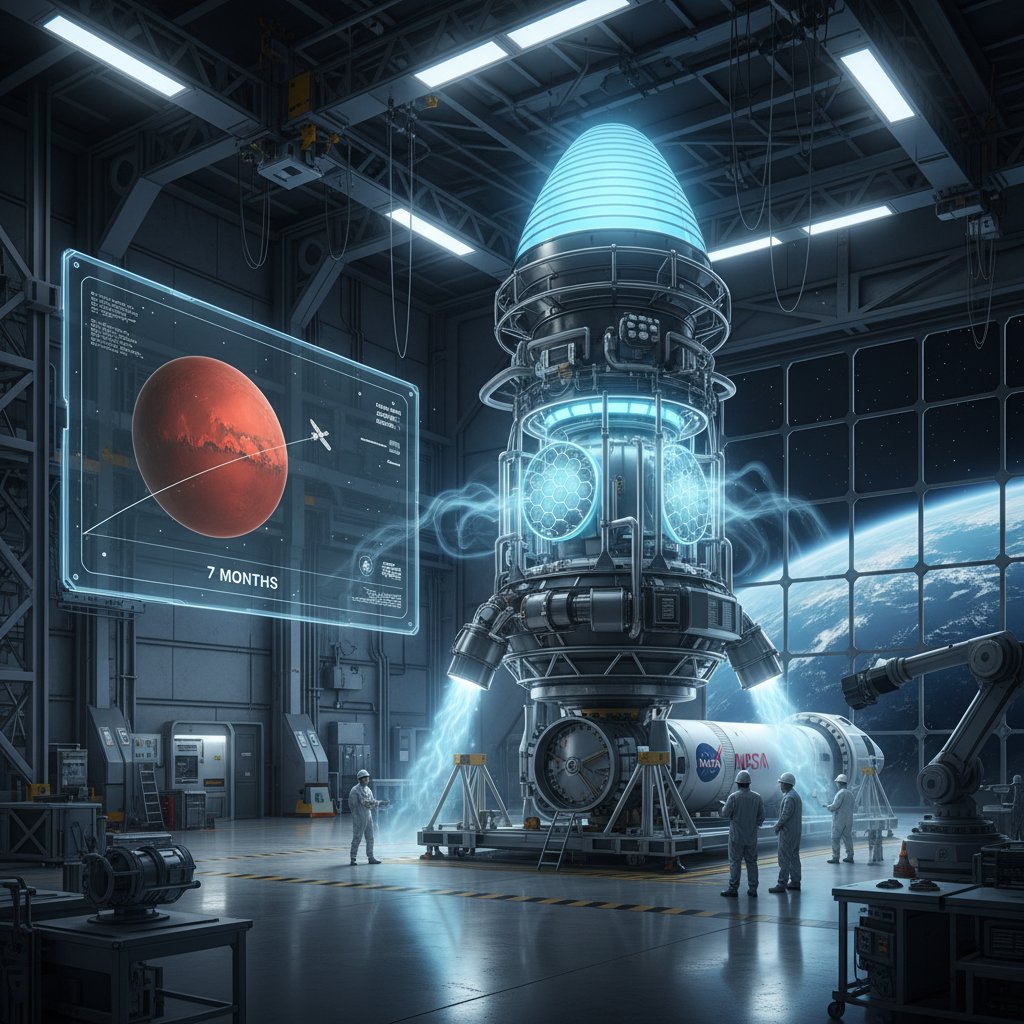
In a nuclear thermal rocket, a small fission reactor heats a propellant—typically liquid hydrogen—to temperatures exceeding 2,500°C. The expanding hydrogen is then expelled through a nozzle to produce thrust. This design delivers about twice the specific impulse of the most efficient chemical engines, meaning it can accelerate a spacecraft far more efficiently per kilogram of propellant. A typical chemical engine like the RL10 used on the Centaur upper stage has a specific impulse of around 450 seconds; an NTP engine can achieve 900 seconds or more.
“Nuclear thermal propulsion is the only near-term technology that can give us the thrust and efficiency needed for a human Mars mission within a reasonable timeframe,” said Dr. Thomas Carter, a propulsion engineer at the University of Michigan and former NASA consultant. “We are talking about cutting the journey time by at least half. That translates directly into reduced risk for the crew and lower mission costs for the agency.”
The reactors themselves are about the size of a small car, using high-assay low-enriched uranium (HALEU) fuel, which is less weapons-proliferation-sensitive than the highly enriched uranium used in earlier designs. NASA has already tested small-scale fuel elements at the Nevada National Security Site, confirming they can withstand the extreme temperatures and rapid thermal cycling of multiple firings.
The dual-track approach: NTP and NEP
NASA is not putting all its eggs in one basket. In addition to nuclear thermal propulsion, the agency is also funding nuclear electric propulsion (NEP), which uses a reactor to generate electricity that powers ion thrusters. While NEP has a much lower thrust-to-weight ratio than NTP, it is extremely fuel-efficient and could enable robotic cargo missions to pre-position supplies on Mars before crews arrive.
The two technologies complement each other. A 2024 NASA study led by the agency’s Space Technology Mission Directorate found that a combined architecture—cargo sent via NEP, crew via NTP—could reduce total mission mass by 25% compared to an all-chemical approach. That matters because every kilogram launched to Mars costs roughly $10,000 in current fuel prices, a figure that will only rise with heavier payloads needed for a permanent base.
For everyday readers, the implications go beyond space travel. Advances in compact fission reactors for space propulsion have already begun to trickle down to terrestrial applications. The same cooling technologies and high-temperature materials developed for NTP are now being adapted for small modular reactors (SMRs) for remote communities and disaster relief. In effect, the drive to reach Mars is accelerating clean-energy innovation right here on Earth.
Real-world hurdles: safety, weight, and political will
Despite the promise, significant engineering challenges remain. Launching a nuclear reactor into space carries inherent risks: a launch failure could release radioactive debris into the atmosphere. NASA has extensive safety protocols inherited from the Cassini and Mars Science Laboratory missions, which both used radioisotope thermoelectric generators (RTGs). But an operational NTP engine runs at far higher power levels—100 megawatts or more—which demands more robust containment.
“The safety culture around nuclear launches is already world-class,” noted Dr. Ellen Park, a nuclear policy analyst at the Secure World Foundation. “But we need new regulatory frameworks for reactors that can be restarted in orbit and then fired for prolonged periods. The public deserves clear communication about risk assessments and accident scenarios.”
Weight is another constraint. A fully fueled NTP stage with liquid hydrogen tanks is bulky because hydrogen has very low density. That means the spacecraft must be assembled in orbit from multiple launches, requiring a proven heavy-lift vehicle like SpaceX’s Starship or NASA’s Space Launch System (SLS). The first orbital NTP demonstration flight is tentatively scheduled for the early 2030s, assuming Congress maintains funding. The Biden administration’s 2025 budget request included a $120 million increase for nuclear propulsion research, but future appropriations remain uncertain.
What this means for the Mars timeline
NASA’s current Artemis program aims to return humans to the Moon by 2027, using that experience as a proving ground for Mars. Nuclear propulsion is the linchpin of the agency’s expanded “Moon to Mars” strategy released in late 2024. Without it, a crewed Mars landing is unlikely before the 2040s. With it, the timeline could shift to the late 2030s, according to NASA’s own internal benchmarks.
China has also announced its own nuclear propulsion research, and in 2023 tested a small prototype reactor for space applications. The race for nuclear-powered spaceflight is no longer purely scientific—it is geopolitical. For North American and European readers, continued investment in NTP represents a strategic imperative to maintain leadership in deep-space exploration.
Forward-looking: from Mars to the outer solar system
If NTP proves reliable, its applications extend far beyond Mars. A nuclear-powered spacecraft could reach Jupiter’s moons in under 3 years instead of 6, enabling missions to search for life in the subsurface oceans of Europa and Enceladus. The same engine could also brake into orbit around gas giants without needing cumbersome gravity assists. Dr. Carter of the University of Michigan summed it up: “We are not just building a better rocket engine. We are building the engine that will make the inner solar system accessible to humanity within a single generation.” That vision is now on a launch pad, waiting for the first hot fire test in orbit—a moment that could redefine our species’ reach among the stars.