








You’d think a backbone bigger than a dinner plate would be hard to misplace. And yet, for nearly four decades, a set of colossal megalodon vertebrae sat in obscurity—lost in the shuffle of museum storage, forgotten by science. But now they’ve resurfaced, and they’re rewriting what we know about the biggest shark that ever lived.
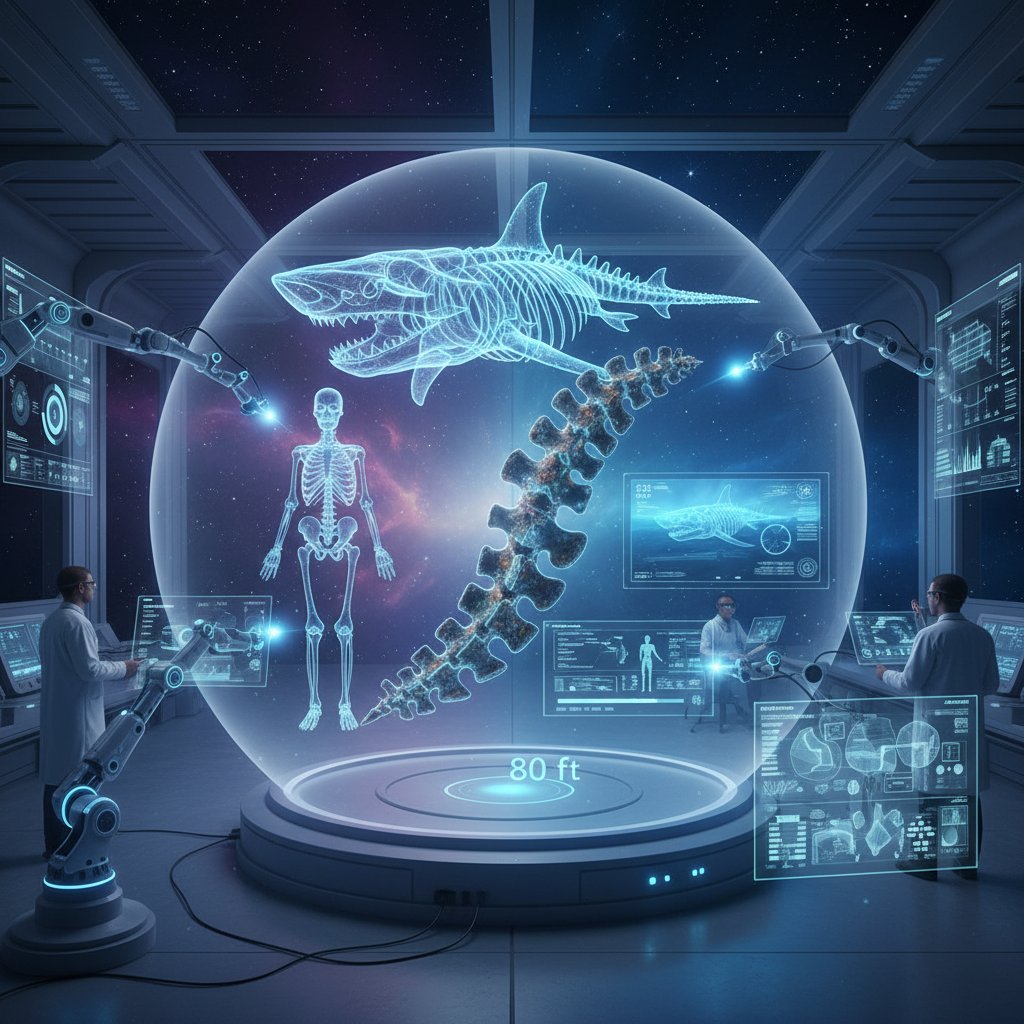
In a story that reads more like paleontological detective work than dry academic routine, two staff members from the Museum of Southern Jutland in Denmark—Mette Elstrup and Trine Sørensen—stumbled upon the long-missing specimens while reorganizing the museum’s collections. The vertebrae, originally excavated in the 1980s from a fossil site in Belgium, had been assumed lost or destroyed. Instead, they were quietly sitting in a cabinet, mislabeled and overlooked. The rediscovery, announced this month, provides the most direct confirmation yet that Otodus megalodon could reach an astonishing 80 feet in total length—the size of a blue whale, but built like a torpedo with teeth the size of your hand.
The Backbone of a Monster
The find isn’t just a curiosity; it’s a missing puzzle piece that paleontologists have been hunting for decades. Most megalodon fossils are isolated teeth—durable, abundant, and easy to identify. But vertebrae are rare. They preserve the body’s architecture: how long the shark was, how it grew, how it moved. And these vertebrae are exceptional.
The set includes a partial vertebral column, with individual centra (the disk-shaped bones of the spine) measuring up to 15 centimeters in diameter. That’s bigger than a standard coffee mug. By comparing these dimensions to those of modern great white sharks, which share a similar body plan, researchers could estimate the megalodon’s length with far greater confidence than tooth-based models alone allow.
“These vertebrae are the smoking gun,” said Dr. Kenshu Shimada, a paleobiologist at DePaul University and leading expert on megalodon, who was not directly involved in the rediscovery but reviewed the findings. “For years we’ve had to rely on extrapolations from teeth. But the spine doesn’t lie. This specimen confirms the upper size range we’ve suspected—around 24 to 26 meters, or roughly 80 feet.”
The numbers are staggering. An 80-foot shark would have weighed an estimated 50 to 70 tons—as much as a fully loaded semi truck. Its mouth could swallow a modern great white whole. Its bite force? Scientists calculate it exceeded 40,000 pounds per square inch, enough to crush a car.
A New Window Into Megalodon’s Lifestyle
But size alone isn’t the whole story. The vertebrae also contain growth rings—similar to tree rings—that record the shark’s age and growth rate. Analysis suggests this individual was at least 50 years old at death, and that megalodons grew more slowly and lived longer than previously assumed. That kind of slow-growth, long-life strategy is exactly what we see in other apex predators that lived through ancient climate shifts—and it has implications for how they responded to environmental pressure.
The timing of the find is also fascinating. Megalodon went extinct around 3.6 million years ago, during the Pliocene epoch. That period saw dramatic cooling and sea-level changes—events eerily similar in some ways to today’s climate upheaval. But don’t go drawing direct parallels just yet. “The megalodon lived in a world where the oceans were structured very differently,” said Dr. Catalina Pimiento, a paleontologist at Swansea University who has studied the shark’s extinction. “What this find tells us is how resilient—and vulnerable—such giants can be. They needed large, warm coastal waters to raise their young. When those habitats shrank, they couldn’t adapt.”
The vertebrae also show signs of pathology: healed fractures and possible infection. That suggests these animals led rough lives. Even an 80-foot apex predator wasn’t immune to injury—perhaps from struggling prey, perhaps from other megalodons. The scars on the bones hint at a world where survival was far from guaranteed.
Lost and Found: The Backstory
How do you lose a megalodon spine? It’s almost comical—except that paleontological collections are notoriously underfunded and disorganized. The Belgian excavation in the 1980s yielded a trove of material, but much of it was never properly cataloged. The vertebrae were shipped to Denmark for study, then archived. Over time, curators retired, records were misplaced, and the specimens faded into institutional amnesia.
Elstrup and Sørensen weren’t even looking for megalodon. They were conducting a routine inventory when they noticed a drawer filled with unusually large, rounded bones. “We knew immediately they were something special,” Elstrup told reporters. “The size was unbelievable.” A quick check against old photographs from the original excavation confirmed the match. The lost vertebrae were home.
This isn’t just a happy ending for museum archivists. The rediscovery underscores how much remains hidden in museum basements around the world—specimens that could hold keys to understanding ancient ecosystems, evolutionary patterns, and even modern conservation challenges. Think about that the next time someone dismisses natural history museums as dusty relics. They’re more like time capsules, and we’re still opening them.
What It Means for Megalodon Science—and for Us
The confirmation of an 80-foot megalodon settles one debate, but opens others. How fast could it swim? How much did it need to eat each day? Did it behave more like a great white or a whale shark? The vertebrae will help answer those questions because they contain isotopic signatures that reveal diet and habitat preferences.
Early isotope work suggests megalodon occupied a higher trophic level than any modern shark—meaning it ate other large predators, not just fish or seals. It was the top of the top. Just as ancient evolution gave invasive plants an edge by adapting to past climates, megalodon’s evolutionary toolkit made it a super-predator for millions of years. But when the rules changed, that extreme specialization became its downfall.
So what does an 80-foot shark have to do with us? More than you might think. As we push ocean temperatures higher and strip coastal habitats, we’re creating conditions that favour smaller, faster-reproducing species over giants. Megalodon’s story is a cautionary tale about the limits of adaptation. And it’s not just a story about the past—it’s happening now. Climate change is already intensifying heat waves and disrupting marine ecosystems, forcing species to migrate, shrink, or vanish. The vertebrae that resurfaced in Denmark remind us that even the most formidable creatures can disappear—and that sometimes, the evidence of their lives is hiding in plain sight.
For now, the rediscovered vertebrae are being CT-scanned and analyzed in detail. The results will refine growth models and could even help identify other mislabeled fossils in museum collections worldwide. It’s a second chance to study a lost giant, and a stark reminder that the stories we tell about Earth’s past are only as complete as the specimens we bother to find.
Frequently Asked Questions
How do scientists know megalodon was 80 feet long just from vertebrae?
Vertebrae are directly proportional to total body length in sharks. By comparing the diameter of megalodon vertebrae to those of modern great whites (which share a similar body plan), researchers can calculate length with high accuracy. The 15 cm centra in this specimen point to a shark around 24–26 meters long.
Why were the vertebrae lost for so long?
The remains were excavated in Belgium in the 1980s and shipped to the Museum of Southern Jutland in Denmark. They were never properly cataloged, and over decades of staff turnover and reorganisation, the specimens were misplaced. They were rediscovered in 2023 during a routine inventory.
Does this mean megalodon could still be alive today?
No. The vertebrae are clearly fossilised and date to the Pliocene epoch, about 3.6 million years ago. There is no credible evidence that megalodon survived into modern times. The discovery confirms its past size, not its present existence.