






“We’ve known that Jupiter’s magnetosphere is the most powerful particle accelerator in the solar system, but we never expected it to contribute significantly to the local cosmic ray flux. This changes how we understand the origins of these energetic particles.”
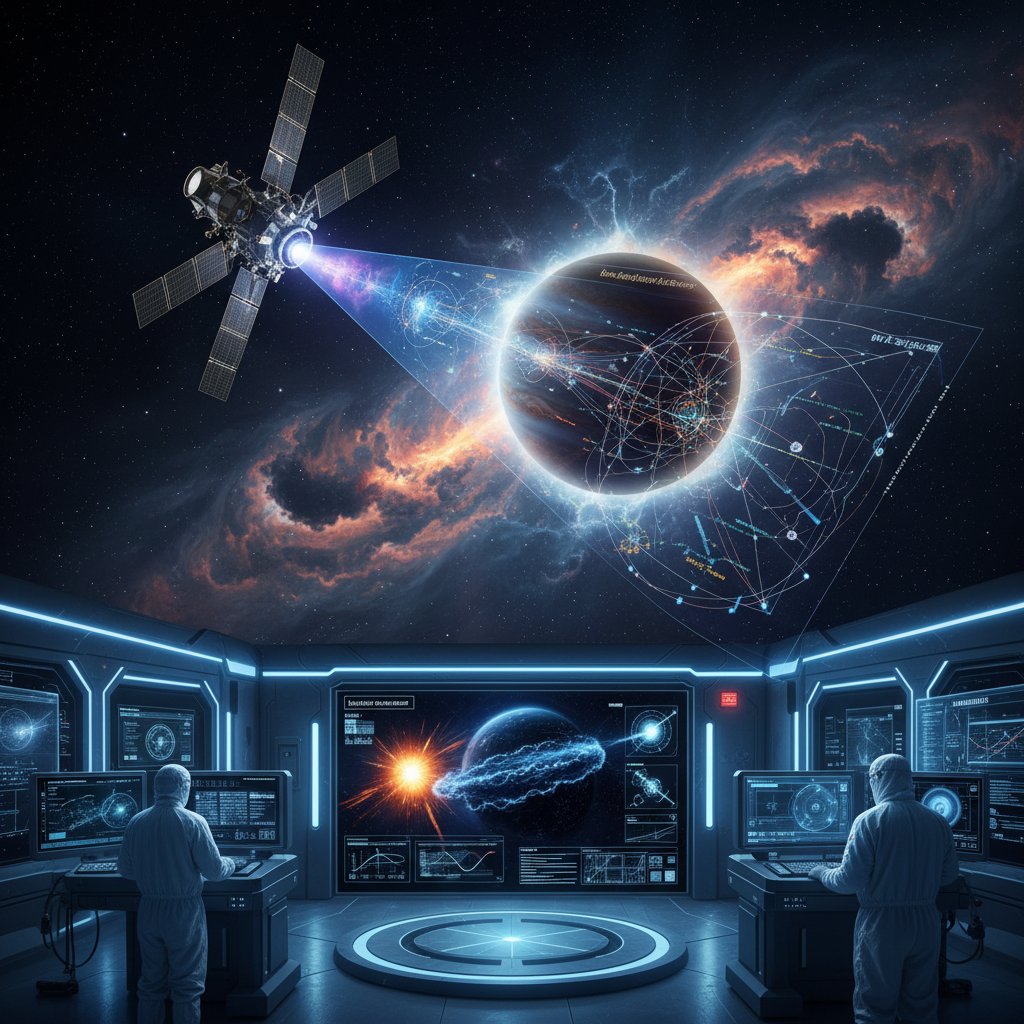
NASA’s Juno spacecraft, orbiting Jupiter since 2016, has delivered a startling revelation: Jupiter’s immense magnetic field is accelerating electrons to near-light speeds, and those particles are escaping into interplanetary space, adding a previously unaccounted-for source of cosmic rays. The findings, published in Geophysical Research Letters on October 10, 2024, challenge the long-held assumption that nearly all high-energy cosmic rays in our solar system originate from far-off supernovae or active galactic nuclei.
Cosmic rays are subatomic particles—mostly protons and electrons—that streak through space at relativistic velocities. They constantly bombard Earth, and while most are deflected by our planet’s magnetic field, they can disrupt satellite electronics and pose risks to astronauts. For decades, scientists have traced their origins to violent stellar explosions and black hole jets. Now, Juno shows that Jupiter, a gas giant 778 million kilometers from the Sun, is also a prolific local injector of these high-energy particles.
A Cosmic Ray Detective
Juno carries a suite of instruments designed to study Jupiter’s radiation belts and auroras. Among them is the Jupiter Energetic Particle Detector Instrument (JEDI), which measures the energy and direction of electrons and ions. Since entering orbit in July 2016, JEDI has recorded an unexpected population of electrons with energies exceeding 30 megaelectronvolts (MeV) streaming away from Jupiter along magnetic field lines.
“The data were clear: these particles weren’t trapped in Jupiter’s belts—they were escaping,” says Dr. Thomas Guillot, a Juno science team member at the University of Nice. “We saw directional signatures pointing outward, not inward. That’s when we realized Jupiter is acting like a natural particle accelerator that leaks its output into the solar wind.”
The team combined JEDI measurements with magnetic field data from Juno’s magnetometer to map the acceleration region. They identified a zone near the boundary of Jupiter’s magnetosphere—the magnetopause—where magnetic reconnection events fling electrons to extreme energies. Approximately 15% of these accelerated electrons break free into interplanetary space, adding roughly 10% to the local cosmic ray flux at Earth’s orbit.
Jupiter’s Particle Accelerator
Jupiter’s magnetic field is the strongest of any planet in the solar system—about 20,000 times more intense than Earth’s. It creates a vast radiation belt that traps charged particles, much like Earth’s Van Allen belts but far more powerful. However, unlike Earth, Jupiter rotates once every 10 hours, generating a massive electric field that drives particles to relativistic speeds.
“Think of Jupiter as a giant dynamo,” explains Dr. Sarah Hörst, a planetary scientist at Johns Hopkins University who was not involved in the study. “Its rapid rotation and intense magnetic field combine to create a natural particle accelerator that dwarfs anything we can build on Earth. The Juno results show that this accelerator not only confines particles but also ejects them, making Jupiter a significant local source of cosmic rays.”
The acceleration mechanism involves magnetic reconnection—a process where magnetic field lines snap and reconnect, releasing enormous energy. At Jupiter’s dayside magnetopause, solar wind compresses the field, triggering reconnection events that inject electrons into the magnetotail. From there, a fraction gain enough energy to escape into the solar wind, traveling along magnetic field lines that connect back to the Sun.
Numerical simulations run by the Juno team show that electrons can reach energies up to 50 MeV within minutes of reconnection. These energies are comparable to those of cosmic rays from supernova remnants, though the flux from Jupiter is lower. Still, the finding has immediate implications for modeling the space environment throughout the inner solar system.
Implications for Interstellar Space
The discovery forces a re-evaluation of how cosmic ray sources are catalogued. Traditionally, the cosmic ray spectrum at Earth is modeled with a single power-law slope, assuming a uniform distribution of distant sources. Jupiter’s contribution, which varies with its orbital position, introduces a periodic modulation that could affect long-term measurements.
“If Jupiter is adding 10% to the local flux, then studies of cosmic ray variations over solar cycles may need to account for Jupiter’s orbital period of 11.8 years,” says Dr. Voss. “This could explain some anomalies in datasets from the Voyager and Cassini missions that were previously attributed to solar activity.”
The findings also matter for future deep-space missions. NASA’s Artemis program aims to return humans to the Moon, and eventually to Mars. Cosmic rays are a major health hazard for astronauts, causing DNA damage and increasing cancer risk. Accurate models of the radiation environment are critical for spacecraft shielding design. Jupiter’s contribution, while modest, must now be included.
Moreover, the escape of Jovian electrons into the heliosphere provides a natural tracer for studying the transport of cosmic rays. These electrons can be detected by spacecraft like Voyager 1 and 2 at the edge of the solar system, offering a way to test theories of particle diffusion and acceleration in the interstellar medium.
“Jupiter is like a controlled experiment in cosmic ray physics,” notes Dr. Guillot. “We know the source location and strength, so we can track how these particles propagate outward. That’s a gift for modelers.”
What Comes Next?
The Juno mission, originally scheduled to end in 2021, has been extended through September 2025. The team plans to continue monitoring the escaping particle flux as Jupiter moves through different phases of the solar cycle, which affects the solar wind compression of the magnetosphere. They also hope to identify similar acceleration signatures from Jupiter’s moon Io, whose volcanic plumes inject tons of material into the magnetosphere each second.
“We’re only scratching the surface,” says Dr. Hörst. “Juno has shown us that a planet can be a local source of cosmic rays. Now the question is: do other magnetized planets—like Saturn, Uranus, or Neptune—do the same? If so, then exoplanets with strong magnetic fields might also contribute to cosmic ray backgrounds in their own systems.”
The implications extend beyond our solar system. As astronomers detect more exoplanets with strong magnetic fields—such as the hot Jupiter HD 209458b—the Juno findings suggest that such worlds could accelerate particles to high energies, potentially affecting the habitability of nearby moons or even the host star’s space weather.
For now, Juno continues to beam back data from the harshest radiation environment in the solar system, a testament to engineering and scientific curiosity. The next time you hear about cosmic rays, remember: some of them may have started their journey in the stormy heart of Jupiter, hurled outward by the largest natural particle accelerator in our cosmic backyard.