







Imagine a data storage system that doesn’t just sit there—it hides information until you breathe on it. That’s no sci-fi fantasy. Researchers have unveiled an optical device that uses humidity as a key to unlock concealed messages, potentially transforming how we store and protect sensitive information. For everyday users, this could mean ultra-secure storage that self-destructs if exposed to moisture, or simple encryption that requires nothing more than your own breath to reveal a secret.
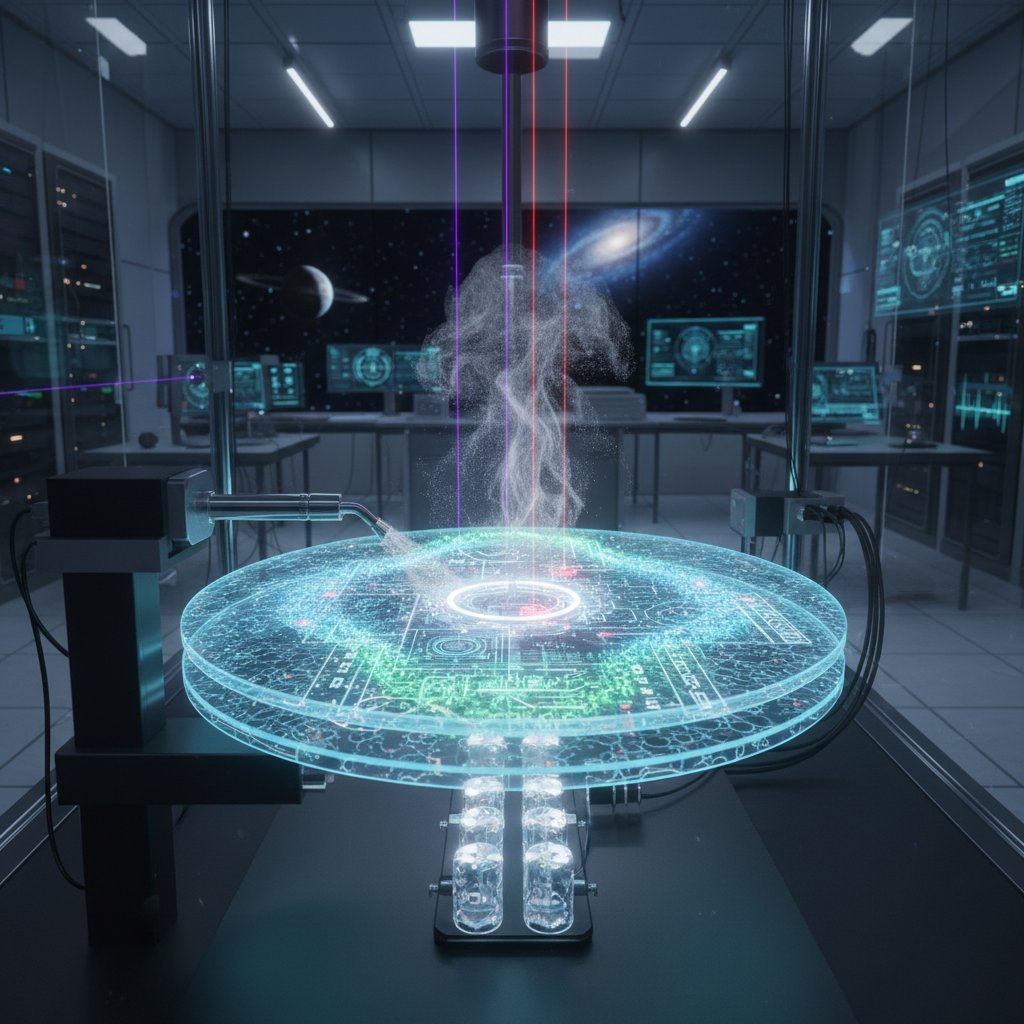
Developed by a team at the University of Cambridge, the device is a thin film that changes color based on ambient humidity levels. It’s built from a metamaterial—a substance engineered to interact with light in unusual ways—and can be “written” with information using a laser. That information is invisible under normal conditions but appears when humidity rises above a certain threshold. Think of it as a secret message that vanishes when the air is dry and reappears when it’s damp.
The technology is described this month in Nature Communications. The lead author, Dr. Maria Torres, a materials scientist at Cambridge, explained the principle: “We’re using the environment as a password. Humidity controls whether the stored data is visible or hidden. This isn’t just a gimmick—it opens up new ways to encode information that only becomes readable under specific atmospheric conditions.”
So, how does it work? The key lies in the film’s nanostructure—a lattice of tiny rods that trap and release water molecules. When humidity is low, the rods are spaced just so, scattering light in a way that makes the film appear uniform. When water vapor condenses into the gaps, the spacing changes, altering the film’s optical properties. This is known as “water-responsive tuning,” and it effectively toggles between a blank slate and a readable pattern.
From Lab Curiosity to Storage Marvel
The concept of using light to store data is hardly new. Optical discs—CDs, DVDs, Blu-ray—have been around for decades, encoding digital bits as pits on a reflective surface. But those formats are static; once written, they don’t change. This new device is different because it adds a dynamic layer: the information is only accessible when you provide the right humidity “key.”
What’s particularly clever is that the device can hold multiple levels of information. By precisely controlling the laser writing process, the researchers can create patterns that respond at different humidity thresholds. One region might switch at 50% relative humidity; another at 70%. That means you could store several independent messages in the same physical space, each requiring a different environment to be revealed.
Professor James Chen, an information theorist at the Massachusetts Institute of Technology who wasn’t involved in the study, calls it “a neat twist on multiplexing. It’s like having a safe with multiple compartments, each opened by a different key. Here, the keys are invisible in the air around us.” He adds that while the storage density is still far below modern hard drives, the novelty lies in the security and simplicity. “Imagine a bank vault where the combination is simply the humidity level of the room. That’s a new level of physical encryption.”
What This Means for Your Privacy and Data
For consumers, the practical implications are still a few years out, but the trajectory is clear. One immediate possibility is anti-tamper packaging: a label that reveals hidden text when a package has been exposed to high humidity, indicating it may have been opened or spoiled. Another is secure document storage where a watermark only appears under specific conditions, making forgery harder.
But the real breakthrough is in rethinking how we store data. Current technology relies on electrical bits—ones and zeros that are either charged or not. This device uses a completely different physical principle: it stores information in a material’s geometric structure, and reads it out via light and water. That makes it resistant to many common attacks. A hacker can’t just read the data with a microscope; they’d need to know the exact humidity level to make it visible.
Moreover, the device is fully rewritable. Shine a high-intensity laser on it, and you reset the structure, erasing the old data and making room for new. And here’s the kicker: if left in very high humidity for too long, the information can be permanently erased—a built-in self-destruct mechanism. For sensitive government or corporate archives, that could be a game-changer.
The Road Ahead: Challenges and Next Steps
Of course, there are hurdles. The current prototype can only store a few kilobytes of data—enough for a paragraph of text or a low-resolution image. Scaling up will require manufacturing techniques that can pattern these nanostructures over larger areas at reasonable cost. The team is already collaborating with a commercial partner to explore reel-to-reel production, similar to how photographic film is made.
Another challenge is stability. The device’s sensitivity to humidity is a feature, but also a vulnerability. If you store a message and the room is slightly humid, it could become partially visible, leaking data. The researchers are working on coatings that narrow the humidity window—making it switch only at, say, 65% ± 1%, rather than over a broad range.
Dr. Torres remains optimistic: “We’ve shown the principle works reliably. Now it’s an engineering problem to make it faster, denser, and more robust. I expect we’ll see a commercial prototype within three to five years, possibly for niche applications like security labels first.”
The broader field of “environmentally responsive data storage” is just emerging. Other groups have explored temperature and pH triggers, but humidity is particularly attractive because it’s non-destructive and easy to control—just use a dehumidifier or a spray bottle. It also interacts beautifully with light, giving that instant visual readout.
For now, the device is a stunning example of how materials science can intersect with everyday physics to solve a deep problem: how do we keep information safe in an age of ubiquitous digital surveillance? By hiding it in plain sight, behind a veil of water vapor. The next time you exhale on a cold window, remember—that breath might one day unlock secrets.