








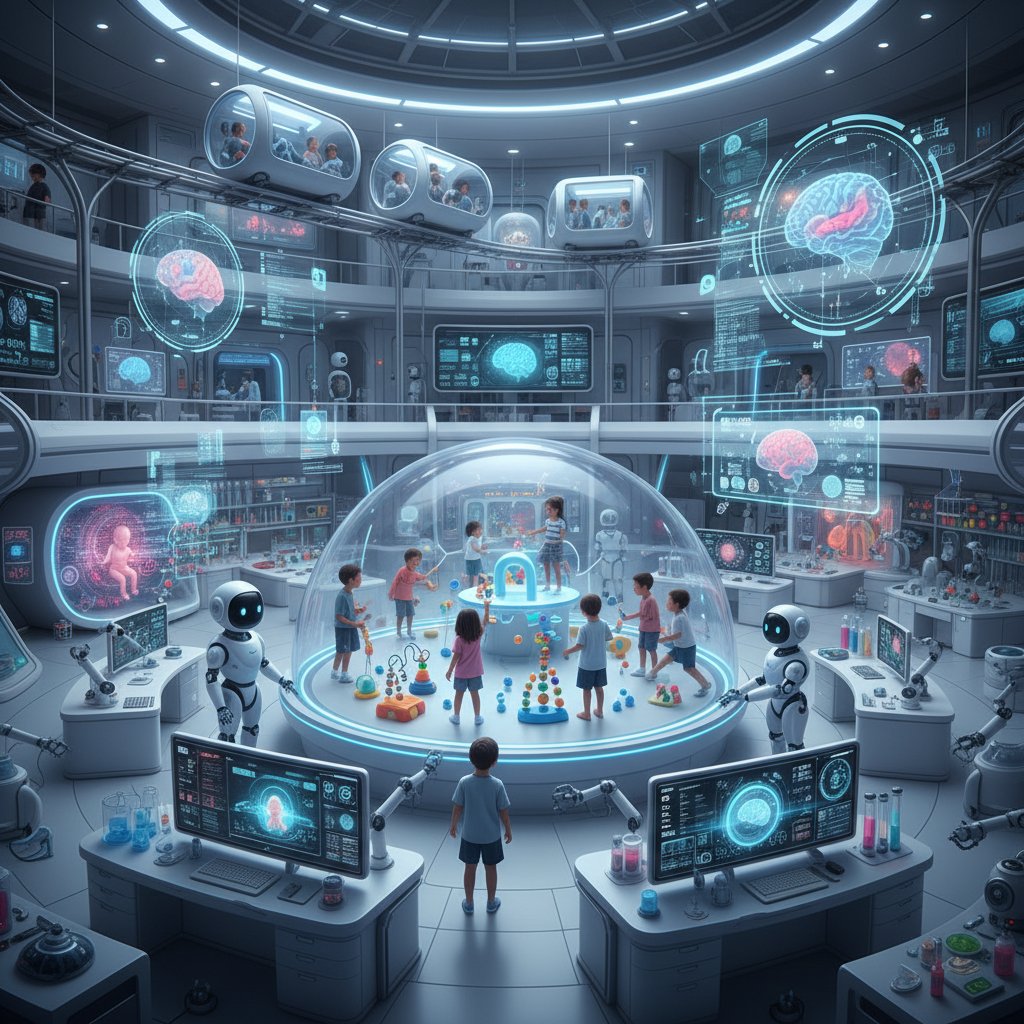
Can artificial intelligence truly replace the warmth of a human caregiver? That’s the question on the minds of parents, educators, and scientists as a wave of AI-powered childcare tools hits the market. From interactive robots that teach language to smart monitors that track developmental milestones, technology is reshaping how we nurture the youngest minds. But is this progress or a perilous experiment?
In March 2025, researchers at Stanford University’s Center for Early Childhood Cognition published a landmark study in Nature Human Behaviour. They found that children aged 2 to 4 who interacted with an AI-powered storytelling robot for 20 minutes daily showed a 15% improvement in vocabulary acquisition over six weeks, compared to a control group. The robot, named “Luna,” uses natural language processing and emotion recognition to adapt stories in real-time based on a child’s reactions.
“The results are promising, but we must tread carefully,” says Dr. Sarah Lin, a developmental psychologist at the University of Cambridge. “AI can supplement human interaction, but it cannot replicate the nuanced emotional bonding that occurs between a child and a caregiver.” Her caution underscores a growing debate: where do we draw the line between helpful tech and necessary human touch?
The Rise of AI in Childcare
The childcare industry has long faced challenges—high costs, shortage of qualified staff, and inconsistent quality. Enter AI. Over the past five years, startups and tech giants alike have poured billions into developing solutions. Smart cribs that rock babies to sleep using machine learning, wearable sensors that monitor breathing and temperature, and apps that generate personalized lesson plans for toddlers are now commonplace.
One notable example is “KinderAI,” a platform launched in 2024 by a team from MIT. It uses computer vision and audio analysis to assess a child’s engagement and emotional state during play. Parents receive daily reports with suggestions for activities to boost cognitive skills. The company claims a 30% reduction in parental stress based on user surveys.
But not all innovations are created equal. A 2023 report from the American Academy of Pediatrics warned that excessive screen time—even with AI—can hinder social development. “The key is balance,” says Dr. Mark Chen, an AI researcher at MIT who worked on KinderAI. “We designed the system to be interactive and responsive, not passive. It encourages parents to engage alongside the child, not replace themselves.”
What the Science Says
Scientific evidence on AI in childcare is still sparse but growing. A 2024 study from the University of Tokyo tested a robot that teaches empathy by mimicking facial expressions. Children who played with the robot for a month showed a 12% increase in emotion recognition, as measured by standard tests. However, the same study noted that children who only interacted with the robot—without human guidance—developed fewer prosocial behaviors.
Another area of research is AI-driven monitoring. Systems like “Cocoon” use cameras and sensors to detect early signs of developmental delays. In a pilot study at Boston Children’s Hospital, the system correctly identified 87% of children who later received a diagnosis of autism spectrum disorder, months earlier than traditional screening. “Early intervention is critical,” says Dr. Emily Torres, lead researcher on the study. “AI can help us catch issues sooner, but it must be paired with professional evaluation.”
The numbers are compelling, but they come with caveats. Privacy concerns loom large: Who owns the data from these devices? A 2024 survey by the Pew Research Center found that 68% of parents worry about their child’s data being misused by AI childcare products. Companies have responded with encryption and anonymization, but trust remains fragile.
“AI can supplement human interaction, but it cannot replicate the nuanced emotional bonding that occurs between a child and a caregiver.” — Dr. Sarah Lin, University of Cambridge
The Human Touch: Why Caregivers Still Matter
Despite the hype, experts agree that AI is not a replacement for human caregivers. The Stanford study, while positive, also found that children who interacted with a human storyteller showed greater gains in comprehension and emotional engagement than those who used the robot alone. The robot’s advantage was only seen when it was used as a supplement.
“Technology can handle repetitive tasks—like reading the same book 50 times—but it cannot provide the spontaneous, empathetic responses that build secure attachment,” explains Dr. Lin. “That’s the foundation of healthy development.”
For parents, the practical takeaway is clear: use AI as a tool, not a crutch. Interactive toys can enhance learning, but they should not replace conversation, play, and physical affection. The American Academy of Pediatrics recommends limiting screen time for children under 2 to video calls only, and for ages 2–5, no more than one hour per day of high-quality programming—with a parent present.
Moreover, the cost of these technologies can widen inequality. High-end AI childcare systems can cost thousands of dollars, putting them out of reach for many families. “We risk creating a two-tier system where affluent children get AI-enhanced development while others fall behind,” warns Dr. Chen. “We need policies to ensure equitable access.”
The Road Ahead
As AI continues to evolve, so will its role in childcare. Researchers are already developing systems that can detect a child’s emotional state with over 90% accuracy and adjust interactions accordingly. But the ultimate goal, says Dr. Torres, is not to replace humans but to empower them. “Imagine a future where every parent has a personalized AI coach that helps them understand their child’s unique needs,” she envisions. “That’s a world where technology amplifies love, not substitutes it.”
For now, the message is one of cautious optimism. The science of childcare is being rewritten, but the most important algorithm remains the human heart. As we navigate this brave new world, one thing is certain: the bond between caregiver and child is irreplaceable—and no robot can change that.