







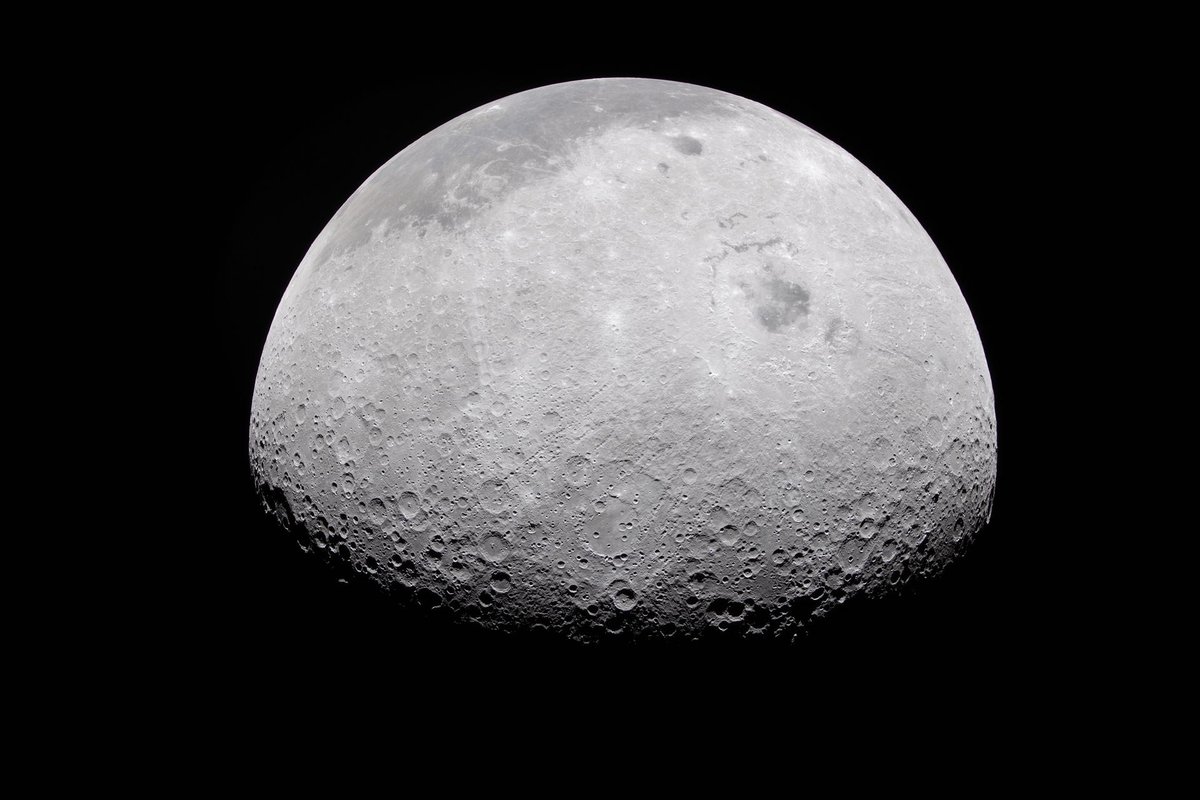
I remember the first time I saw the Moon through a backyard telescope as a kid. The craters looked like pockmarks on a dusty golf ball — familiar, almost mundane. But the photo the Artemis II crew captured on flight day 6? That’s a whole different beast. It shows the Moon half-illuminated, the terminator slicing across its face like a knife. And let me tell you, that line between light and darkness isn’t just pretty — it’s a window into the Moon’s brutal, alien reality.
The image, released by NASA this week, was taken by the Orion spacecraft’s crew during their journey around the Moon. On one side, sunlight blazes across the ancient highlands; on the other, pitch black. The contrast is stark. But look closer at the terminator itself — that fuzzy boundary where shadows stretch long and craters become deep, yawning pits. That’s where you see the Moon’s true character: rugged, uneven, and utterly otherworldly.
Why the Terminator Matters
For planetary scientists, the terminator isn’t just a cool visual effect. It’s a goldmine of data. When the Sun hangs low on the horizon — just like at dawn or dusk on Earth — every bump and crevice casts a long shadow. That reveals topography you’d never see under a high Sun. “It’s like looking at a face in profile versus straight on,” says Dr. Sarah Chen, a lunar geologist at NASA’s Johnson Space Center. “The shadows tell you the height of ridges, the depth of craters, the slope of ancient lava flows.”
And the Artemis II photo captures this perfectly. You can make out the Mare Tranquillitatis — the Sea of Tranquility — but it’s no calm sea. It’s a field of basalt, hardened from volcanic eruptions billions of years ago. The terminator cuts right through it, highlighting wrinkle ridges and impact craters that tell a story of violent history. This isn’t just a pretty picture; it’s a geological map in a single frame.
What the Near Side Hides — and Reveals
The photo shows the near side of the Moon — the face we always see from Earth. But even this familiar landscape holds surprises. The terminator reveals subtle differences in surface texture: rougher regions where asteroids pummeled the crust, smoother patches where lava once pooled. And those dark spots, the maria? They’re not just darker rock; they’re younger, chemically distinct, and they hold clues to the Moon’s internal heat engine.
But here’s the kicker: the Moon’s interior is still largely a mystery. We know from Apollo-era seismometers that the Moon has moonquakes — some triggered by tidal forces from Earth, others by meteorite impacts. But we lack a modern network of sensors. That’s why research like hidden seismic clues is so critical. By studying how seismic waves travel through the lunar crust, scientists can piece together the Moon’s structure — its core, mantle, and crust — without ever drilling through it. The terminator photo reminds us that the surface is just the skin; what’s underneath shapes everything.
“Every time we look at the terminator, we’re reminded that the Moon is not a dead world,” says Dr. Mark Thompson, Artemis II mission scientist. “It’s geologically alive in subtle ways. The shadows hide stories we’re only beginning to read.”
From the Moon to the Cosmos — A Broader Perspective
There’s something humbling about seeing the Moon half-lit from a spacecraft window. It forces you to think about scale. The Moon orbits Earth at an average distance of 384,400 kilometers — that’s about 30 Earth diameters away. And yet, from Artemis II, it fills the view. But step back further — say, to the scale of the entire solar system — and the Moon becomes a speck. And our galaxy? A grain of sand.
This perspective echoes a deeper mystery in cosmology: the growth of cosmic structure. Observations suggest that something — maybe a hidden dark force — is slowing the clumping of matter in the universe. Just as the Moon’s terminator reveals hidden details in the lunar surface, the subtle effects of dark energy (or something else) reveal the invisible scaffolding of the cosmos. We’re always looking at shadows, trying to infer the shape of what we can’t see.
So, what does this mean for you and me? It means that the Artemis II photo isn’t just a cool wallpaper. It’s a reminder that exploration — whether of the Moon or the universe — starts with a single, sharp image. And that image challenges us to ask: what’s hiding in the shadows?
What’s Next for Lunar Exploration
The Artemis II crew is testing systems for future missions, including the first woman and next man to land on the Moon. That landing site will likely be near the south pole, where permanent shadows hide water ice — a resource for future habitats. The terminator photo gives us a taste of the terrain they’ll face. And as NASA opens new opportunities for research — like new aeronautics solicitations — the science from these missions will only accelerate.
We’re not just going back to the Moon to plant flags. We’re going to learn how to live off-world, to decode the Solar System’s history, and maybe — just maybe — to catch a glimpse of the dark forces shaping our universe. And it all starts with a photograph, half-lit, hanging in the balance between day and night.
Frequently Asked Questions
What is the terminator on the Moon?
The terminator is the line separating the illuminated side of the Moon from the dark side. It’s not a sharp edge but a gradual transition where sunlight hits at a low angle, creating long shadows that reveal surface features like craters, ridges, and mountains in sharp relief.
Why is the Artemis II photo significant?
It’s one of the first high-resolution images of the lunar terminator taken by a crewed spacecraft in decades. It provides valuable geological data and a human perspective on the Moon’s rugged terrain, helping prepare for future landings near the south pole.
How does the Moon’s geology connect to dark matter or dark energy?
While not directly related, both fields rely on observing subtle clues — shadows on the Moon, or the large-scale structure of the universe — to infer properties of invisible forces. The terminator teaches us to look at what’s hidden, a mindset that applies to cosmology as well.