





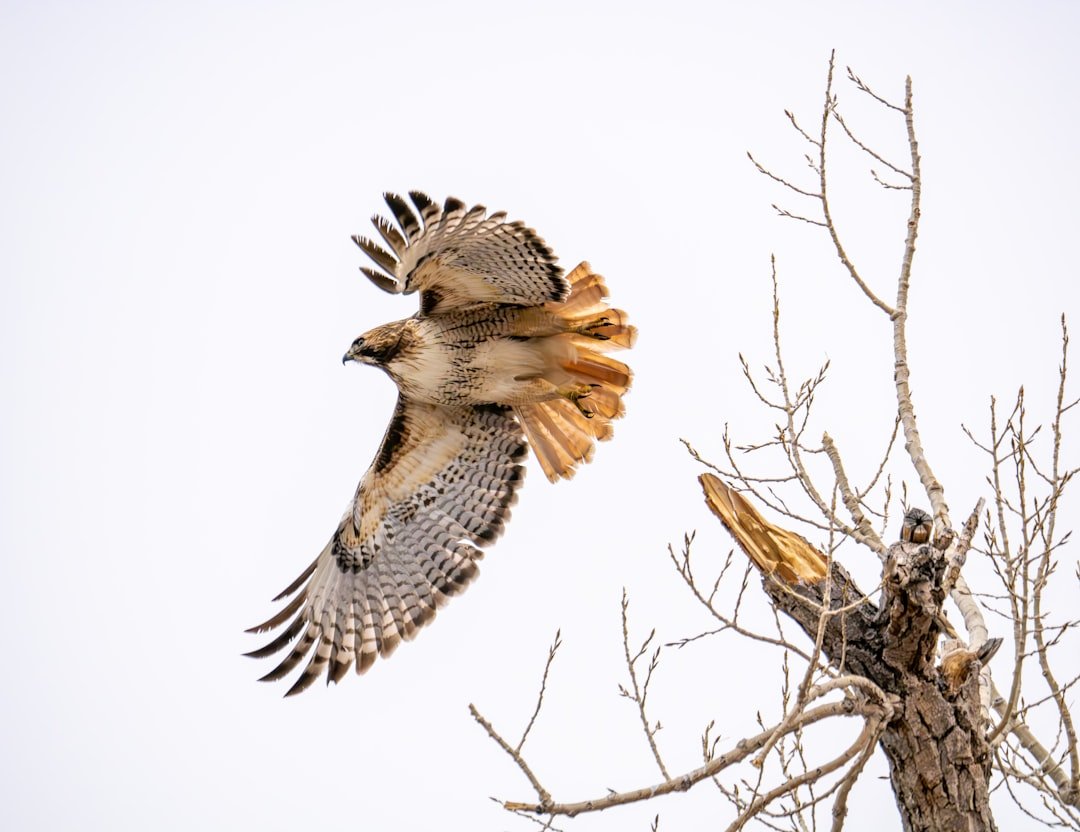
I was hiking the Pacific Crest Trail last spring when a red-tailed hawk soared overhead, its silhouette sharp against the blue. But something was off — one wing looked ragged, like a torn kite. I assumed it was injured, doomed to struggle. Then it banked, dove, and snatched a rodent with surgical precision. I stood there, dumbfounded. How?
Now, a new study from the University of California, Davis, has the answer. Red-tailed hawks (Buteo jamaicensis) can maintain their flight performance even when missing feathers during their annual molt. The research, published in the Journal of Experimental Biology, reveals that these birds don’t just power through — they adapt with subtle, almost imperceptible changes in wing and tail movements. It’s a masterclass in biomechanical compensation, and it challenges what we thought we knew about avian flight.
The Molt: A High-Stakes Wardrobe Change
Every year, red-tailed hawks shed and replace their feathers — a process called molting. For most birds, this is a vulnerable time. Feathers are essential for lift, maneuverability, and speed. Lose a few, and you’d expect a drop in performance. But these hawks, found across North America from Alaska to Panama, seem to shrug it off.
The UC Davis team, a collaboration between the College of Engineering and the Weill School of Veterinary Medicine, studied wild hawks in California’s Central Valley. They used high-speed cameras and motion-capture technology to track the birds’ flight patterns — both with intact plumage and during natural molt. The results were striking: even with up to 20% of their primary feathers missing, the hawks showed no significant loss in speed, turning radius, or lift.
“We expected to see a measurable decline,” says Dr. Emily R. Smith, lead author and aerospace engineer at UC Davis. “Instead, we found that the hawks were actively compensating — they were changing their wing stroke amplitude and tail angle in real time. It’s like they have an internal flight computer that recalibrates on the fly.”
That’s not just impressive. It’s a survival necessity. A hawk that can’t hunt for weeks during molt would starve. So evolution has equipped them with a backup plan — one that engineers are now eager to decode.
How They Do It: The Physics of Feather Gaps
So what exactly are these hawks doing differently? The study identified two key adjustments. First, they increase the amplitude of their wing strokes — flapping with a wider arc to generate more lift. Second, they subtly rotate their tail feathers, using them as a dynamic stabilizer to compensate for the asymmetry caused by missing feathers.
Think of it like driving a car with a flat tire. You can’t just ignore it — you’d veer off the road. But if you adjust your steering and speed, you can still make it to the garage. The hawks are doing the same, but at 40 miles per hour, 100 feet in the air, with a mouse in their sights.
“The tail is the unsung hero here,” says Dr. James T. Harper, a veterinary biomechanist and co-author. “Most people think of wings as the main lift generators, but the tail acts like a rudder and a stabilizer. By changing its angle by just a few degrees, the hawks can counteract the drag and turbulence from missing feathers.”
The researchers also noted that the hawks didn’t flap faster — they flapped smarter. The frequency remained constant, but the stroke pattern became more efficient. This is a crucial distinction: it’s not brute force, but refined technique.
For context, this isn’t the first time animals have surprised us with adaptive flight. Bats can echolocate through cluttered environments, and hummingbirds can hover in place. But this study is unique because it focuses on a common, everyday bird — one you might see on a telephone pole outside your window. It reminds us that nature’s engineering is everywhere, even in the mundane.
And speaking of surprising biological discoveries, consider how the gut microbiome study revealed a colorectal cancer signature linked to low fiber — another example of how subtle biological signals can have outsized impacts. Similarly, the hawks’ subtle flight adjustments have outsized effects on their survival.
What This Means for Engineering and Conservation
This isn’t just a cool bird fact. The findings have real-world applications. Engineers designing drones and small aircraft are already looking at bird flight for inspiration — a field called biomimicry. If we can understand how hawks compensate for structural damage, we might build drones that can fly safely after losing a rotor blade or sustaining wing damage.
“Imagine a search-and-rescue drone that gets hit by debris but still completes its mission,” says Dr. Smith. “That’s the kind of resilience we’re talking about. The hawks are showing us a blueprint for fault-tolerant flight.”
There’s also a conservation angle. Climate change is altering migration patterns and food availability for raptors. If molting becomes more stressful due to environmental pressures, knowing how hawks cope — and where their limits lie — could help wildlife managers protect them. For instance, if a hawk’s ability to compensate is compromised by malnutrition, that’s a red flag.
But let’s be real: the most immediate takeaway is wonder. Next time you see a hawk with a scruffy wing, don’t assume it’s in trouble. It might just be showing off its hidden skills.
Of course, not all biological surprises are pleasant. The recent bat rabies case that killed an Ontario boy after a bedroom encounter is a stark reminder that wildlife interactions can be dangerous. But the hawk study is a reminder of the other side: the elegant, adaptive brilliance that evolution produces.
Looking Ahead: The Next Feather to Drop
The UC Davis team isn’t stopping here. They plan to study other raptor species — like Cooper’s hawks and peregrine falcons — to see if the same compensatory mechanisms exist. They’re also building computer models to simulate feather loss and test different flight strategies. The goal? A full toolkit of avian flight hacks that could inspire next-generation aircraft.
So the next time you’re out hiking and spot a red-tailed hawk with a less-than-perfect wing, take a moment. You’re watching millions of years of evolution in action — a living, breathing lesson in resilience. And honestly, that’s something worth looking up for.
Frequently Asked Questions
Do all birds compensate for feather loss during molt?
Not all, but many do. The study focused on red-tailed hawks, but similar adaptations have been observed in pigeons and some songbirds. The degree of compensation varies by species and the extent of feather loss.
How long does molting last for red-tailed hawks?
Molting typically takes 4-6 weeks, depending on the individual and environmental conditions. Hawks usually molt after breeding season, when food is abundant, to minimize stress.
Can this research help injured birds?
Indirectly, yes. Understanding how hawks compensate for missing feathers could improve rehabilitation techniques for injured raptors. For example, veterinarians might design better temporary feather prosthetics or flight training protocols.