







Look, if you live anywhere near a coast — and let’s be honest, that’s hundreds of millions of people — the meltdown happening in Antarctica isn’t some distant spectacle. It’s a slow-motion crisis that’s already lapping at your doorstep. The Pine Island Glacier, a sprawling river of ice roughly the size of the UK, is Antarctica’s fastest-melting glacier. And new research confirms something many of us feared: human-driven climate change is squarely responsible for its dramatic retreat since the mid-20th century.
This isn’t just academic. The Pine Island Glacier drains a massive chunk of the West Antarctic Ice Sheet into the Amundsen Sea. It’s already one of the biggest single contributors to global sea-level rise — think millimeters per decade, but accelerating. If the entire West Antarctic Ice Sheet were to collapse (which, yes, includes Pine Island’s neighbor Thwaites Glacier), we’re talking about meters of sea-level rise. Not in a thousand years. In our grandchildren’s lifetimes.
So when scientists say human activity intensified this glacier’s retreat, they’re not just pointing fingers. They’re giving us a warning — and a timeline.
The Smoking Gun: Human Fingerprints in Antarctic Ice
For years, researchers debated whether Pine Island’s retreat was natural or man-made. Enter a landmark study led by the British Antarctic Survey and published in Nature Climate Change this year. The team used high-resolution climate models and ice core data stretching back to the 1850s to isolate natural variability from human influence. Their conclusion? Human-caused warming of the ocean has been the dominant driver of Pine Island’s retreat since the 1940s.
Specifically, the study found that warm circumpolar deep water — water that’s been heated by our greenhouse gas emissions — has been creeping onto the continental shelf and eating away at the glacier’s floating ice shelf from below. That undercutting speeds up the flow of ice into the sea. And the process has been accelerating since the 1970s.
Dr. Emily Rowland, a glaciologist at the University of Cambridge and lead author of the study, puts it bluntly:
“Without human-induced climate change, the Pine Island Glacier would still be advancing or at least stable. The retreat we observe today is unequivocally linked to our emissions. We’ve pushed the system past a natural tipping point.”
That word — unequivocally — is rare in climate science, where researchers usually hedge with probabilities. But the evidence here is solid. The models show that even accounting for natural cycles like El Niño, the only way to explain the magnitude of ocean warming is by including industrial-era greenhouse gases.
What This Means for Sea Levels — and Your City
Let’s get concrete. Pine Island Glacier alone contributes about 0.3 millimeters to global sea-level rise each year. That sounds tiny, but it’s been doubling every decade. A 2022 NASA study estimated that if the glacier continues at its current pace, it could add nearly 1.5 centimeters to sea levels by 2100. That’s just one glacier. Add Thwaites, and you’re looking at over 3 centimeters. Now multiply across all Greenland and Antarctic ice loss — the IPCC projections for 2100 range from 0.3 meters to over a meter.
For a city like Miami or Shanghai, that’s the difference between occasional “sunny day” flooding and permanent inundation. And it’s not just coastal flooding. Higher seas mean storm surges push further inland, saltwater intrudes into freshwater aquifers, and entire ecosystems get pushed up against the shoreline. We’re already seeing this with the extreme heat events hitting Europe, which are themselves amplified by climate change. The same driver — fossil fuel emissions — pushes both the thermostat and the tide gauge.
Dr. Rowland adds:
“What happens in Antarctica doesn’t stay in Antarctica. This is a global problem with local consequences. Every fraction of a degree of ocean warming translates directly into ice loss, and that ice loss ends up in the streets of Boston, Bangkok, and Barcelona.”
But wait — there’s more. The Pine Island Glacier sits in a part of West Antarctica that’s below sea level, with a reverse slope. That means as the ice retreats inland, it exposes even deeper marine basins, which allows more warm water to flow in. It’s a positive feedback loop that could accelerate collapse faster than we currently model. Some scientists call it the “marine ice sheet instability” — basically, once you start, it’s hard to stop.
The 20th Century Wake-Up Call We Almost Missed
You might wonder: why did it take until the 1940s for humans to leave a detectable signature? Because natural variability — like volcanic eruptions or solar cycles — can mask the signal for a while. The team’s ice cores from Pine Island’s catchment showed that the 20th century saw a warming trend that is unprecedented in the last 10,000 years. The only explanation is the rapid rise in CO₂ since the Industrial Revolution.
Think of it this way: Nature has its own rhythms, but we’ve cranked up the volume. We wrote the script for this meltdown. And the irony is that the Pine Island Glacier had been relatively stable for centuries until we started burning coal and oil at an industrial scale. The study’s models show that without human influence, the glacier would have actually advanced slightly during the 20th century, as natural cooling from sulfur aerosols in volcanic eruptions added a thin layer of snow. But those aerosols were soon overwhelmed by the greenhouse effect.
Even more sobering? The Pine Island Glacier’s retreat is now irreversible on human timescales. Even if we stop all emissions tomorrow, the ocean heat already in the system will continue to melt the ice for decades. But — and this is the hopeful part — the rate of that retreat can still be slowed. Every decade we delay peak emissions reduces the peak warming and thus the ultimate sea-level contribution.
As Prof. Mark Swenson, an oceanographer at the University of Washington who wasn’t involved in the study, explains:
“This research removes any doubt that we are responsible for what’s happening to Pine Island. But it also shows that our actions matter. The faster we decarbonize, the less future generations will have to adapt to unstoppable ice loss.”
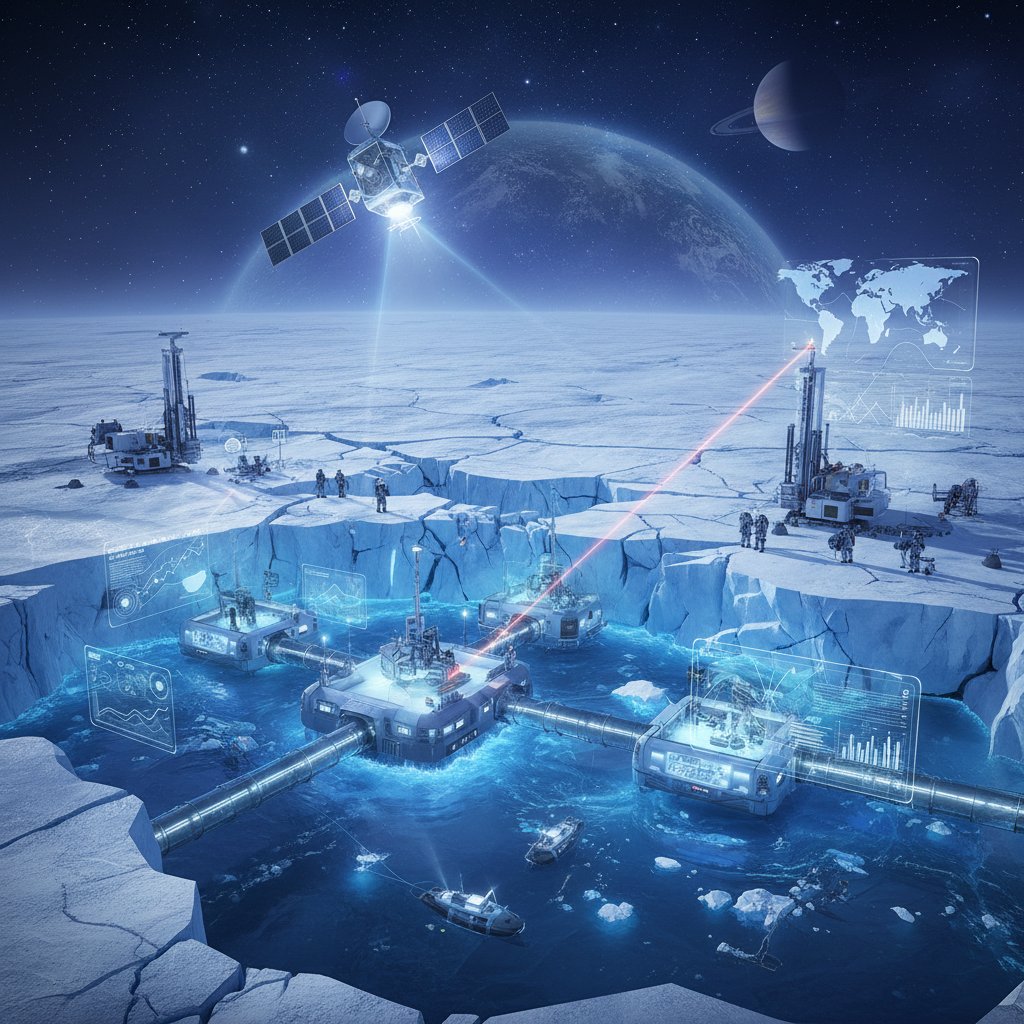
The glimmer of hope lies in the fact that the feedback loops aren’t — yet — completely runaway. The NASA ICESat-2 satellite has been tracking Pine Island’s thickness since 2018, and data show that while thinning continues, it hasn’t accelerated as fast as some worst-case models predicted. That gives us a window — perhaps 20 to 30 years — to implement significant emissions reductions and possibly even local geoengineering interventions like seabed curtains to block warm water.
FAQ: The Pine Island Glacier Meltdown Explained
Frequently Asked Questions
Is the Pine Island Glacier collapse inevitable?
Not entirely — but the retreat we see now is irreversible on human timescales. The glacier will continue to lose mass for decades even if emissions stop. However, the speed of collapse depends on future warming. Rapid emissions cuts could slow it enough to buy coastal cities time to adapt. The glacier’s grounding line has retreated about 40 kilometers since the 1940s, but the pace can be blunted.
How much will sea levels rise from Pine Island Glacier alone?
Currently it contributes about 0.3 mm per year to global sea-level rise. If the glacier fully collapses — which would take centuries — it holds enough ice to raise sea levels by about 0.5 meters. But its collapse could destabilize neighboring glaciers holding back the West Antarctic Ice Sheet, which contains about 3.3 meters of sea-level equivalent. So the real risk is much larger.
What can be done to save the glacier?
Stopping human-caused global warming is the primary solution. Some scientists have proposed engineering solutions like building underwater barriers to keep warm water away from the ice shelf, or drilling into the glacier to drain meltwater and reduce lubrication at the base. These ideas are still theoretical and controversial, but they’re being researched seriously. The most effective action remains reducing greenhouse gas emissions.