






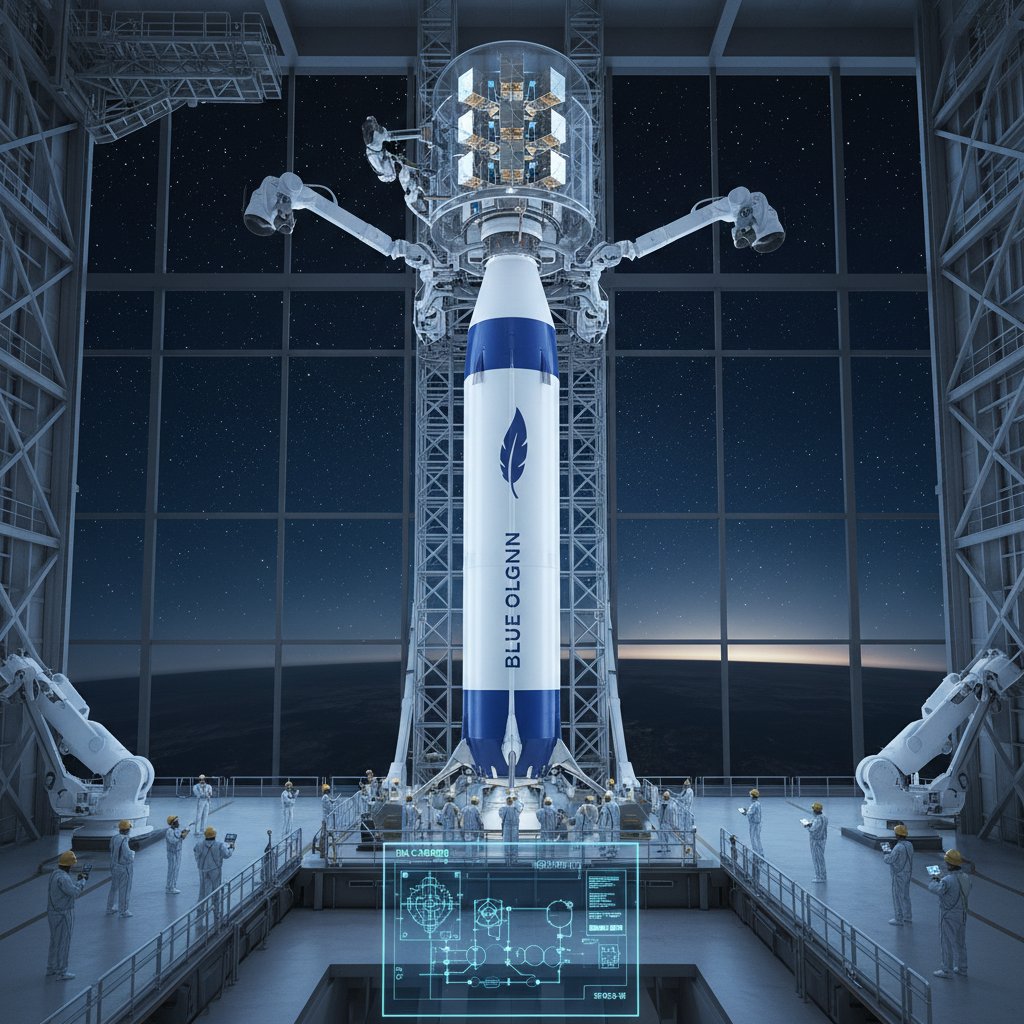
The countdown clock at Cape Canaveral is ticking. Standing tall on Launch Complex 36, Blue Origin’s New Glenn rocket—a gleaming 98-meter behemoth—awaits its maiden voyage, this time tasked with deploying 48 satellites that could reshape global internet access. After months of anticipation, the Federal Aviation Administration (FAA) has granted the launch license, clearing the path for a mission that marks the beginning of a new era in orbital delivery.
For Blue Origin, this isn’t just another rocket. New Glenn is a heavy-lift vehicle designed to compete with SpaceX’s Falcon 9 and Falcon Heavy. For Amazon, it’s the start of Project Kuiper, a constellation of over 3,200 satellites aimed at providing high-speed, low-latency broadband to underserved communities worldwide. The upcoming launch—expected within weeks—will place 48 of those satellites into low Earth orbit (LEO), the first major batch in what Amazon calls the “production deployment” phase.
FAA Greenlights Historic Launch
On January 10, 2025, the FAA issued a revised license for New Glenn’s inaugural flight, following a comprehensive review of safety and environmental impact. The license allows Blue Origin to launch from the historic Launch Complex 36 (LC-36) at Cape Canaveral Space Force Station, Florida—a site once used for early Atlas and Titan rockets. “This is a pivotal moment,” said Dr. Sarah Chen, aerospace analyst at the Space Policy Institute. “Blue Origin has spent years perfecting New Glenn’s reusable first stage and massive 7-meter fairing. FAA clearance is the final bureaucratic hurdle before they can demonstrate what this rocket can do.”
The mission, designated GS-1 (for “Geostationary Satellites” but actually targeting LEO), will be New Glenn’s first orbital attempt. The rocket’s first stage is powered by seven BE-4 engines, each burning liquid methane and liquid oxygen—a fuel combination chosen for reusability and performance. Blue Origin hopes to recover the booster on a droneship in the Atlantic, similar to SpaceX’s Falcon 9 landings. “Reusability is key to lowering cost,” Chen added. “Every successful booster recovery brings the price per satellite closer to Amazon’s target of under $2,000 per kilogram.”
New Glenn: A New Heavy Lifter
New Glenn stands 98 meters tall (321 feet), with a 7-meter fairing—enough volume to carry three school buses side by side. The rocket can lift up to 45 metric tons to LEO, making it one of the most powerful operational rockets in the world. Its design emphasizes reuse: the first stage is built for at least 25 flights, with landing legs and grid fins similar to those used by SpaceX. Blue Origin has spent over $2.5 billion developing the vehicle, according to public filings, and this launch will be its first chance to prove the system works.
The 48 Amazon Kuiper satellites will be deployed in a multi-step process over several hours. Each satellite weighs approximately 500 kilograms and is equipped with advanced phased-array antennas, optical inter-satellite links, and a propulsion system that uses krypton (a less expensive propellant than xenon) to maintain orbit. Amazon has designed the satellites to operate for seven years before deorbiting, ensuring minimal space debris. “The Kuiper satellites are technically impressive,” noted James Branson, a telecommunications expert at MIT’s Media Lab. “They’re built to handle high-throughput data and beam it directly to small user terminals—about the size of a laptop lid. That’s the same approach as Starlink, but with a different orbit geometry and spectrum allocation.”
Amazon plans to deploy the first 578 satellites by mid-2026 to meet FCC licensing requirements—a deadline that makes this launch critical. The constellation will eventually operate at altitudes between 590 and 630 kilometers, higher than Starlink’s ~550 km, which could reduce collision risk and improve coverage over higher latitudes.
Kuiper Constellation: Amazon’s Answer to Starlink
Project Kuiper was announced in 2019, with the first two prototype satellites launched on an Atlas V in 2023. Those “Protoflight” tests proved the design’s viability. Now Amazon is moving into full production, having ordered dozens of launches from multiple providers: 38 from United Launch Alliance’s Vulcan, 18 from Arianespace’s Ariane 6, and of course, these New Glenn flights. The partnership with Blue Origin is especially symbolic—Jeff Bezos founded both companies, and the rocket bears his middle name.
The competition with SpaceX’s Starlink is fierce. Starlink already has over 5,000 satellites in orbit and is available in 100+ countries. Amazon, however, has a unique advantage: the AWS cloud network. Kuiper satellites will integrate directly with Amazon Web Services, allowing customers to process data in orbit without sending it back to Earth first. “That edge computing capability could revolutionize industries like autonomous shipping, precision agriculture, and disaster response,” Branson said. “Imagine a ship in the middle of the Pacific using a Kuiper terminal to run AI models on AWS—latency becomes trivial.”
Still, Amazon faces significant challenges. The FCC’s deadline requires half of the 3,236 constellation to be launched by July 2026, meaning Blue Origin must ramp up to multiple launches per month. New Glenn’s reusability will be crucial. “If Blue Origin can achieve a launch cadence of one every two weeks, Amazon will meet its timeline,” said Chen. “But first, they need this maiden flight to succeed without any major anomalies.”
What This Means for Global Connectivity
The real-world impact of Project Kuiper could be transformative. Over 2.5 billion people worldwide still lack reliable internet access, according to the United Nations. Satellite constellations can bypass terrestrial infrastructure, providing service to remote schools, clinics, and businesses. For rural communities in the US, Canada, and the UK, that means the same online opportunities that urban centers enjoy—telemedicine, remote education, e-commerce, and even Netflix.
Dr. Sarah Chen believes competition will accelerate innovation. “When Starlink launched, it drove down prices for satellite broadband dramatically. Now Amazon entering the fray will do the same. We could see consumer plans drop to $50 per month or less within two years, with higher speeds and lower latency.” Amazon has already announced plans to sell its own user terminals for under $400, produced at a new factory in Kirkland, Washington.
But there are also concerns about orbital congestion, radio frequency interference with astronomy, and deorbiting debris. The FCC has mandated that Amazon ensure 100% of its satellites deorbit within five years of mission end. Blue Origin’s New Glenn has been designed with a “clean” payload adapter to minimize debris release. Still, environmental groups are watching closely.
Forward-Looking: The Dawn of a New Space Economy
The next few weeks will be tense for Blue Origin and Amazon. If New Glenn lifts off successfully, it will be the most powerful rocket to fly since the Saturn V—and the first new heavy lifter from a private US company in decades. A successful landing of the first stage would prove that Blue Origin’s reusable architecture works, opening the door for commercial cargo, crew modules, and even lunar missions (Blue Origin is building a lunar lander for NASA).
Looking ahead, the Kuiper constellation will eventually number thousands, but this launch is just the start. Amazon has contracts for up to 100 launches from various providers through 2030. If New Glenn proves reliable, Blue Origin could capture a significant share—perhaps 20 to 30 launches over the next five years. That would generate billions in revenue, fund development of the next-generation New Armstrong rocket, and solidify Jeff Bezos’ vision of “millions of people living and working in space.”
For now, all eyes are on LC-36. Engineers are running final checks. The war room at Blue Origin’s headquarters in Kent, Washington is buzzing. In orbit, the 48 satellites wait for their ride. The countdown clock is ticking. Ready for launch, ready to connect the world. And with FAA clearance in hand, nothing stands in the way—except the Florida weather. Let’s hope for clear skies over the Cape.
— Nathan Reeves, Science and Technology Editor, QuasarPost