






Imagine a future where launching a satellite costs as little as a cross-Atlantic flight, and space travel becomes as routine as air travel. That future is inching closer, thanks to The Exploration Company, a European startup quietly developing a reusable heavy-lift rocket that could reshape the economics of space exploration.
Founded in 2021 by Hélène Huby, a former Airbus executive, the company is headquartered in Paris and has already secured over €40 million in seed funding. Their flagship project, named Nyx, is a reusable rocket designed to carry up to 15 metric tons to low Earth orbit (LEO)—a capacity that rivals SpaceX’s Falcon 9 but with a distinctly European twist: a focus on sustainability and modular design.
“We’re not just building a rocket; we’re building a transportation system for the future,” says Huby, CEO of The Exploration Company. “Reusability is the key to making space accessible, but we also want to minimize our environmental footprint.” The company plans to use methane as fuel, which produces fewer soot deposits and can be synthesized from carbon dioxide, making it a cleaner alternative to traditional kerosene.
But what does this mean for you? Lower launch costs could translate into cheaper internet from satellite constellations, more affordable Earth observation for climate monitoring, and even the possibility of space tourism packages that don’t break the bank. It’s a shift from a government-dominated space race to a commercial playground where innovation drives prices down.
The Race for Reusability
The pursuit of reusable rockets isn’t new. SpaceX landed its first Falcon 9 booster in 2015, revolutionizing the industry. Blue Origin followed with its New Shepard, and Rocket Lab is working on its Neutron rocket. But The Exploration Company is betting on a different approach: a fully reusable two-stage rocket that can land both its first and second stages, much like a giant, precision-guided boomerang.
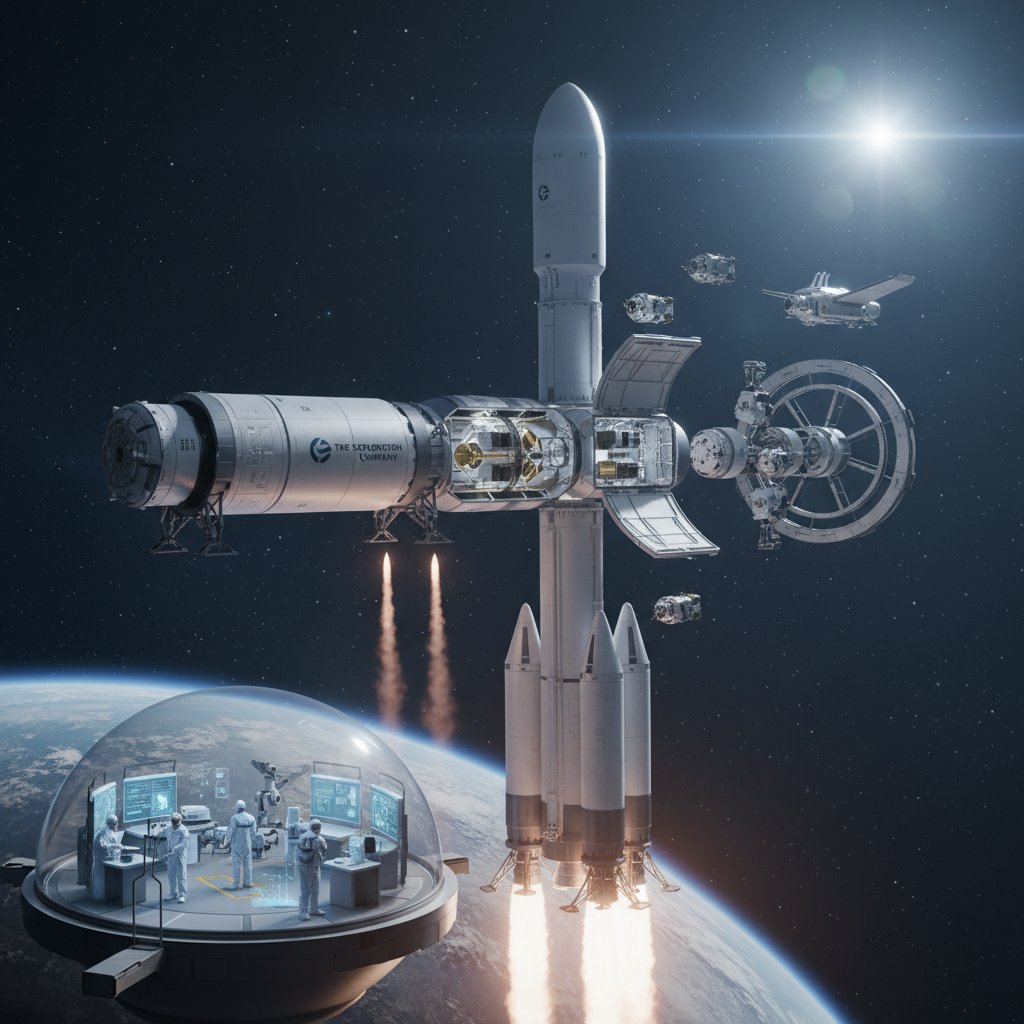
The company’s design uses a ‘strap-on’ booster configuration, where the first stage is powered by nine methane-burning engines, and the second stage is integrated into the rocket’s core. This modularity allows for rapid manufacturing and scalability. “We’re learning from the automotive industry,” explains Dr. Markus Landgraf, an aerospace engineer at the European Space Agency (ESA), who is not affiliated with the project. “By standardizing components, they can produce them faster and cheaper. The Exploration Company is applying that logic to rocketry.”
According to the company’s timeline, the first test flights of the Nyx rocket are slated for 2025, with commercial operations beginning as early as 2027. That’s an aggressive schedule, but the team has already completed successful static fire tests of their engine, the Mistral, which produces 1,000 kilonewtons of thrust. “We’ve validated the combustion chamber and turbopump designs,” says Huby. “Now it’s about scaling up.”
Why Europe Needs Its Own Heavy Lifter
Europe has long relied on the Ariane 6 rocket, developed by Arianespace, for heavy-lift capabilities. But Ariane 6 is expendable—each launch costs around €100 million—and its first flight has been delayed multiple times. Meanwhile, the global launch market is shifting toward reusability, with SpaceX launching over 100 times in 2023 alone.
The Exploration Company aims to fill a gap. “Europe is at a crossroads,” says Dr. Elena Petrova, a space policy analyst at the University of Leiden. “Without a competitive reusable rocket, European satellites and astronauts will depend on American or Chinese launchers. That’s a strategic vulnerability.” The company’s rocket could also support ESA’s future missions, including the Moonlight navigation constellation and cargo deliveries to the Lunar Gateway.
But it’s not just about geopolitics. The company’s focus on methane fuel aligns with global efforts to reduce carbon emissions. Methane combustion produces water and carbon dioxide, but if the fuel is sourced from atmospheric CO2 (via carbon capture), the process can be carbon-neutral. “This is a game-changer for the industry’s environmental image,” says Dr. Landgraf. “Spaceflight has a dirty reputation, but innovations like this can clean it up.”
The Technical Challenge: Precision Landing
Reusability hinges on the ability to land a rocket booster with pinpoint accuracy—a feat that requires cutting-edge guidance systems and robust hardware. The Exploration Company’s approach uses a ‘grid-fin’ system, similar to SpaceX, but with an enhanced algorithm that compensates for wind and fuel slosh in real time.
“The hardest part is the landing burn,” explains Huby. “You have to kill all vertical and horizontal velocity just as the rocket touches down. It’s like balancing a pencil on your finger, but the pencil is 50 meters tall and weighs 100 tons.” The company has simulated thousands of landing scenarios using digital twins—virtual replicas of the rocket—to train their AI controllers.
One unique feature: the rocket’s second stage is also designed to be reusable. After deploying its payload, it will re-enter the atmosphere and perform a controlled descent, deploying parachutes and airbags for a soft landing on land or sea. This could reduce costs further, as both stages are recovered and refurbished.
“If they pull this off, they’ll be the first to achieve full reusability on a heavy-lift vehicle,” says Dr. Petrova. “That would put them ahead of everyone except SpaceX.”
What’s Next: From Test Flights to Orbit
The Exploration Company has already signed preliminary agreements with several satellite operators, including European telecom providers and Earth observation startups. They’re also in talks with the European Space Agency for potential government contracts. “Our goal is to launch from Kourou in French Guiana, but we’re also exploring mobile sea platforms,” says Huby.
The company plans to raise a Series B funding round later this year, aiming for €200 million to complete development. With the global launch market projected to grow to $45 billion by 2030, the timing is ripe. “Space is no longer just for governments,” says Dr. Landgraf. “It’s for entrepreneurs, scientists, and eventually, ordinary people. The Exploration Company is helping to build the bridge.”
As the first test flights approach, one thing is clear: the era of cheap, sustainable spaceflight is no longer a sci-fi fantasy. It’s being built in a Parisian workshop, one engine test at a time. And if Nyx takes flight, the stars might just be closer than we think.